
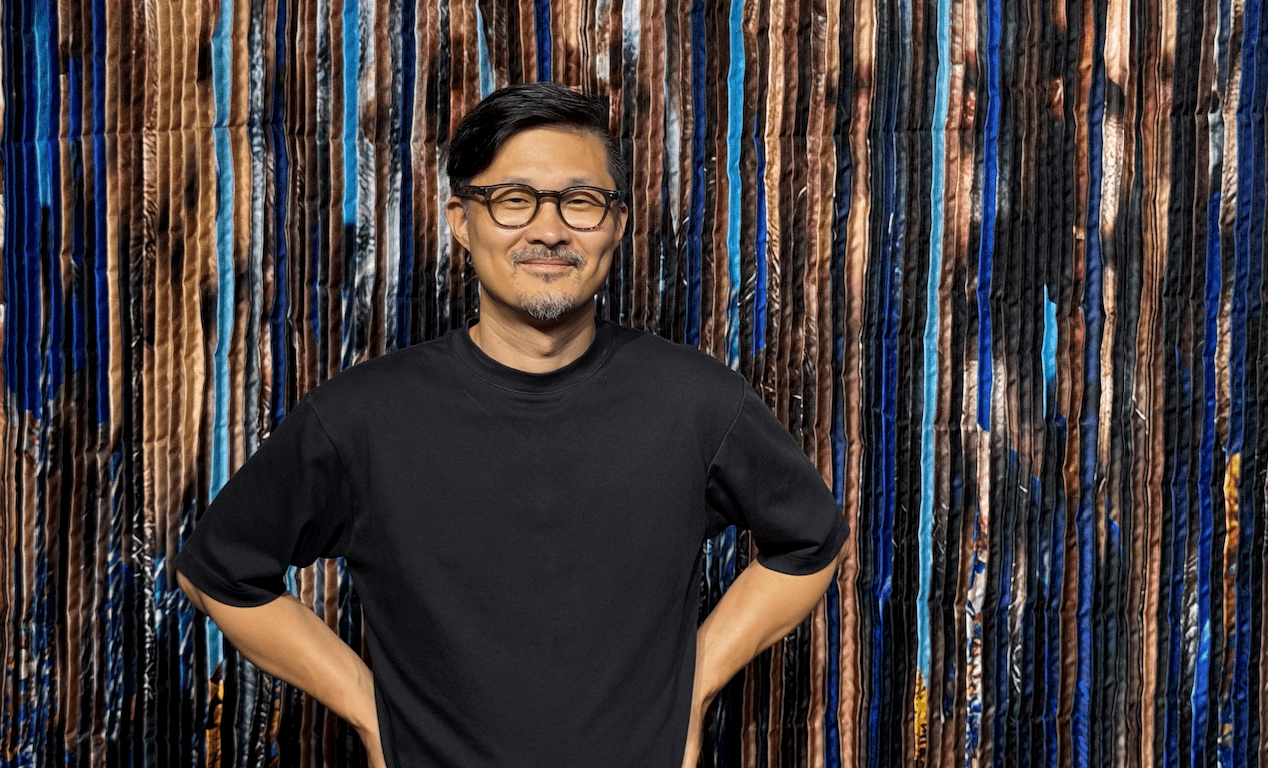
By the time you step back far enough, the faces begin to disappear. Up close, there are hints—an eye caught in a fold, a sliver of hair, the curve of a mouth reduced to colour and rhythm. But as Korean contemporary artist Jeon Byeong Sam calmly points out during a walkthrough of his exhibition, recognition is never the point. Distance changes everything. Meaning shifts. Order emerges, then dissolves again.
“This is the world we are facing,” he says, gesturing toward a vast composition of layered portraits. “Everything is more blended now. More abstract. We’re constantly switching between realities, physical, digital, emotional, and identity doesn’t stay fixed in one place anymore.”

Jeon is not interested in offering answers. He is interested in conditions; conditions for thought, for doubt, for reflection. At Singapore Art Week 2026, his dual exhibitions, InterFace at Capitol Singapore and Rumination at CHIJMES, unfold as a quiet but forceful meditation on identity, coexistence, and what remains when familiar structures begin to fall apart.
Together, they mark not just a major presentation of Korean contemporary art on the global stage, but a pivotal moment in Jeon’s own journey, one that points decisively toward Southeast Asia, with Singapore as a potential new base.

Jeon Byeong Sam does not romanticise the life of an artist. “I’m working full time,” he says matter-of-factly. “I don’t make one work at a time. I create entire projects, and then I move on.”
In his studio in Korea, Jeon produces over 1,000 unique artworks a year, a staggering number that almost sounds implausible. But for him, volume is not excess; it is necessity. Ideas, he explains, arrive simultaneously. They develop together, tested, clarified, and executed as complete systems rather than isolated pieces.
“When a project becomes clear enough, and the timing feels right, I make all the works at once,” he says. “After that, everything goes into storage. Then I start the next project. I don’t like to linger emotionally. I like to stay focused conceptually.”

He is unapologetic about this intensity. Jeon has said no to distractions, opportunities, and even exhibitions if they interfere with the one thing he considers essential: making work. “My job is just making good artworks in my studio,” he admits. “That’s my mission. Exhibitions are outcomes, not the goal.”
It is a philosophy rooted not in spectacle, but in discipline. He describes himself as someone who fixates on goals, and does whatever is necessary to reach them.

At first glance, Jeon’s works appear intuitive, even organic. In reality, they are the result of extreme precision. For InterFace, he collected 30 portraits representing global diversity—people of different ages, genders, professions, and cultural backgrounds. Ten of them are Singaporeans, included deliberately as a reflection of place. Some portraits come from friends he has met through exhibitions around the world. Others, when real-world connections were impossible, were generated using AI tools to complete the conceptual balance.
“The word InterFace works on many levels,” Jeon explains. “It’s about the face itself, of course. But it’s also about the interface—how we meet the world, how we interact with systems, screens, other people. A face is often the first interface we encounter.”

From there, the process becomes almost obsessive. Jeon prints tens of thousands of copies of these images, on paper and fabric then hand-folds, slices, stacks, and reassembles them. Every decision is tested first through software he developed more than a decade ago, analysing image data, colour density, and structural variation.
“To make one piece, I usually simulate more than 2,000 times,” he explains. “Then I choose one pattern. There is no random between the thinking and the result. The randomness you feel as a viewer is actually very controlled.”

In a single work within the exhibition, however, Jeon introduces chaos deliberately—throwing prepared images into the air and assembling them in the order they land.
“I wanted to test what happens when control breaks down,” he says. “Even then, when you step back, you start to see patterns again. Similarities appear. That’s something I find very human. My practice is more like scientific research. One concept, many possibilities.”

Held at Capitol Singapore, JEON BYEONG SAM: InterFace is an inward-looking exhibition. The building’s intimacy shaped the work itself, pushing Jeon toward questions of individual presence and identity. “Capitol feels close, almost private,” he says. “It made sense to think about the human condition there, how identity is constructed, perceived, and slowly abstracted through repetition and proximity.”
In these works, facial features dissolve into texture and rhythm. Identity becomes unstable—no longer something fixed, but something shaped by context, time, and repetition. “When faces lose their clear individuality,” Jeon says, “something paradoxical happens. Viewers often become more aware of themselves. Without a recognisable image to hold onto, they’re forced to slow down.”

Jeon is deliberately “unkind,” as he puts it, erecting a barrier between viewer and image. “If people don’t recognise the original faces, they only see about fifty percent of the exhibition,” he says. “But that’s the starting point of engagement, not the end. I want people to stay longer. To sit with the discomfort. To wonder why they feel blocked.”
It is a direct response to a world saturated with images—scrolling, swiping, consuming in milliseconds. “I hide the image not to obscure meaning,” he explains, “but to restore it. Slowness creates space. And in that space, thought can mature.”

One of the most quietly powerful works in InterFace is also its most personal. Printed on fabric and hand-sewn—a technique Jeon began exploring only recently—the piece is made from a photograph of his mother. He grew up surrounded by materials. His father worked in construction, his mother in the fibre industry. After the Korean War, they built a life through labour.
“Fabric is not symbolic for me,” he says. “It’s familiar. It’s part of my body memory.” The photograph was taken four years ago. His mother is smiling, wearing bright lipstick and a scarf. Folded and stitched into abstraction, her image becomes both intimate and universal, memory rendered as structure.

If InterFace examines the individual, Rumination expands outward—to systems far larger than any one person. Installed across the historic façade of CHIJMES, JEON BYEONG SAM: Rumination is a large-scale projection mapping work composed from all 193 national flags registered with the United Nations. Each flag appears briefly before dissolving into abstract movement—woven into vertical and horizontal lines of light, ordered alphabetically from Afghanistan to Zimbabwe.
“The title Rumination is intentional,” Jeon notes. “It’s about thinking slowly, repeatedly. Letting something turn over in your mind. Flags are powerful symbols. They’re tied to national pride, conflict, belonging. When those symbols dissolve into colour and movement, they momentarily lose their authority.”

What remains is rhythm, motion, and light—national identity stripped of ideology and presented as pure visual language. The work invites uncertainty, even disorientation, before settling into quiet contemplation. It feels strangely appropriate to witness this work while the bars beside showcase live football matches, the respective fans cheering for their own team.
“What is a nation?” he asks. “Who are we, and where are we within all this? I hope audiences feel a moment of uncertainty first, Then reflection. Not a clear message, but a question.”

Throughout his career, Jeon has returned to the same core idea: the finite. Life, faces, nations, ideologies, things with beginnings and endings. Through repetition and layering, he transforms them into experiences that suggest infinity.
“My work is a process of inducing infinite thought through finite matter,” he says. “That tension is where everything begins.” Digital tools and AI have only deepened this inquiry. For Jeon, AI is not a collaborator or a threat, but a material, one that reflects human intention, bias, and limitation.
“Even AI has boundaries,” he notes. “Data, algorithms, cultural assumptions. Infinity is never truly infinite. It’s always shaped by structure.”

This belief is grounded in his unusual background. Jeon holds a B.F.A. in Sculpture, an M.F.A. from the School of the Art Institute of Chicago, and an M.S. in Computer Science from UC Irvine. Sculpture taught him resistance and space. Computer science introduced logic, iteration, and abstraction. Art gave him permission to let them coexist.
“Contemporary art shouldn’t offer fixed answers,” he says. “It should create conditions for thought.”

Jeon’s decision to present these works in Singapore is deliberate. “This is my first proper solo presentation here,” he says. “And the face felt like the simplest, most universal subject to begin with.”
Singapore’s layered identities, its careful balance between systems and individuality, make it an ideal site for his questions. More than that, the city represents possibility, a place where Jeon sees space to build, experiment, and expand his large-scale practice across Southeast Asia.

As viewers drift through InterFace, or pause beneath the lights of Rumination, they may not immediately recognise what they are seeing. That is intentional. Jeon Byeong Sam is not asking to be understood all at once. He is asking something more demanding: to stay longer, to sit with uncertainty, and to consider what remains when the structures we rely on, faces, flags, identities begin to dissolve.
And in that space, somewhere between data and devotion, order and labour, he continues building infinity, one fold at a time.
JEON BYEONG SAM: Interface runs from 22nd January 2026 to 22nd February 2026 at Capitol Singapore, 13 Stamford Road #01-19/20 (near Outdoor Plaza) Singapore 178905. JEON BYEONG SAM: Rumination continues to be projected onto the CHIJMES facade over this final weekend, til 8th February 2026.
 Bakchormeeboy