
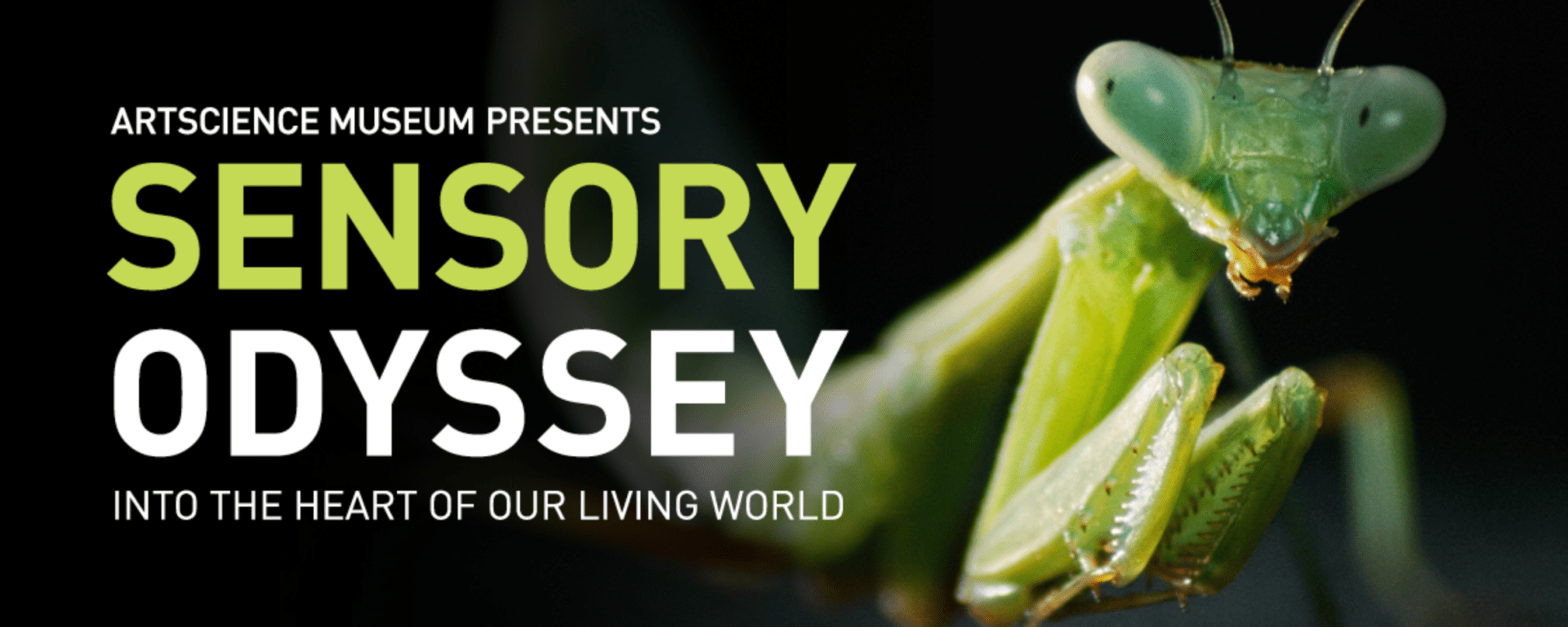
Nature takes centre stage at a new exhibition making its Asian premiere at ArtScience Museum on 27th May. Under the cover of darkness where the scent of dry earth and moisture permeates the air, the growl of a lion, the grunts of a baboon and the rustling of grass break the silence, welcoming explorers to the African Savannah. A multi-sensory expedition through this habitat and six other ecosystems awaits visitors at Sensory Odyssey: Into the Heart of Our Living World.
Starting in Africa, visitors will be part of an expedition that takes them from the rainforest canopy of South America and the wide expanse of the Indian Ocean, to the raw magnificence of the Arctic Circle. Through state-of-the-art technology, this exhibition gives visitors the rare opportunity to intimately explore some of the natural world’s most extraordinary environments alongside the living creatures and organisms that inhabit them.

Each habitat features stunning original footage of nature shot on location around the world by natural history filmmakers. These captivating scenes are presented in a series of immersive environments featuring hyper-realistic 8K resolution projection, spatial audio, and unique scents that will engage and magnify visitors’ senses.
The exhibition concludes with a gallery titled Discover: Our Nature Our Stories, where visitors can learn about the flora and fauna they have encountered as well as meet seven experts and advocates from Singapore who are spearheading conservation efforts in our own region. It culminates in having visitors participate in creating a collective installation of a mangrove tree – one of Asia’s most important tree species. As each visitor contributes to the growth of the mangrove tree in the gallery, ArtScience Museum, through its partnership with WWF-Singapore (World Wide Fund for Nature Singapore) will support planting of mangrove trees in Sarawak, Malaysia.
“We strive to create a memorable experience for everyone that enhances our awareness and lifts our spirits, to care more about the world we all share,” said Gwenaël Allan, Creator, co-founder and CEO of Sensory Odyssey Studio.

Sitting at the intersection of exhibition, performing arts, cinema, technological innovation, as well as cognitive and natural sciences, Sensory Odyssey was developed by a cross-disciplinary team of 350 artists, designers, biologists, engineers, developers, neuroscientists, scent-makers, and media specialists. It was produced by Sensory Odyssey Studio in collaboration with the National Museum of Natural History in Paris and is now presented in Singapore by ArtScience Museum in partnership with BASE Entertainment Asia.
At the heart of the exhibition lies original footage shot especially for the exhibition of some of the world’s most dramatic landscapes – ranging from scenes of animals in Africa and the rainforests in South America, to exquisite insects in the French countryside, and dramatic scenes of glaciers and whales in Greenland. These scenes of nature are accompanied by a 360-degree ambient soundscape including works by Oscar-winning composer Nicolas Becker, and custom scents created by IFF.
A dynamic adventure across seven natural environments at Sensory Odyssey will renew visitors’ sense of wonder and empathy for this beautiful yet fragile planet.

I: Savannah Nights
Visitors begin their journey in the African Savannah, where the scent of moisture and dry earth fills the air. Animals including buffaloes, zebras, lions, mongooses and baboons gather around a watering hole to quench their thirst. Visitors are surrounded by the animals’ calls and movements until they catch the smell of something burning – a bushfire appears nearby that causes the animals to flee.

II: Tropical Rainforest
Visitors will be whisked away to French Guiana in South America to discover the Earth’s oldest living ecosystem – the rainforest. In the midst of the fragrant blooming flowers and scent of damp wood, they will take in panoramic views from the top of the forest canopy 30 metres above ground, before making a slow descent to the forest floor. A diversity of wildlife can be encountered along the way, including centipedes, snakes, a spider, and a sloth hanging from a branch.

III: On the trail of bats
Among the nocturnal inhabitants of the temperate forest is the serotine bat. While they are hunting for food, visitors can take to the skies with them and witness the phenomenon of echolocation which manifests through soundwaves that bats use to see in the dark. Visitors will be able to hear, as well as see, how the bats’ high-pitched clicks bounce off distant objects to reveal the topography of their surroundings, aiding in their navigation and hunting.

IV: Underground
Visitors will be taken on a journey underground, into the soil of the earth, where almost 25 per cent of all known species of animal and plant reside. Projections of a subterranean landscape reveal tunnels in the soil that are home to a wide variety of living organisms – from tiny bacteria and small animals such as ants, soil mites, earthworms, and springtails, to larger mammals like hedgehogs and moles. Underground connections between plant roots and fungi mycelium will be revealed, highlighting the vital symbiotic relationship that sustains this ecosystem. The gallery presents the rustling and scraping sounds of activity in the soil, and surrounds visitors with the scent of fresh earth and the aroma of mushrooms.

V: Prairie and Insects
In a sunny meadow accompanied by a pleasant spring breeze, visitors will come face to face with a dazzling array of insects filmed up close in stunning resolution. A honeybee pollinates flowers, insects feed on nectar, butterflies and damselflies flutter around, grasshoppers climb on beautifully filmed leaves, a praying mantis nibbles on its prey, and a colony of ants trail up the stems of plants. Here, nature’s autonomous sensory meridian response transports visitors into the mesmerising world of these tiny creatures.

VI: Into the Deep Blue Sea
The glistening blue ocean offers visitors an encounter with a pod of majestic sperm whales navigating the Indian Ocean near Mauritius. As the whales swim gracefully onward, one can listen in on how they find each other through sound. Pulsating clicks increase in intensity as the whales regroup, signifying their emotional reunion. Meanwhile, a maritime scent lingers in the air as the bubbling sound of the sea echoes through the space.

VII: To the End of the World
Finally, visitors will arrive at the far north of Greenland, where they fly above, navigate across, and plunge underwater amongst breathtaking polar landscapes. Here, visitors will encounter glaciers, fjords, tundra plains, hills, and underwater environments. Despite its seemingly inhabitable conditions, a rich biodiversity of animals appear, including the Arctic fox, Arctic stern, black-legged Kittiwake, seal and humpback whales. Visitors will also witness the effects of climate change and watch as iceberg shards cleave away and plunge into the Arctic waters with loud cracks that pierce through the howling cold wind.

The final gallery of Sensory Odyssey curated by ArtScience Museum explains the ecosystems that visitors have encountered throughout the exhibition. The space also contains seven commissioned videos that spotlight local experts and advocates who share enriching stories about Singapore’s biodiversity, conservation efforts and research. Kartini Omar, Group Director of Parks Development and Jurong Lake Gardens from NParks introduces the vibrant grasslands habitats in Singapore in connection to the first ecosystem in the exhibition; tropical rainforest ecologist Dr Shawn Kaihekulani Yamauchi Lum deepens visitors’ understanding of the second ecosystem in the exhibition by explaining the incredible range of biodiversity that can be found in Singapore’s largest remaining primary rainforest.
Naturalist and nature guide Dr Leong Tzi Ming highlights how bats are important members in our native ecosystem in Singapore; self-taught mycologist Ng Sze Kiat also takes visitors further into the underground world of the fourth ecosystem by illuminating the many ways that fungi could help heal our planet and create a more sustainable future; urban beekeeper John Chong delves deeper into the ideas presented in the fifth ecosystem by pointing out why bees are essential in keeping humans and the planet healthy; marine biologist Dr Neo Mei Lin takes visitors into the seas of the sixth ecosystem, revealing the beauty and ecological significance of the endangered giant clams in Singapore’s waters; and ocean engineer Dr Hari Vishnu unveils a surprising side of the glacial landscapes presented in the final ecosystem, introducing his innovative research on the acoustics of melting glaciers. He explains how his work can help more accurately predict sea level rise which is accelerated by climate change.

Visitors are then invited to contribute to the exhibition by writing their thoughts on paper leaves that can be attached to a large mangrove tree in the gallery. Over the duration of the exhibition, this mangrove tree will gain more and more leaves until the tree is finally in full bloom. While visitors contribute leaves to the tree over time, ArtScience Museum will also be working with WWF-Singapore on planting real mangrove trees in the Rajang-Belawai-Paloh Delta in Sarawak, Malaysia – an important habitat for the endangered Irrawaddy Dolphin.
Mangroves play a critical role in both climate change mitigation and adaptation because of their ability to capture and store carbon, while providing protection against the negative effects of sea level rise such as floods and tidal surges. Mangroves provide coastal defense and buffer against strong waves and storm surges, and act as a habitat for reptiles, birds, mammals and countless fish species. While mangrove forests provide a wide variety of ecosystem services, they are among the most severely threatened and undervalued ecosystems on Earth. The actions of visitors to Sensory Odyssey will lend support to the planting of thousands of new mangrove trees in Southeast Asia, thus preserving nature in the region.

Following its successful eight-month run in Paris at the National Museum of Natural History, this iteration of Sensory Odyssey features new sections created for the Asian premiere in Singapore. Visitors will be able to connect their journey through the seven habitats by walking through new interlinked tunnels that feature specially designed sound and light installations inspired by the elements of water, air, fire, and earth.
The opening time and space tunnel will prepare visitors for an expedition through the different dimensions of our living world, where they will be greeted by a hypnotising soundscape designed to rewild the senses. Moving between the African Savannah and the Tropical Rainforest ecosystems, visitors can find refuge and take a deep breath in a cloudy passage where they will encounter the sounds of plants growing rapidly as if in a time lapse. Travelling down the Tropical Rainforest into the Underground, visitors begin their descent beneath the earth as they tread their way through a myriad of ‘bioluminescent’ filaments that mimic electrochemical currents with the gentle accompaniment of an unfamiliar, unidentifiable soundscape.
Retreating from the damp darkness of Underground, visitors will find their way to the Prairie and Insects ecosystem via the Light Tunnel, experiencing the sensation of crawling back to the surface to take a new breath. As the horizon opens up before them, they can rejoice with the sights and sounds of a flowering prairie from the perspective of insects. A trickling sound attracts visitors to the Water Passage, where they are invited to imagine themselves as a water droplet undergoing several states of transformation, from solidifying into an arctic icepack, or dissipating into and becoming one with the immensity of the ocean, as they transition to the final section of the exhibition. After the sensorial journey through the wonders of our natural world, visitors will slowly move along a dreamlike space back towards the ‘real world’ and into the Discover: Our Nature Our Stories gallery.

A comprehensive slate of education activities will accompany the exhibition, including workshops, talks, a film season entitled Wandering Wild, guided walks with local biodiversity experts and conservation advocates, drop-in activities, and a symposium on 27 Mayth. The opening symposium will consider approaches for environmental stewardship and conservation in a rapidly changing world, as well as explore new ways to imagine sustainable futures. The symposium will feature presentations by the Sensory Odyssey Studio, as well as the local experts featured in the exhibition.
The symposium will also highlight the work of young sustainability leaders in Singapore. To drive impact and inspire positive change, Marina Bay Sands has collaborated with Conservation International on the 10 for Zero Awards which spotlights ten of the brightest environmental youth leaders in Singapore who are advocating for a future of zero waste and net zero carbon emissions. The Award Ceremony for 10 for Zero will be held at the opening symposium, inciting audiences to meet these inspiring young leaders. The event is free with registration on a first-come-first-served basis. Additionally, the launch of Sensory Odyssey is a precursor to ArtScience Museum’s forthcoming season of biodiversity and sustainable futures – a two-month-long series between August and September that features exhibitions, public programmes and educational activities exploring issues related to biodiversity, conservation, environmentalism, and sustainability.

“ArtScience Museum cares about nature and preserving the planet’s biodiversity, and this is at the core of our new exhibition, Sensory Odyssey: Into the Heart of Our Living World. Designed to awaken our senses to the wonders of nature, this show immerses us in the sights, sounds and scents of the natural world. After embarking on an extraordinary journey through some of the world’s most inspiring environments, visitors will be invited to consider how they can preserve our natural environments by contributing their own stories and thoughts about the world around us. This reflective exercise, done on leaf-shaped notes that will be incorporated into a display of a mangrove tree in the exhibition’s final gallery, provides visitors with a tangible way of demonstrating their support for the Museum’s intention to plant new mangrove trees in Sarawak, Malaysia, as part of its commitment to sustaining biodiversity in the region,” said Honor Harger, Vice President of ArtScience Museum and Attractions at Marina Bay Sands.
Photo Credit: Marina Bay Sands
Sensory Odyssey: Into the Heart of Our Living World runs from 27th May to 29th October 2023 at the ArtScience Museum. Tickets and more information available here
 Bakchormeeboy
One thought on “Museum Musings: Sensory Odyssey – Into the Heart of Our Living World at the ArtScience Museum”