
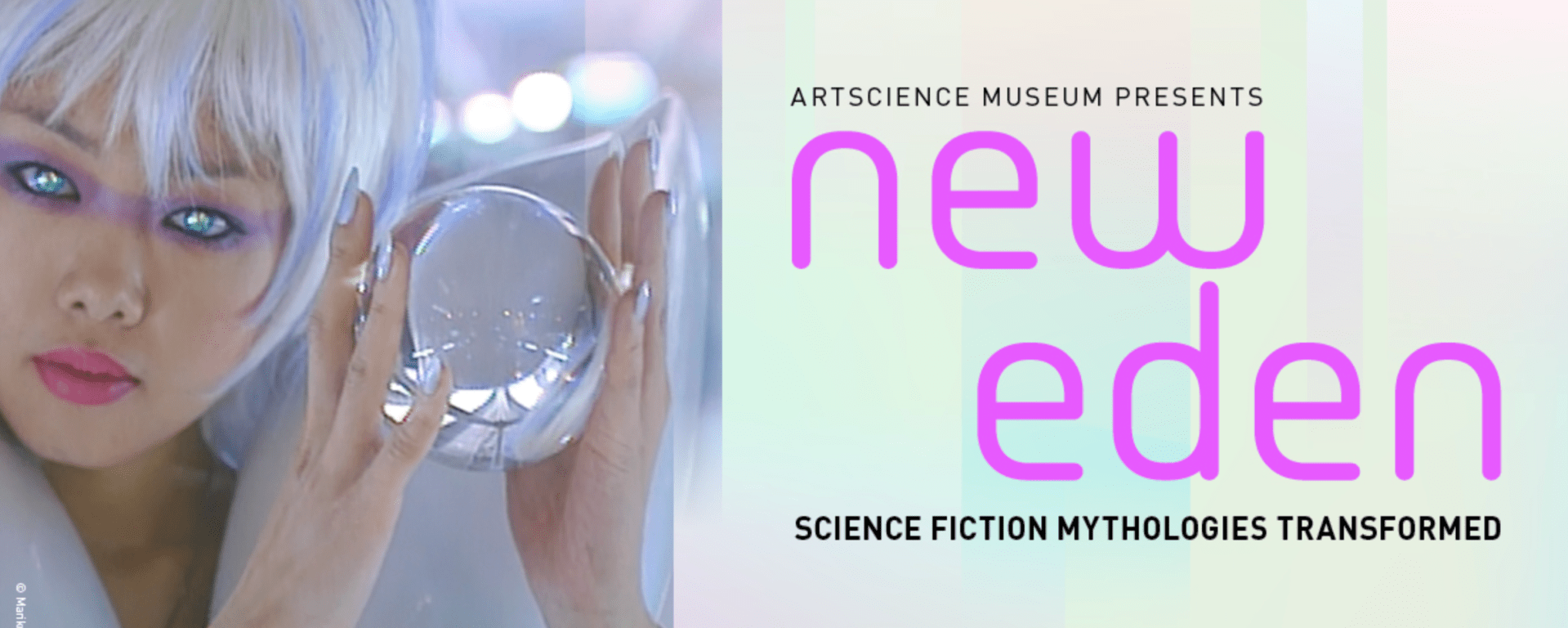
A journey to alternative realms awaits visitors at ArtScience Museum’s latest major contemporary art exhibition, New Eden: Science Fiction Mythologies Transformed. Making its global premiere on 21 October, the exhibition will uncover new perspectives on the genre of science fiction by presenting 24 women artists and collectives from Asia, whose works have been inspired by the region’s history and cultures.
Curated by ArtScience Museum, New Eden weaves together narratives found in the Western literary and cinematic genre of science fiction, with ideas rooted in Eastern spiritual traditions that have evolved over millennia. It finds synchrony between speculative ideas in science fiction and concepts embedded in Asian spiritual frameworks such as Buddhism, Hinduism, Taoism and Shintoism, alongside other diverse belief systems of Southeast Asia.

The exhibition also confronts the historically Western and male-dominated genre of science fiction, foregrounding the diverse voices of women including Cao Fei, Patty Chang, Lee Bul, Mariko Mori, Moon and Jeon, Sputniko! and The House of Natural Fiber. Featuring close to 70 contemporary artworks, historical artefacts, and film extracts, New Eden sheds light on the connections between science fiction imagination and Asian philosophy and mythology. With popular science fiction concepts such as parallel universes, interdimensional travel, and transcendence deeply rooted in Asian philosophy, New Eden draws lines between these cultural traditions, suggesting that some science fiction tropes could have their origins in Asia.
Curated by Gail Chin, Joel Chin, Adrian George and Honor Harger from ArtScience Museum, New Eden: Science Fiction Mythologies Transformed unfolds across eight chapters. In the first, Paradox of Paradise, the opening chapter of the exhibition examines the depiction of utopia in science fiction. The pursuit of paradise can be traced back to ancient religious texts, which allude to its location as either a remote place on earth, a heavenly realm, or even on another planet. One such example of a mystical utopia is the fabled land of Shangri La, the subject of the artworks in this gallery. American-born Chinese artist Patty Chang dissects ‘Shangri-La’, a mythical Eastern paradise first described in James Hilton’s 1933 novel, Lost Horizon.

In an effort to promote tourism, Zhongdian, a rural town in China was renamed Shangri-La in 2001. Chang decided to visit Shangri-La, making a real journey to an imaginary place. Her video, Shangri-La, shot on location, documents her experience. Her trip echoed the narrative of Hilton’s novel, beginning with a descent into an idyllic mountain setting and meeting monks secluded in the mountains. Yet as Shangri-La progresses, Chang collapses the space between fiction and reality, bringing her lens to the real-world issues that Zhongdian faces. Mountain (Shangri-La) is a dazzling, mirrored, three-dimensional artwork that can be rotated slowly like a prayer wheel to reflect light and emit ‘energy’ into the surrounding space. The works reflect on the entangled links between tourism economies, fantasies of utopia, and notions of exoticism.

Popular science fiction concepts such as parallel universes and interdimensional travel are ideas that are also found at the heart of Asian philosophy and spirituality. In Chapter II: Words and Worlds, this gallery draws connections between Asia and the West, examining both the emergence of science fiction as a genre throughout the 19th and 20th century, as well as the spiritual traditions of Buddhism, Taoism, Jainism and Southeast Asian folklore. Humanity has always imagined gateways to distant and unexplored realms, and embarked on mystical journeys that extend the boundaries of knowledge. In the West, these ideas manifested in science fiction, explored in the gallery through a timeline that begins in the present and journeys back in time to the 19th century, focusing on selected literature and films. Eastern traditions are presented through a collection of artefacts on loan from Asian Civilisations Museum that explore concepts such as transcendence, portals to heavenly worlds, and parallel dimensions.

The idea of parallel worlds is one of the most well-explored concepts in both science fiction and Asian belief. In science fiction, a parallel world is situated alongside our own world and intertwined in some way. Exploring these parallel worlds often illustrates how the different realms are connected in intricate ways and how a choice in one reality can affect the other. In many Asian beliefs, the concept of parallel worlds extends beyond fiction. In the Buddhist and Jain traditions, all phenomena arise due to karma and reincarnation, with actions in one realm possibly having repercussions in another. One of the artefacts that illustrates parallel universes is The universe in the form of a human being, a cultural object dating back to the 18th century. This cosmological painting from the Jain religion depicts the universe in human form. The body is divided into three, referencing the three worlds where souls reside. Jains believe that souls move between the three worlds through the cycle of rebirth, which only ends when a perfect spiritual state has been reached.

Within Words and Worlds, Mumbai-based artist Shilpa Gupta presents Untitled (Heat Book). The work challenges our perception of books as simple carriers of knowledge. What looks like an everyday book is heated from below, becoming dangerously hot to touch. This piece acts as a metaphor, exposing the potential hazards that can lie hidden in seemingly benign objects. It gestures towards the inflammatory impact of sacred texts in differing cultural contexts. The artwork bridges Eastern spiritual narratives and Western systems of knowledge, illustrating how these different traditions can co-exist, sometimes uneasily, in a single object.
Science fiction films and novels have been central to shaping our understanding about how nature may evolve. From the post-apocalyptic visions of ecological catastrophe, to more utopian views of a world where people and nature co-exist in harmony, the fate of the natural world is often a major theme in science fiction. The two galleries in New Nature explore nature’s potential to transform and thrive against the odds. It features films and artworks that imagine new eco-systems, novel relationships between humans and other living beings, and how life might be sustained in the future. Some of the artistic propositions and cinematic extracts speculate on hopeful, more resilient ecological futures, whilst others act as stark warnings about our planet’s possible trajectory, calling for ecological mindfulness, and asking us all to reconsider our relationship with the planet.

In the first gallery, Hindu spirituality blends with science fiction to explore the origins of life. Commissioned by ArtScience Museum, Galactica V.2 Dharma Garden is a mixed media installation by The House of Natural Fiber – a multi-disciplinary collective of artists, environmentalists, scientists, and designers based in Indonesia who explore the interaction between life, art, science, and technology to address critical social issues. Unveiled for the first time in Singapore, this artwork imagines the Hindu goddess Lakshmi – widely associated with fertility, prosperity and even agriculture – as an otherworldly being descending in a spacecraft in the form of a dharmic wheel. Accompanying her are capsule-like terrariums filled with moss and other organic materials which represent systems supporting biological activity, capable of regenerating nature and triggering terra-formation – the hypothetical process of modifying the environment of a planetary body to make it habitable like Earth. The eight screens of the spacecraft also extend out from the central capsule to provide a graphical display of the system in operation.

In the second gallery, artists such as Soe Yu Nwe and Chok Si Xuan probe metamorphosis and hybridity. latent by Singaporean artist Chok Si Xuan, blurs the line between organic and inorganic, suggesting a possible future in which nature has been replaced by technology. In this installation, mechanical flowers and tubular vines are suspended mid-air. Parts of the 3D-printed mechanical flowers – connected to air pumps – expand and contract, mimicking the act of breathing.

In Chapter IV: Ways of Folding Space, the artwork in this section of the exhibition reveals the interconnection between Asian Taoist philosophy and the aesthetics of Western science fiction. Teleportation and levitation are themes commonly explored in science fiction which can be traced back to the ancient beliefs of Taoist alchemy, an Asian body-spirit tradition. Korean artists Moon Kyungwon and Jeon Joonho, draw on these concepts in their installation The Ways of Folding Space and Flying.

The title of the work references two Korean words, chukjibeop and bihaengsul, which originate from ancient Taoist practices. Chukjibeop loosely translates as “to fold space as a method of travelling vast distances” and bihaengsul means “to fly across time and space”. These ideas have been studied by Taoist practitioners for hundreds of years, as methods of freeing mind and body from physical limitations and natural forces. Folding space and flying through time are also major themes in Western science fiction, appearing in numerous novels and films. First presented at the Korean Pavilion at the Venice Biennale in 2015, Moon and Jeon’s video installation is set in a distant future in which much of the world has been covered in water, with the artists questioning the future of art and creativity in human civilisation.

In Chapter V: Crafting New Worlds, drawing on Asian cultural heritage and traditional craft, this gallery weaves together narratives from Asian spiritual traditions, mythology, and science fiction to express a hope for a more inclusive future. The two artists presented reflect on their cultural traditions in spirit and in form, reinforcing their sense of belonging in an increasingly diverse world.

Critically acclaimed New York-based artist Saya Woolfalk uses elements from science fiction, mythology, anthropology, and Eastern spirituality to envision a utopian world founded on empathy. In Cloudscape, she introduces the ‘Empathics’, a futuristic race of women with the ability to time travel and share genetic material with plants. Woolfalk draws inspiration from her multi-racial heritage and blends it with speculative fiction to create a rich story-world around the Empathics. In doing so, Woolfalk advocates for a pluralistic world that honours cultural diversity.

Chapter VI: The Monstrous Feminine recalls how early science fiction films blended elements of horror with science, tapping into humanity’s collective fear of the unknown. In these films, women were almost always depicted as victims. Influential film studies scholar, Barbara Creed, coined the term, “the Monstrous Feminine” to critique this portrayal of women in genre film, challenging the patriarchal and one-dimensional representation of women. Conversely, in popular Asian myth and folklore, the monstrous was often represented by female figures. Powerful women, or those who had been marginalized, were often shown as characters that transformed into fearsome creatures who went on to exact revenge.
This section of the exhibition inverts these narratives, positioning outlandish feminine characters as vigorous and empowered figures. The artists on show aim to inspire a shift in perspective, paving the way for more authentic portrayals of women, allowing them to reclaim their stories and create new symbols of strength that can resonate across time and cultures.

Club Ate employs science fiction to refashion traditional Filipino myths into what they call Future Folklore. Their Ex Nilalang series reinterprets Filipino diasporic identities through a blend of myth and speculative fiction. The term ‘Nilalang’ encapsulates dual meanings, both ‘to create’ and ‘creature’. Club Ate uses the word to emphasise that they are both transforming existing mythologies and imagining a form of Filipino futurism. Ex Nilalang: Balud centres on the “manananggal” a mythical creature from the Philippines often depicted as a nocturnal vampirelike entity with the ability to sever its upper torso and fly using bat-like wings. It is said to prey on pregnant women. In traditional folklore, the manananggal serves as a cautionary tale, but Club Ate reimagines her as an avant-garde science fiction figure, replete with sparkling skin and shot through with a sensuous poignancy. She sings local waray song, a ‘Balud’, mourning the loss of part of her body to convey both sorrow and resistance.

Meanwhile, in Japanese folklore, the Namahage is an ogre-like demon which threatens villagers. In Northeast Japan, men dress up as this demon as part of their year-end rituals, going around frightening lazy and ill-behaved children to instill a sense of awareness and communal responsibility in the young. Media artist Etsuko Ichihara, tells a fresh story of how the Namahage might exist in Japan’s modern capital city through Namahage in Tokyo. Instead of being an ogre, the Namahage is now a futuristic being that brings about peace by enforcing surveillance over the city, visiting misbehaving adults on social media and punishing them by hacking their minds.

In Chapter VII: New Myths, the gallery explores traditional stories that explain the beliefs or customs of a culture. Science fiction often borrows from myth, creating connections between ancient stories and futuristic ideas. The artists in this gallery breathe new life into myths using science and technology.

Featured in this section of the exhibition is a dramatic installation by Sputniko! based on the myth of the “Red thread of fate”, an East Asian belief originating from Chinese mythology, which imagines invisible red threads that wrap around the fingers of those who are destined for each other. Sputniko! manifested this myth in physical form, with the red threads of her installation made by silkworms which have been genetically mutated to produce silk containing oxytocin, a love hormone. The handwoven silk is presented in the form of an installation that emulates a Japanese Shinto shrine. A pair of special lenses can also be used to see the silk glow with embroidered patterns and colours that symbolise the Night-Blooming Cereus – a flower that opens briefly under moonlight. The accompanying science fiction videos invite us to imagine a future where humans could soon be creating living things which previously only existed in myth.

Also on show is a screening room presenting Re-fabricated Realities – a compilation of films by artists from Asia whose works blend Asian mythology with science fiction. Curated by Gridthiya Gaweewong, some of the experimental films, video art, and animated works on show depict alternate worlds and futuristic landscapes, while others draw on mythology and memory to critique the present.

In film, and in literature, it is clear that Asia is now shaping science fiction on its own terms. However, Western science fiction has historically marginalized or misrepresented Asian culture, resorting to stereotypes and appropriation. In Chapter VIII: In A New Light, the artists in the final section of the exhibition invite critical reflection on the impact of such outdated cultural cliches, proposing alternative more authentic representations of Asian voices. Mariko Mori’s iconic video artwork draws on Eastern mysticism and Western science fiction to create an entirely new aesthetic all her own. Astria Suparak’s work explicitly critiques the representation of Asian culture in science fiction film, while Cao Fei devises cinematic science fiction worlds of her own. The young girls in Liu Xiao Fang inhabit uncanny landscapes blurring the line between dream and reality, while Lee Bul presents a striking visual of an exploded and splayed female cyborg body that manifests her fascination for the space where fantasy meets biotechnological evolution. Together, these works show how artists in Asia are reclaiming agency, encouraging us to consider what a more inclusive future might look like.

Miko No Inori – translated from the Japanese language as ‘Priestess’ Prayer’ – is a seminal work by internationally acclaimed multidisciplinary artist Mariko Mori that merges Eastern spirituality and science fiction into an entirely new aesthetic. In this work, Mori adopts the persona of an ethereal priestess residing in Kansai International Airport – highly regarded at one time for its futuristic architecture. Performing a ritual that beckons the viewer to travel between worlds, she sings the lyrics “words are melting and becoming one”. Through this depiction, Mori becomes a conduit between our earthly existence and spiritual cosmos, seamlessly fusing elements of contemporary technology and ancient transcendental practices.

Seoul-based artist Lee Bul has gained international recognition for her unconventional performances and sculptural installations. Having had a long-standing interest in the motifs and social critiques of science fiction, her work navigates the utopian and dystopian possibilities that emerge from a culture increasingly infused with technology. In her work Untitled, she draws influence from the idealised female form in ancient classical Western art as well as early Japanese manga, subverting the notion of the perfect body and regarding cyborgs as symbols of human imperfection. Central to this installation is a female body comprised of multiple parts, seemingly both organic and technological. Exploding outwards, fragments of familiar yet arguably grotesque forms, taken from the natural world, suggest that all belong to one entity.
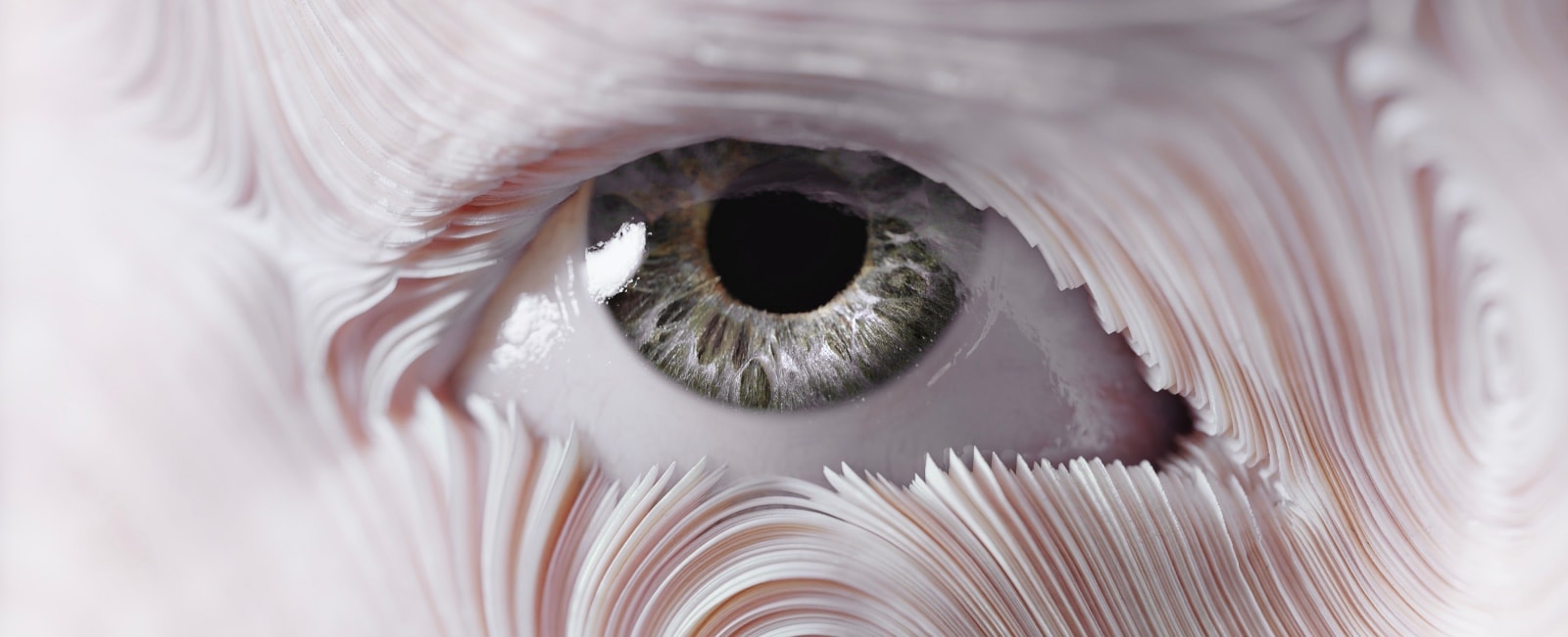
New Eden launches a season of exhibitions and programmes at ArtScience Museum which explores science fiction, inviting visitors to dive deeper into the genre and ideas explored within the exhibition. The season includes Radical Imaginations, a symposium on 21 October, that marks the opening of New Eden. The symposium explores speculative futures and new worlds informed by Asian mythologies and science fiction. It includes presentations from artists and curators who have contributed to the exhibition including Sputniko!, Irene Agrivina from House of Natural Fiber, Debbie Ding, Si Xuan Chok, Soe Yu Nwe and Darryl Lim from Asian Civilisations Museum.
Alongside New Eden, ArtScience Museum will also be screening the artwork, The Flavor Genome by renowned Korean artist Anicka Yi. The 3D film (rated M18) explores hybridity and the porous boundaries between species. It is just one of several science fiction films being presented at ArtScience Museum over the next few months. Anchoring the science fiction season is a major film programme, curated by Jerome Chee and Rachel Wong entitled In Search of Tomorrow. It celebrates visions of the future with science fiction films that depict fantasies of what life could be like on Earth or elsewhere. Featuring spaceships, androids, floating cities and red dusty planets, the film season takes an expansive dive into the kaleidoscopic tapestry of science fiction on screen.
It ranges from innovative science fiction films from Asia like Krabi, 2562 (2019) by Anocha Suwichakornpong and Ben Rivers, Manta Ray (2018) by Phuttiphong Aroonpheng, Tetsuo: The Iron Man (1989) by Shinya Tsukamoto, Memoria (2021) by Apichatpong Weerasethakul, and Unidentified (2022) by Jude Chun, to classics of the genre such as Solaris (1972) and Stalker (1979) by Andrei Tarkovsky, Interstellar (2014) by Christopher Nolan and 2001: A Space Odyssey (1968) by Stanley Kubrick, on top of of everyone’s favourite cartoon android, Astro Boy (1980).
New cutting-edge titles will also be screened, including Piaffe (2022) by Ann Oren and Creature (2022) by Asif Kapadia, which is having its Singapore premiere. Meanwhile, visitors can also let their creativity bloom by sculpting their own clay bouquet in a pottery masterclass led by featured artist Soe Yu Nwe on 22 October, or become a modern mythmaker in a creative writing session with local author Natalie Wang on 18 November.

“New Eden launches a season at ArtScience Museum that explores science fiction. While it has become a topic of fascination within the artworld in recent years, rarely is science fiction approached from the perspective of Asia and through the work of women. New Eden changes this narrative. It is a major new interdisciplinary exhibition that delves into the intersectionality of science fiction and Asian spiritual philosophies through the creative praxis of Asian women artists and collectives. It moves between ancient mythology, contemporary art, and post-modern cinema, celebrating the dream worlds, future visions, and fantastical realities of Asian artists, showing that women and alternative voices are calling for a more inclusive future,” said Honor Harger, Vice President of ArtScience Museum at Marina Bay Sands.
New Eden: Science Fiction Mythologies Transformed runs from 21st October 2023 at the ArtScience Museum. Tickets and more information available here
 Bakchormeeboy