
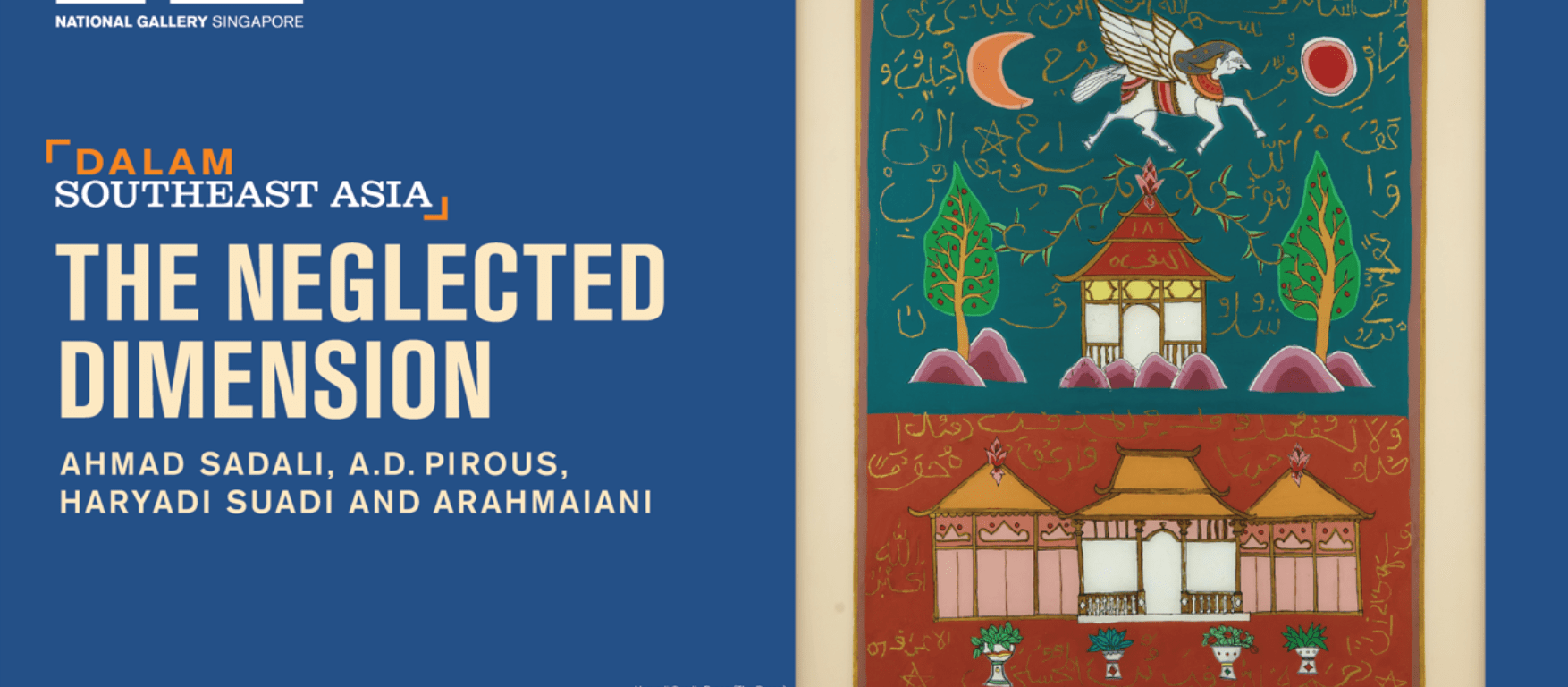
National Gallery Singapore unveils the third edition of DALAM SOUTHEAST ASIA: The Neglected Dimension which opens from 7th July 2023 till 25th February 2024. The exhibition explores the incredible artistic experimentations that occurred in Indonesia with Arabic calligraphy, showcasing its significant role in the development of modern and contemporary art in the region.
The title of the exhibition, The Neglected Dimension, is borrowed from a 1987 essay by the Indonesian art critic, Sanento Yuliman, which offers a tribute to the life and work of Ahmad Sadali, one of the artists featured in the exhibition. In his essay, Sanento rearticulated Sadali’s idea to reconsider the position of spirituality in the development and practice of modern painting in Indonesia.

While exhibitions of modern calligraphy have taken place since the 1970s in Indonesia, Malaysia and Singapore, The Neglected Dimension offers a deep dive into new ways of engaging with calligraphy by focusing on the Faculty of Art and Design, Institut Teknologi 2 Bandung (FSRD ITB), an art school in Indonesia that stood at the forefront of experimentations with forms of Islamic spirituality and abstraction. This move occurred as its artists engaged with the language of modern art through their formal training at ITB as painters and printmakers, their extensive travels to Western Europe and North America, and their careful studies of the rich material traditions of Southeast Asia. In this way, Bandung, with its new approach to modern art played a pivotal role in realising what this exhibition terms “calligraphic abstraction.”
Four artists are featured in the exhibition: Ahmad Sadali (1924–1987), A.D. Pirous (b. 1932), Haryadi Suadi (1938–2016), and Arahmaiani (b. 1962). They represent three generations of artistic training at ITB and distinct approaches to calligraphy that reflect changing values, identities, and conventions in Indonesia from the 1970s to the present. Together, their works highlight how they interacted with global conventions in modern art, evolving ideas around Islamic spirituality, feminist activism, and the experiences of being Muslim in Indonesia. Visitors can look forward to a range of artistic expressions, from abstract paintings to explorations with prints, glass paintings, installation, and performance art.

Some of the works on display include Ahmad Sadali’s Lukisan. Translated simply as “Painting” in English, Lukisan is Ahmad Sadali’s early experimentation with calligraphy and modernist abstraction. Lukisan puts forward an abstract field of colours in dominant yellow and light ochre counterpoised with an expressive stroke of a blue orb on the right corner of the bottom left corner. Diagonally facing the blue orb, Sadali thinly incised Arabic writing. While one can make out the letters, it is somewhat difficult to read as it shows no clear diacritics, with some letters appearing more simplified. There is a crude quality to Sadali’s writing – they are less refined, more hidden, and dissolved in the expressiveness of Sadali’s brushwork and the heavy layers of textures and irregular shapes that form the painting’s horizon. Sadali’s calligraphy prompts one to move closer and look at the painting more intimately to contemplate more profoundly.

Tulisan Merah (Red Writing) shows the intense play of textured calligraphic writing with smooth and even strokes of bold red paint. Clusters of calligraphic writings float unevenly on the top part of the composition, accentuated by the smooth layer of purple that peeks from the top right corner. Tulisan Merah represents the early period when A.D. Pirous primarily experimented with the expressive and formal qualities of Arabic calligraphy. Unlike his works from 1975 onwards that showcase the primacy of legible Qur’anic calligraphy, the inscriptions on Tulisan Merah are illegible and only perform an approximate similitude to Arabic script.

Haryadi Suadi’s Buroq shows a localized rendition of the widely circulated image of the Buraq. The Buraq is a hybrid winged semi-mythical creature with a beautiful human head known to have transported the Prophet Muhammad in his miraculous night journey known across the Muslim world as Isra and Mi’raj. Painted in white with the facial feature derived from a Javanese wayang (shadow puppet) form, the Buraq floats between the sun and the moon over two Cirebonese 7 architectural structures on the middle and bottom part of the composition. Buroq’s glass surface is further adorned with gold calligraphic inscriptions that defy orders and clear directions for reading. They are indeed illegible. Suadi’s illegible calligraphy points to the notions of secrecy in the production and circulation of Islamic talismanic objects in the Indo-Malay Archipelago and the wider Muslim world.

Crossing Point is a video documentation and installation of Arahmaiani’s performance at the Singapore Art Museum in 2011. The work was one of many iterations of Arahmaiani’s ongoing collaborative and community-based Proyek Bendera (Flag Project) that started in Yogyakarta in 2006. The installation includes fourteen colorful flags inscribed with different words from varied origins written in Jawi script – a permutation of Arabic script used to write local languages in many parts of Muslim Southeast Asia. The words on the flags suggest notions of the impermanence of the physical world and bear the importance of the sense of belonging, love, and local knowledge and wisdom. They are a visual and creative manifestation of the artist’s collaborative work with different communities across the globe, including in Singapore.

(right) A.D. Pirous. Subuh / Doa VIII (Dawn / Prayer VIII). 1980. Silkscreen print on paper. Collection of National Gallery Singapore. Image credit: Joseph Nair, Memphis West Pictures.
Dr Eugene Tan, Director of National Gallery Singapore, says, “The intention of Dalam Southeast Asia has been to explore understudied aspects of Southeast Asian art through cutting-edge exhibition making. Although considerable work has been done on Islamic aesthetics in West Asia, North Africa, and South Asia, debates on modern art rarely featured the rich and diverse developments in Southeast Asia. Through this exhibition, we invite visitors to discover the untold stories and vibrant innovations that have flourished in our region. The Neglected Dimension is a testament to the Gallery’s commitment to fostering inclusive and diverse artistic dialogues, while continuously pushing the boundaries of art experience.”
The Neglected Dimension runs from 7th July 2023 to 25th February 2024 at National Gallery Singapore. More information available here
 Bakchormeeboy