
Lessons drawn from reflections on the past and those who came before in the local theatre scene.
How much value is there in looking back on the past? For that matter, how many young artists and theatre practitioners today know about those that came before them and their history, when performance is such an ephemeral, fleeting art form?
Answering those questions, to an extent, is Centre 42, committed to the creation, documentation and promotion of text-based works for the Singapore stage. Their long-running The Vault series of works has been dedicated to safe-keeping local works that date as far back as the 1960s. But in no way is this a static archive, as they produce contemporary responses from practicing artists as they withdraw them from the vault, providing a necessary space to critically reflect on them.

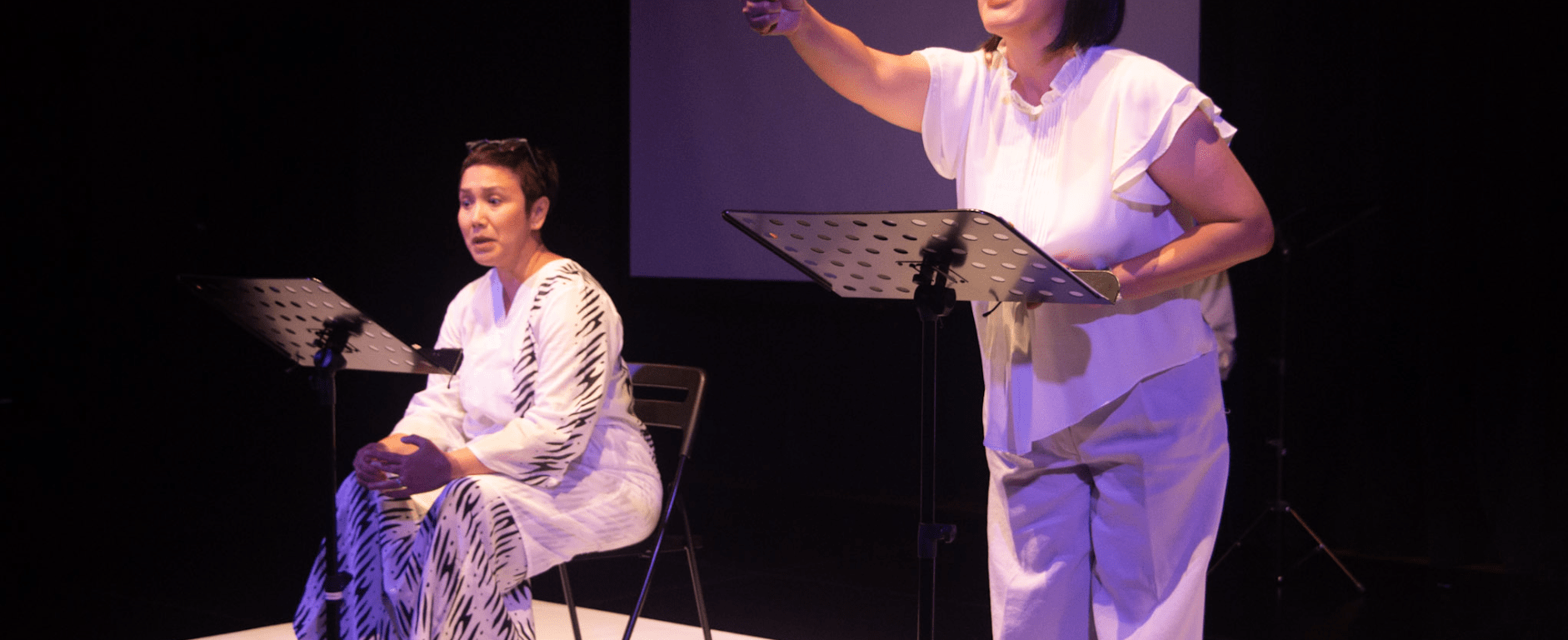
Perhaps the very essence of such a programme is encapsulated in their work The Vault: Past Perfect, which returns for a second run after its initial staging in May during the 2023 edition of the Singapore International Festival of Arts. Co-conceptualised by Dr Robin Loon and Casey Lim, the work gathers actors Nelson Chia, Serene Chen and Oniatta Effendi, to think back to their days as a young practitioner back in the 90s, as they re-present select extracts and offer up personal reflection on their experiences and what it meant to be an artist in those days.
Past Perfect initially begins by situating our minds back to a simpler time in the 90s, with several extracts from Haresh Sharma’s 1997 play Galileo [I feel the earth move]. These take the form of tongue-in-cheek news reports that comment on local and global politics, going from the realistic to the surreal. While this does make for a somewhat odd beginning, it drives home the wilderness of the 90s and how pre-empts the rest of the show that reminisces over how daring the scene was at the time, willing to play with form, explore OB markers with taboo topics, and experiment with training and production methods.

If anything, the 90s were a time that were integral to establishing the scene proper, terra incognita for a young nation figuring out where they stood in the arts, and what the arts could do to express identity and deal with the most pressing of issues, and what artmaking meant as a whole. To do that, the three actors preface the next segment with a dramatised reading from Ovidia Yu’s Three Fat Virgins Unassembled, centering on a woman who settles for a teaching career while doing theatre on the side, facing what feels like abuse when faced with tyrant directors with impossible demands.
This segues into Nelson’s segment, where he recalls his earliest encounters with the late Kuo Pao Kun, Singapore’s doyen of theatre. In his eyes, Kuo seems to be able to do no wrong, and became a beacon of inspiration for the young Nelson. Every interaction seems to be laced with wonder, and one particularly significant memory sees the two of them in a taxi ride home, where Nelson expressed his fear that he will no longer be able to sustain being an artist. Kuo acknowledges the struggle, and sagely replied that he too faces the same dilemma every morning, but chose to pursue art rather than the other option – to walk away. Later on, Nelson also mentions William Teo, and how rigorous his rehearsal sessions were that actors immediately knew when they were no longer aligned with the production, and left of their own will.

To create art then, is an act of bravery, a choice one makes daily, and it feels appropriate that Nelson ends off his segment with an excerpt from Kuo’s play Lao Jiu, where Nelson reprises his role as the titular prodigious son who has to make a decision between pursuing puppetry or a brighter, more stable future in his studies. As Nelson speaks his lines, production photos of his performance displayed on the screen, we see tears well up in his eyes, each word hitting him like a sledgehammer, while Serene and Oniatta smile from their seats behind, acknowledging the heart and hard work that goes into artmaking.
The group then performs an excerpt from Michael Chiang’s Private Parts, where Warren and Mirabella meet at the hospital and exchange a conversation about love, construction and gender. This leads us into Serene’s segment, where she recalls her unusual foray into theatre, going from choir girl at MGS to loving her time doing hall productions at NUS. Taking a chance on an audition notice in the Straits Times, she lands a role in Dick Lee’s Kampong Amber, where she met and befriended some of theatre’s brightest stars, including the late Emma Yong. Serene still holds those memories close to her, singing the iconic ‘Bunga Sayang’ while playing the ukulele, and considers the possibility that this is something she can do and turn into a career after all.

From mainstream English musicals, Serene’s path diverts rather suddenly, and she finds herself applying instead for an experimental, unwritten Mandarin theatre production – what would become Quah Sy Ren’s Invisibility, about fetishism amongst strangers, and marginalisation of individuals in society. She recalls her unusual audition process, literally having to translate traditional Chinese to simplified Chinese with a thick dictionary (impressing director Kok Heng Leun), and the arduous devising process, with figures like Ang Gey Pin pushing the cast to extremes. While tough, Serene ends up triumphant with a sense of pride from praise in a review, and perhaps encapsulates the strangely simple joys one can derive from the arts, no matter how tough it gets.

After exploring Mandarin and English theatre, musical and experimental theatre, in its final segment, we move on to Oniatta Effendi, who covers her experiences with Malay and intercultural theatre. Oniatta is a warm presence, and out of the three, perhaps feels the most forthcoming and energetic as she talks about the various controversial productions she worked on, starting with Teater Kami’s Anak Melayu. With Malay newspapers criticising the play for its negative portrayals of Malay youth, Oniatta’s own mother even warned her that the ISD would be out looking for her, casting fear into her heart each time she stepped out of the house.
More than that, Oniatta also recounts the intercultural experiences working on Geylang People In The Net, where as a young tudung-clad student she went around the red light district for research, or during Sunset Rise where she would frequently encounter language barriers she learnt to overcome or accept, alongside long conversations at S11 outside the Substation, alongside encounters with Kuo Pao Kun and Gene Sha Rudyn. All this speaks of the fertile ground the 90s possessed for artistic development in spite of the fear and crackdowns, and the bravery of artists back then to do what they did.
Oniatta also provides a satisfactory resolution to her entire story, where she speaks of the power of theatre. Upon performing monologue Peti Kayu Ibuku (My Mother’s Wooden Chest), she found her own mother, who usually responds to her performances with nonchalance, in tears, clearly affected by the relationship depicted in the play. From song to acting, experiments in research to conversation, Oniatta seems to have done it all in her youth.

Past Perfect is certainly an emotional work, mourning a time gone by and paying respect to the pioneers that set the scene in the first place. And while it does seem to champion nostalgia first, Past Perfect‘s mostly rose-tinted lens is a precious piece of oral and performance history from the mouths of those who experienced theatre in the 90s firsthand. But in its final moments, all three actors gather again to perform an extract from Kuo Pao Kun’s Descendants of the Eunuch Admiral, speaking of struggles through a storm echoing the Sang Nila Utama myth where the only way to move forward is to toss their treasures into the ocean, and their subsequent arrival at a land that suggests people governing themselves (Negara Raja-Raja), a clear symbol of how it is perhaps time to move on.
Archives cannot be left in the vault, and to that end, Centre 42 has used this production to enliven these memories of the past, a badge of honour for how far Singapore theatre has come and what we’ve lost, and most of all, opened up the conversation for things we should hold on to, and what needs to be left behind in this new world.
Photos Courtesy of Centre 42
The Vault: Past Perfect ran from 25th to 29th October 2023. More information available here
Production Credits:
| Concept, Dramaturg and Writer: Robin Loon Concept and Director: Casey Lim Performers and Collaborators: Nelson Chia, Serene Chen, Oniatta Effendi |
 Bakchormeeboy