
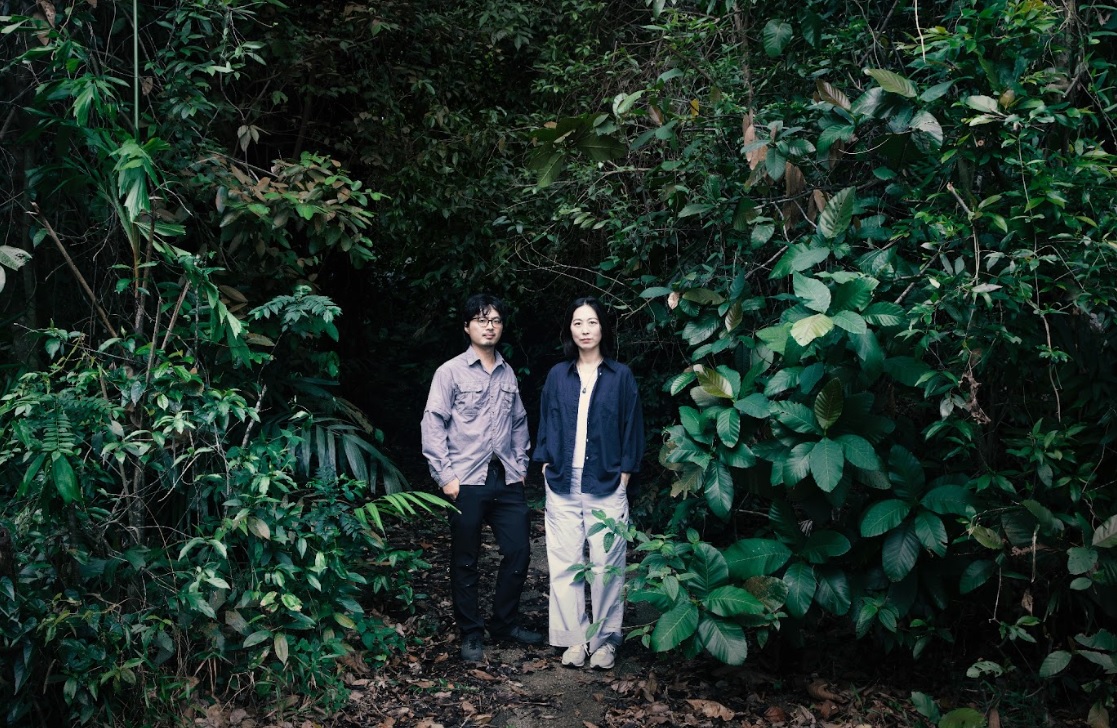

An unassuming patch of greenery reveals the life and stories it holds – but only with patient observation. In Seeing Forest, Singaporean artist Robert Zhao offers an evocative exploration of secondary forests – forests regrown from deforested land due to human intervention such as development and plantation. Often taken over by invasive plant and animal species introduced to Singapore in the 19th century, these thresholds between primary forest and developed areas offer insights into a complex web of human and non-human co-existence.
Rooted in several years of accumulated observations from countless fieldtrips and the windows of his own apartment, Zhao’s research and documentations are condensed and organised into an installation that explores the multifaceted life of Singapore’s secondary forests and the manifold worlds within, encapsulating the landscape’s histories of settlement, colonisation, migration and mutual co-existence amongst species. Going beyond the humdrum existence of a forest, visitors will be invited to examine the ways in which human urban design can shape the natural world, and result in a new ecosystem of migrant species that echoes the trajectories and makeup of a city’s human population.

In secondary forests, we can find the traces of humanity in debris and litter, the abandoned tents of migrant workers, the ruins of kampungs1 and colonial barracks, cast aside dustbins. Yet there is life, too. A canopy of fast-growing, non-native Albizia trees weaves a lacey web against the sky. Samba deer, escaped from the local zoo in the 1970s, form large roaming populations. Japanese sparrowhawks, flying in from Siberia, pause to drink from a concrete drain.
Through an assemblage of video works and sculptural installations, the exhibition created for the Singapore Pavilion explores the lesser-known stories of intersection, and moments of apparent dependence between human society and nature. The presentation reveals how these transitional spaces offer points of intersection for colonisation, migration, sustainability, and discovery, while suggesting that the edge of a city — especially one that is so carefully planned— may be the most intense frontier in existence.

Artist Robert Zhao Renhui says: “Secondary forests are a second chance for nature to find a way to reclaim its place after environmental and human disruptions. They provide a radically hospitable space for a variety of living subjects, where novel organisms are able to thrive despite and because of human activity – an abandoned dustbin, for example, turns into a waterhole for migrant birds. These spaces are also rich in histories and ecologies, and this interest has driven the exploration of these multilayered ecosystems in my practice over the last seven years. I hope that my presentation captures the richness and variety of the sensuous surroundings, and allows us to experience these spaces as active, animate, and open-ended.”
The Pavilion’s curator, Haeju Kim explains: “Robert Zhao’s projects have served as lenses that highlight the resilience of nature and the various interactions that occur when such resilience overlaps with human life and society. In the meanings generated by these observations, we are offered a rare glimpse into the true complexities and realities of the natural world around us. The exhibition will be a reminder that even in the most modernised places, humans cannot wrest initiative and tenacity from nature, and we are only part of the broader ecosystem and intricate web of the world. Through the sensorial experience that the exhibition will offer, I hope that audiences can listen attentively to what nature says to us.”

Complementing Stranieri Ovunque – Foreigners Everywhere, the theme for Biennale Arte 2024, Zhao’s presentation offers a tribute to the undomesticated and free forests found along the margins of our urban lives. As the world enters the era of the Anthropocene and humanity is forced to face the impact of climate change, Seeing Forest sounds a call for audiences to pay attention to the ecosystems around us, while offering a beacon of hope that communities – human and non-human, visible and hidden, natural and developed – can coexist in harmony.
Eugene Tan, Co-Chair of the Commissioning Panel and Director of SAM, comments, “SAM believes fervently in the power of art to inspire change. In Robert Zhao’s Seeing Forest, the artist goes beyond quiet contemplation to invite audiences to pay attention to these often-unseen encounters in our environment, offering hope in the unyielding resilience of our natural world by evoking the experiences of secondary forests in Singapore. As societies around the world try to make sense of the impact of climate change, we hope that audiences will resonate with the Pavilion and be provoked into conversations on the possibilities of mutual co-existence and more connected ways of being.”

Low Eng Teong, Co-Chair of the Commissioning Panel and Chief Executive of the National Arts Council, Singapore (NAC), says, “We are delighted to be able to showcase Robert Zhao’s work at the Biennale Arte 2024, whose practice emphasises that even the smallest observations can move us in purposeful ways. Featuring scenes from Singapore’s own secondary forests, Seeing Forest is an exploration of what it means for any city to embrace nature and our connections to the natural world. Through the perspective of Zhao’s research, the exhibition underscores the important role of art in broadening our understanding of the world around us. We invite all to experience the work and engage in meaningful conversations with one another.”
The official opening of the Singapore Pavilion will be on Wednesday, 17th April 2024 at the Arsenale’s Sale d’Armi. The exhibition will be on display on the second floor of the building from 20th April to 24th November 2024. The presentation will return to Singapore in January 2025, and will be exhibited at SAM at Tanjong Pagar Distripark for local audiences. Follow the latest updates via Facebook and Instagram (@singaporeartmuseum), or visit bit.ly/SingaporePavilion-VB2024.
 Bakchormeeboy