

Pride comes before a fall.
Among the many male-dominated industries that exist in the world, the military may be among the most skewed, with a much smaller minority of female professionals who exist within the field. In that sense, the women who do find success in the military often seem to have to shelve their femininity, to become ‘one of the boys’ to fit in and rise through the ranks.
In Singapore Theatre Company’s (STC) production of George Brant’s Grounded, Oon Shu An plays an unnamed fighter jet pilot, whose personality seems to fit exactly that. Directed by Renee Yeong, Grounded traces the pilot’s journey as she undergoes an unexpected fall from grace, where a sexual encounter leads to love, a baby, and her being literally grounded from her plane, instead jettisoned out to spend her days in a windowless trailer as a remote drone pilot.

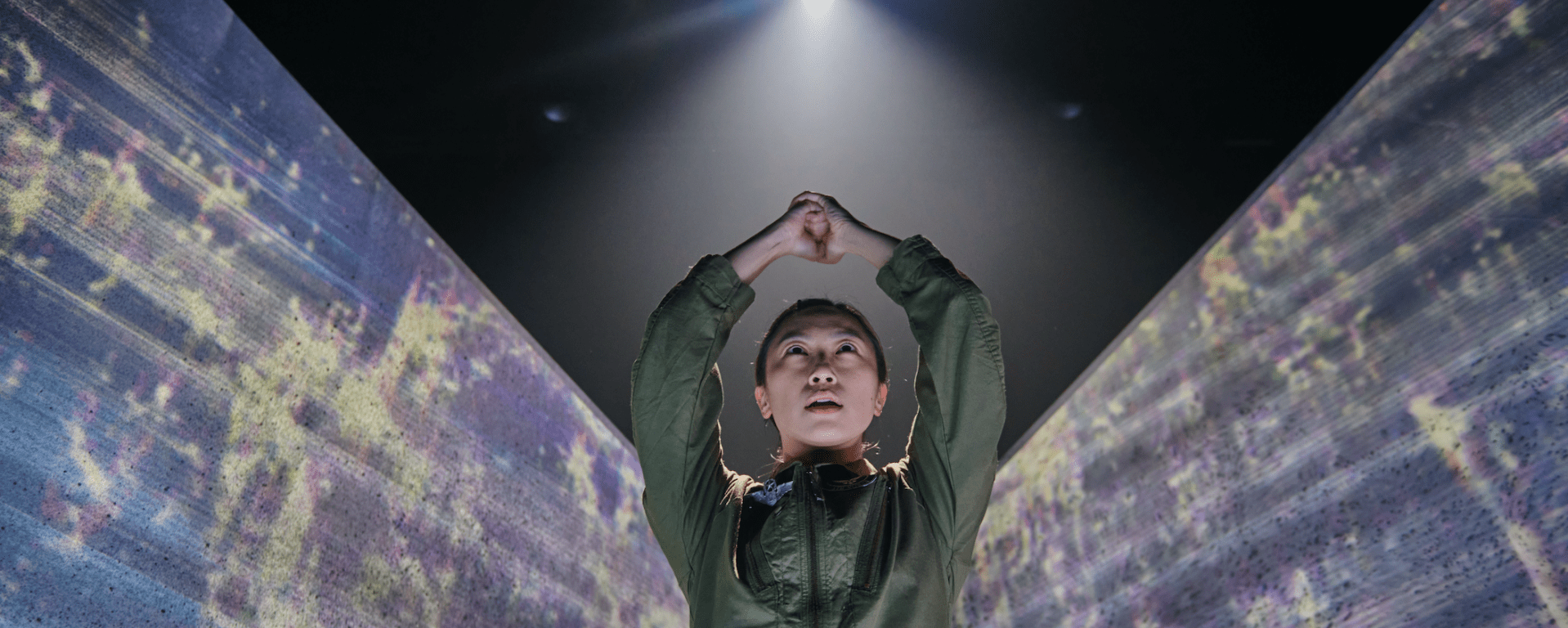
The KC Arts Centre stage is not particularly large, but Diego Pritarch’s set manages to make it feel claustrophobic, utilising large makeshift walls to cut the performance area down, mimicking the pilot’s own feeling of entrapment from being grounded and away from her comfort zone. Shu An can only navigate the space in front of the walls, or a gap between the walls, where she finds herself in a leather seat, initially representing the cockpit of her jet’s, before becoming the desk chair she finds herself in, when she joins the drone ‘Chairforce’, as she puts it.
This seat is flanked by two screens, displaying Genevieve Peck’s multimedia that gives form to the pilot’s consciousness – from the azure blue and fluffy clouds of the sky she once ruled over, to an ultrasound of a baby with beating heart when she realises she’s pregnant, to the dull grey of the drone surveillance cameras, waiting for an opportune moment to strike as she tails her mark. But these screens also feel oppressive at times; there are scenes where we see multiple images of Shu An, as if she herself is being watched by a camera, while acknowledging the existence of the screens itself reminds us that all the blue of the sky is merely artifice, a distant memory for her, as they fade to black. All of these intricate details are much appreciated as they contribute to experiencing the pilot’s inner mind in visual form.

Brant’s script is complex but focused, charting the pilot’s emotional journey throughout this difficult transition process. We see her shed her initial hard shell of aloofness, allowing herself to be charmed by this civilian she meets while on break, how her unborn child makes her feel fear, before grasping the desire to be a good mother to her, how the sparks of love bring out a softer, more emotional side to her as she says yes, and accepts her leave of absence while pregnant. There are some great metaphors and recurring motifs in colours used to make her descriptions all the more vivid, something almost darkly sexual and domineering in the way she seems to coo over her jet and its weaponry.
The initial part of the script however, drags from stretching out the pilot’s entire backstory. In performing the role, Shu An takes on a deeper drawl to her voice, alongside a pseudo-American accent. There is the sense that Shu An is always performing rather than embodying the character as she is, even uncomfortable at times. Perhaps this is meant to represent how the pilot herself feels compelled to behave more masculine to fit in with her male colleagues, but you never really feel connected to what feels more a caricature than a fully fleshed out being. Even the times when she tries to assert power, where she describes the euphoria of sex, seem more hollow than enjoyed, and especially when she shows off her more vulnerable sides, it sometimes feels like she sheds the guise of the character altogether and is simply Shu An, the actress, being herself onstage.

This becomes especially difficult towards the mid-sections of the play, which sees the pilot at her lowest moments, from accepting the hard truth of becoming grounded, feeling trapped in her new life, and experiencing vivid nightmares as she goes through the dull routine of shuttling between sending her daughter to daycare, going through the motions of piloting the drone, before returning home exhausted. This is the part of Grounded where the energy dips the most, and it takes a more seasoned performance to bring out the deterioration of her mind, verging on psychosis when she is no longer able to tell truth from hallucination – we do not feel that intensity, instead we simply feel as trapped as the pilot does, wanting desperately for some kind of forward momentum.
Amidst the ennui, there are occasional highlights – you do feel her grasping for something to hold onto, such as when she realises her relationship with her daughter is becoming strained, while each time she places a 1.5l bottle of Pepsi onstage, it is a visceral representation of her body’s physical limitations and accumulation of fatigue. Even if she constantly tries to claim herself as a ‘god’, an eye in the sky with her new role, you see the breakdown happening, where there are times she feels dwarfed by everything that is going on, her frustration each time she gets closer to her mark pushing her closer to the mental edge.

Grounded does find an updraft in its final thirty minutes however, as Brant’s script finally brings all the elements introduced together to great effect. Shu An recovers and finds her groove when she plays a mixtape from her husband, still very much in love with each other, and rocks out to the ‘decompression’ playlist he’s prepared for her. This seems to be the catalyst for her to finally nail the play’s searing climax, as the pilot finally closes in on her target, and in a turn of events, her new life and military career collide, and she awakens from a sleepwalking stupor, aware of the horrors of war and jeopardising all she’s worked for, in a pulse-racing, adrenaline-fuelled rush of a finale.
In a world where more countries are calling for a ceasefire and pull a plug on violence, Grounded‘s anti-war message rings powerful, as it invites us to be more empathetic, and imagine if our own families were the ones being ripped to shreds by missiles. It’s a story about what it means to be plucked from one’s ivory towers, to crash land like Icarus, and a story of vengeance gone astray. Grounded‘s unnamed protagonist shows us an exercise in humility, and how even perceived failures may instead be an opportunity for transformation and change for the better. It is a pity that the performance is one that does not have enough strength to uplift the play’s message to its full potential.
Photo credit: Singapore Theatre Company/ Tuckys Photography
Grounded runs from 7th to 23rd March 2024 at the KC Arts Centre. Tickets available here
Production Credits:
| Director Renee Yeong Playwright George Brant Cast Oon Shu An Production Design Diego Pritarch Lighting Design Petrina Dawn Tan Sound Design Guo Ningru Multimedia Design Genevieve Peck |
 Bakchormeeboy
2 thoughts on “★★★☆☆ Review: Grounded by Singapore Theatre Company”