
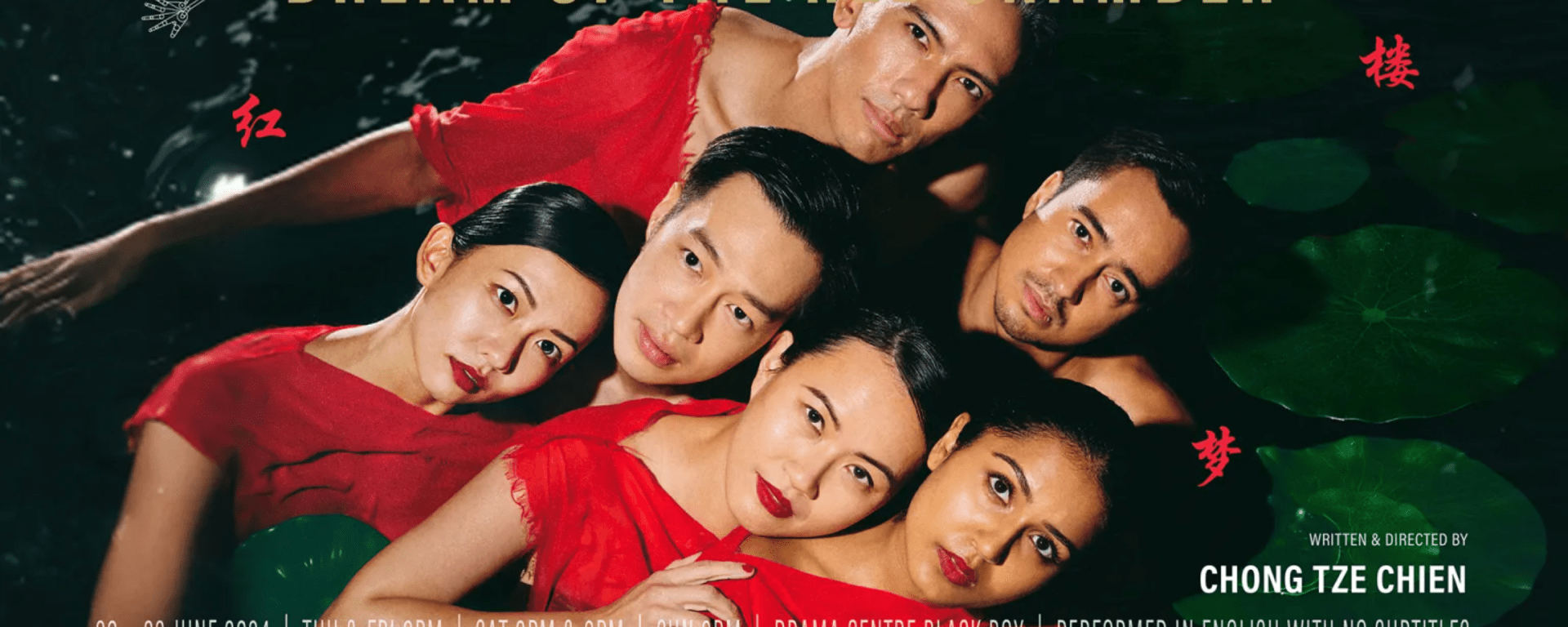
Skilful mask work turning actors into living puppets amidst pseudo-poetic translation of Chinese classic.
Cao Xueqin’s Dream of the Red Chamber has long been considered one of the greatest works of Chinese literature, as the novel passes social commentary, criticism, and philosophy over power, hierarchy and morality, as it follows the rise and fall in a family’s fortunes. Adapted countless times for stage and screen in various forms, local theatre company The Finger Players is the latest group to do so, as they bring it to a black box theatre and present it through their signature use of puppetry.
Translated and directed by Chong Tze Chien, Dream of the Red Chamber is part of The Finger Players’ The Maker’s Lab programme, an initiative that aims to nurture and grow builders and designers of puppets and objects. Led by puppet and props designer Daniel Sim, with assistants Ling Jia Le and Shawne Kho Yzelman, the production’s visuals and theatrical style make it an instant standout amidst other shows this year, and to that end, shows a degree of success in line with The Maker’s Lab’s aims.
Sometimes referred to as The Story of the Stone, Dream of the Red Chamber employs a framing narrative where a stone finds itself reincarnated as Baoyu, the son of a well-to-do aristocrat family, and comes to understand the trails and tribulations of what it means to be human, and the forces of society that shape our lives. In the performance, actors never show their real faces, instead utilising intricately crafted masks and large 2D puppets reminiscent of wayang kulit to create the impression of life-sized puppetry playing out onstage, further giving the story a sense of the mystic, like a fairytale or legend, by making these characters feel almost human.
Adapting any of the great classics of Chinese literature was always going to be a lofty task, not only due to their sheer length, but also the complexity of the language and number of characters. Director Chong Tze Chien is no stranger to adapting the classics, with the critically-acclaimed OIWA and Mahabharata under his belt, but while his vision is clear, the translation is lacking. Chong certainly attempts to capture the poeticisms and literary flair from the original Mandarin, however, the English language as a whole is a poor substitute for conveying what Mandarin can, and as a result, the dialogue often sounds forced or clunky.
Dream of the Red Chamber is also notorious for its length, and for the sake of the performance, Chong has also truncated the flow of events. Even though the story is more or less complete plot-wise, There are several sequences that feel like key interactions are missing, such as conversations that help us fully understand why Baoyu and his cousin Diaoyu are so drawn to each other, and as a result, the final presentation distinctly feels as if there are some missing scenes, or trying to cover as much ground as possible without fully realising some of the characters.
That being said, as a classic that has withstood the test of time, Dream of the Red Chamber still has the ability to stand on its own. Under The Finger Players, it is the visuals and the performances that still manage to elevate and make this a unique, standalone production that feels distinct from other work this theatre season. Chong’s set design comprises of a sea of lotus plants, their leaves peeking out, symbolic of the adversity one has to go through in life, while also serving a practical purpose of allowing the actors to duck down, re-emerging with new puppets or a different costume to quickly change character, in a single smooth motion. As mentioned, mask work is also the key to this performance, and with the use of voiceovers, the actors never speak live, instead concentrating their energy on nailing every precise movement to convey each character’s emotion. Even though the masks themselves never change, there is so much that is portrayed in every turn or nod of their head, their pose and physicality.
This cannot be achieved without strong cast chemistry, and the ensemble of Ashie Singh, Ellison Tan, Jamil Schulze, Joshua Lim, Tan Guo Lian Sutton, and Tan Wan Sze have clearly been through sufficient rehearsals to nail both the technical aspects of the performance, and get their timings and reactions just right, syncing their movements to the voiceovers. One gets an immediate sense of each character, whether the shy and sickly Diaoyu (Ashie Singh) or the more regal Baochai (Ellison Tan). As lead Baoyu, Joshua Tan does an excellent job in almost every scene, capturing the character’s strong sense of justice and his increasing sense of disillusionment the more the facade of a stable society falls apart before his eyes, culminating in a powerful explosion of frustration when he loses everything all at once.
In line with that final scene, The Finger Players’ interpretation of Dream of the Red Chamber is also decidedly darker in tone and mood, with a rising sense of tension and fear that only increases with each passing scene, as the stakes get raised and Baoyu’s family is thrust into greater danger the more they try to dig themselves out of their social and financial despair. From mysterious, cautionary songs, to a creepy snake-creature that haunts one’s nightmares, uneasiness is at the heart of this adaptation, to the extent one feels almost pessimistic about the state of the world and the capriciousness of one’s fortunes by its end.
The Finger Players’ Dream of The Red Chamber may be flawed in its adaptation, but still finds success in its commitment to what they do best – the uncanny yet engaging “puppetry” work that has taken their artistry to new heights thanks to strong work from the cast and design team. The mask work draws from director Chong’s past experience and success with OIWA, and once again proves to be the biggest draw of this production. Cautionary without being overly moralistic, and haunting in its social commentary, Dream of The Red Chamber is a beautifully presented, stark reflection of the perils of society and the fickleness of fortune.
Dream of the Red Chamber played from 20th to 23rd June 2024 at the Drama Centre Black Box. More information available here
Production Credits:
| Playwright/Director/Set Conceptualizer Chong Tze Chien Puppet/Props Designer Daniel Sim Assistant Puppet & Props Designers and Makers Ling Jia Le, Shawne Kho Yzelman Performers Ashie Singh, Ellison Tan, Jamil Schulze, Joshua Lim, Tan Guo Lian Sutton, Tan Wan Sze Lighting Design Faith Liu Yong Huay Costume Design Max Tan Mask Designer and Maker Loo An Ni Set Realisation Grace Lin Sound Design Jing Ng Production Manager Lam Dan Fong (The Backstage Affair) Production Coordinator Georgia Sim (The Backstage Affair) Technical Manager Peter Chi Stage Manager Tennie Su Assistant Stage Manager Cheow Jiong Ling (The Backstage Affair) Wardrobe Mistress Lim Zhi Ying Sound Assistant and Operator Leeyau Shi Min |
 Bakchormeeboy