
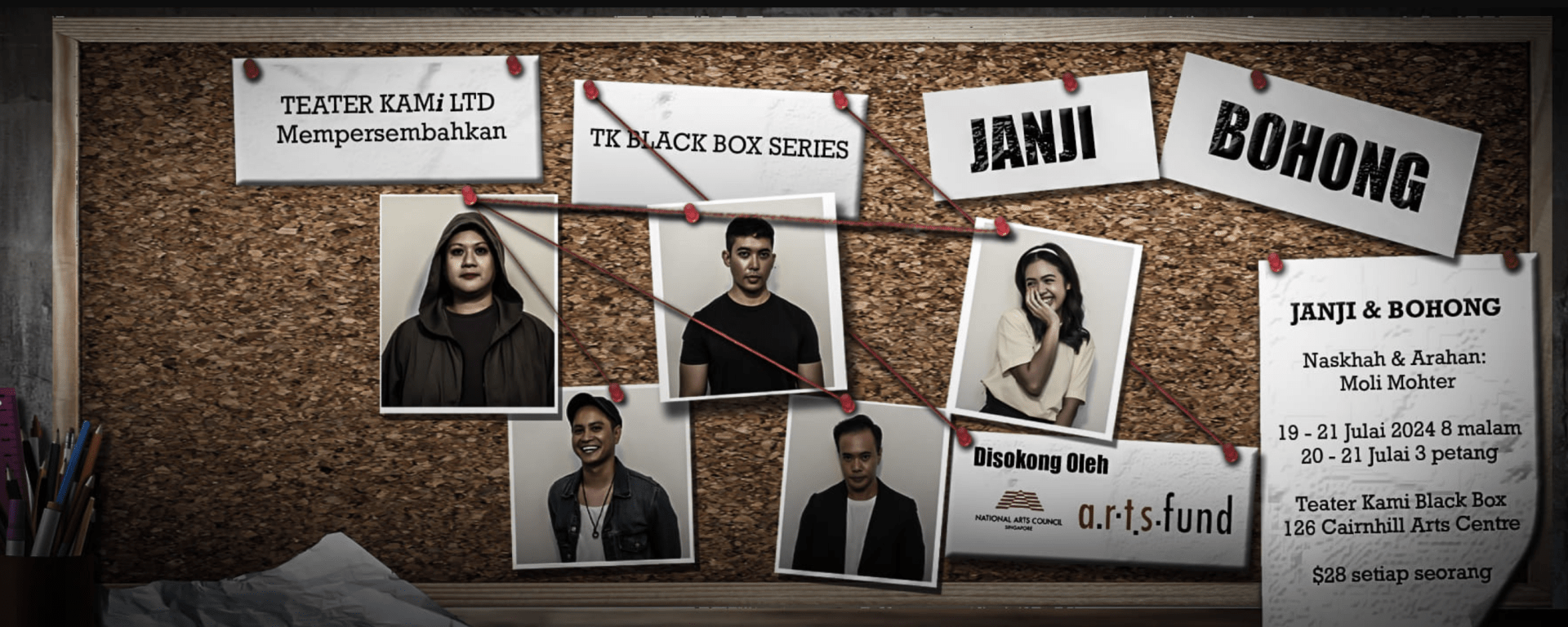
Teater Kami’s new Black Box Series opens the door to a wealth of new possibilities and what-ifs.
While special effects and huge production elements can be fun, oftentimes, the magic of theatre instead comes from the art of a good, sincere performance. In Teater Kami’s new Black Box series, the Malay theatre company goes back to basics and focuses on showcasing Malay actors in brand new short work, written and directed by Moli Mohter, and presented at their black box space at Cairnhill Arts Centre. In their very first iteration, Kami presents double bill Bohong and Janji, two dark comedy works that deal with the universal issues of ties that bind us to this world and to each other, while peppering it with a distinct Malay identity.
Simple in its set-up, both plays utilise the same unassuming living room set, with a couch and coffee table as the centrepiece. At the side are shelves with books and a radio, while a dining table has been set-up behind, alongside a white door from which actors enter and exit from. During the pre-show, all five cast members are engaged in a party, singing, dancing and generally enjoying themselves, at ease as they mentally prepare for the performance, and we too feel a sense of comfort as we settle down, before the showcase opened with Janji (Promise), the other cast members leaving Fandy Ahmed alone on the couch, looking despondent and worried.
Based off Genki Kawamura’s novel If Cats Disappeared from the World, Janji follows Andika (Fandy), who has been diagnosed with a terminal illness and is given a month to live. Facing imminent death, he is given a chance to make a deal with the devil (Suhaila M Sanif), who promises to extend his life in exchange for items of key importance to him, each one removing him further and further from his connection to the world until we are left to wonder if he has any reason left to remain alive. As Andika, Fandy Ahmed is tasked to maintain the look of pain and sorrow for much of the play, his facial expressions a look of despair, his thoughts and the fear of death plain to see. Even with the break from theatre, Fandy shows that he still has it in him, and you can’t help but feel the weight of the world burdening him with every action, strong in his voice but tender in his interactions with his cat Comel (Fadhil Daud, in an impressive 3D mask) and his ex-girlfriend (Amirah Yahya), moving with trepidation as if he’s found himself in a lucid dream. There is clear agony in his performance when he realises that he can no longer even pray without searing pain, and a devastating solitude that emanates from him as we witness him alone with Comel.
Meanwhile, Suhaila M Sanif steals the scene each time she appears, not merely a stereotypical portrayal of evil, but bringing an energy to the role that oozes with charm with sinister undertones. Almost always smiling, cracking jokes and laughing, this is a fun yet commanding version of the devil you become enamoured by, one you’re willing to go to hell with for how convincing she is, as suspicious as you may be of her intentions. But while most of the play is kept light-hearted, there is an undeniable darkness underscoring every scene, as we watch Andika lose his connection to Islam, his sense of time and finally, all the friends around him. It becomes clear that no amount of time is worth sacrificing all that makes us human. and as Andika is finally pushed to his limits, the stage fades to darkness, and we are left to ponder over what it means to lead a good life, and what makes living worth it.
Bohong (Lies) similarly deals with a young man in a crisis, as the lights open on Ali (Rizal Aiman), shaking his leg while perched on the couch. There is a nervous energy and anxiety to him, distracted while his friend Juli (Amirah Yahya) calls out from the kitchen to ask where the cups are. Joined by happy-go-lucky Mikhail (Fadhil Daud), the three friends try to enjoy the little get-together while Ali’s parents are away in Malacca, while Ali is clearly troubled by something on his mind. Over the play, there is a natural camaraderie between the three actors, where it feels like they actually have gone through these experiences they speak of, and have known each other for years, trading anecdotes and just having fun with each other, making their friendship believable.
Tension however, is always lurking at the edges of their conversations, whether it’s to do with the hypocrisy of how much they judge others for extramarital affairs and abuse, yet ignore the ones that are under their nose, or even competing affections, elegantly presented via a seemingly innocent dance off, while the two men keep trying to get Juli to dance with them, intercepting each other’s moves to the point it becomes almost uncomfortable to watch. While Juli and Mikhail remain mostly oblivious, Ali almost finds himself picking at his toes when at rest, a nervous tic that shows how in character Rizal Aiman is, hiding a big secret that raises the stakes of the entire play.
When finally revealed, the play moves fast, and completely transforms the relationship between all three characters, the atmosphere immediately changed to one of fear and suspicion. Yet, just when you think you know what’s going on, there’s a twist yet again, and all the tension dissipates, bringing the darkness back to comedy once more. That perhaps is what makes Bohong such a fascinating play to witness, with how nothing is as it seems, and how easily the cast shifts between modes, testament to Moli’s writing and direction that keeps us guessing at every stage, before bringing it to an absurd close.
With the Black Box series, onstage, the five actors seem to toe a fine line between play and performance, and it’s clear how director Moli has worked with her actors to make them feel comfortable with each other, so much that there is a sincerity to their interactions, and a warmth to their relationship. Both plays feel fresh and original, poignant in how they deal with relatable topics that cut deep, almost always floating beneath our subconscious, and reminding us of how affecting they can be, explored and presented in an innovative and provocative manner onstage. Above all, there is a clear sense that the team is enjoying the process and being there performing, that keeps us engaged throughout the entire showcase. With this double bill, Kami reminds us of the most important parts of theatre – a team that’s committed, and above all, loves what they do. The possibilities are endless, and we can’t wait to see how this Black Box series continues to develop from here.
Bohong & Janji played from 19th to 21st July 2024 at Teater Kami Black Box, Cairnhill Arts Centre. More information in the programme booklet here
 Bakchormeeboy
One thought on “Review: Bohong & Janji by Teater Kami”