
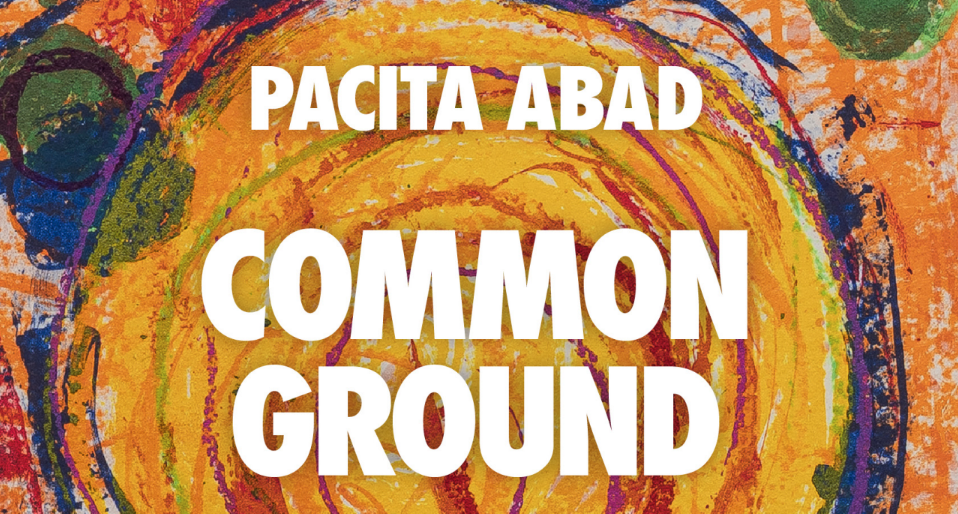
The gallery walls at STPI feel like they are breathing. Each artwork pulses with Pacita Abad’s signature joy and tenacity, a reminder that this artist lived, radiated and stitched her stories into every surface she touched.
STPI – Creative Workshop & Gallery’s exhibition “Pacita Abad: Common Ground” places visitors in the heart of a creative whirlwind from 25 October to 13 December 2025. The show reunites the public with a major body of Abad’s paper and print works made during her 2003 artist residency, a wildly experimental period that helped define STPI’s ethos in its early years.

The exhibition’s genesis reads like a reunion story. When Abad’s longtime partner Jack Garrity visited STPI a couple of years ago, he casually asked if her residency works might ever be “restitched” and shown again. The gallery immediately said yes. After all, even though the original exhibition happened in 2003, her works have continued to travel to international fairs and special projects. The timing could not be better. Institutions around the world are revisiting her oeuvre with fresh intensity, acknowledging how far ahead of her time she was.
During that whirlwind residency, Abad was only the second or third artist ever invited into the workshop. The STPI team remembers her evangelising experimentation: ripping paper, embedding textiles, affixing beads and mirrors, collaging cultural fragments gathered from her travels. At first, she wasn’t sure what she would create. Early pieces feel tentative, like ideas quietly clearing their throat. By the time she left, her circles burst across layers of handmade pulp and luminous paint, dancing with the confidence of a fully electrified universe.
Her only complaint about that residency? She never wanted to leave.

In the exhibition, visitors encounter not only those STPI works, but also two of her trapunto paintings, textile-based pieces she pioneered that lift the surface into dimensional relief. Displayed hanging away from the wall, their backs reveal a hidden garden of stitching. Threads, fabrics, and handwork tell stories of tradition, labor and care.
Her mastery of textiles wasn’t some late-career curiosity. It began in childhood, learning from her mother in Manila. Later, in the United States, she worked as a nighttime seamstress while applying for art school. Sewing paid the bills until her stitched canvases started demanding their own spotlight.

Western critics once dismissed these works as “craft.” Today, they are recognized for what they are: radical interventions that elevate women’s textile traditions and confront a hierarchy that once labeled global art practices as “primitive.” As one STPI staffer noted during a recent tour, Abad was integrating techniques and histories into something fully contemporary and defiantly cohesive. Where others might see chaos, she built symphonies.

Abad’s politics were stitched into her art too. She grew up in a politically active family resisting the Marcos dictatorship, studied political science, and organized protests. Violence against her family eventually pushed her into exile. She flew to Spain intending to study law, stopped in San Francisco along the way and fell headfirst into a new community of immigrant and refugee activists. The paintbrush replaced the legal brief, and the rest is art history.

Her early works documented these communities with realism and urgency. “When the media coverage ends,” she once said, “my paintings continue to stare back at you.” Later, abstraction and the circle motif allowed her to explore belonging and universality: a soft, hopeful geometry for a world in conflict.
One series in the exhibition, “Endless Blues” (2001–2003), responds to both personal battles and world crises following 9/11. Blues music played in her studio. Global headlines weighed heavily. Hope still shimmers through.

Circles became her emblem during the STPI residency: suns, moons, traffic lights, doorknobs, celestial portals, universal symbols of continuity and connection. For Abad, circles were direct, simple, modern, intimate, fascinating and playful. They stitched together different cultures into a shared visual language.
Her resourcefulness was legendary too. If Garrity left her alone anywhere, at a café in Seoul, at a factory meeting, she would emerge surrounded by locals and armed with new materials: toothpicks, discarded circuit board scraps, cowrie shells carried for 15 years before finding the perfect artwork to sparkle inside. She kept everything. Nothing was beneath transformation.

Perhaps even if visitors aren’t familiar with her name, there is one artwork many Singaporeans would have encountered if they just walked around the Robertson Quay aea. Just outside STPI stands the beloved Alkaff Bridge, which Abad transformed with 46 colours and over 2,300 circles. It wasn’t an easy project. She earned nine government approvals while recovering in a hospital, negotiated design software she had never used and obeyed (mostly) a “no ladders” promise to her doctor during radiation treatment. The bridge was her gift to Singapore, quite literally as she refused payment. But every taxi driver snapping a photo became an instant fan.

More than 5,600 artworks. More than 60 countries. More than five decades of shaping culture. Abad passed away in Singapore in 2004, but her star has only grown brighter. Recent retrospectives at MoMA PS1, Walker Art Center, and SFMOMA, as well as powerful appearances at the Venice and Gwangju Biennales, have expanded her global recognition.
This exhibition feels like a homecoming. It is a reminder that STPI helped fuel her experimentation, and that her warmth, ambition, and unstoppable creativity are deeply rooted here in Singapore. Visitors leave with hands warmed by colour and a renewed sense that art can stitch joy into ordinary life. Pacita Abad found common ground everywhere she went. This show proves she never once lost her thread.
Photo Credit: STPI
Pacita Abad: Common Ground runs from 25th October to 13th December 2025 at STPI. More information available here
 Bakchormeeboy