
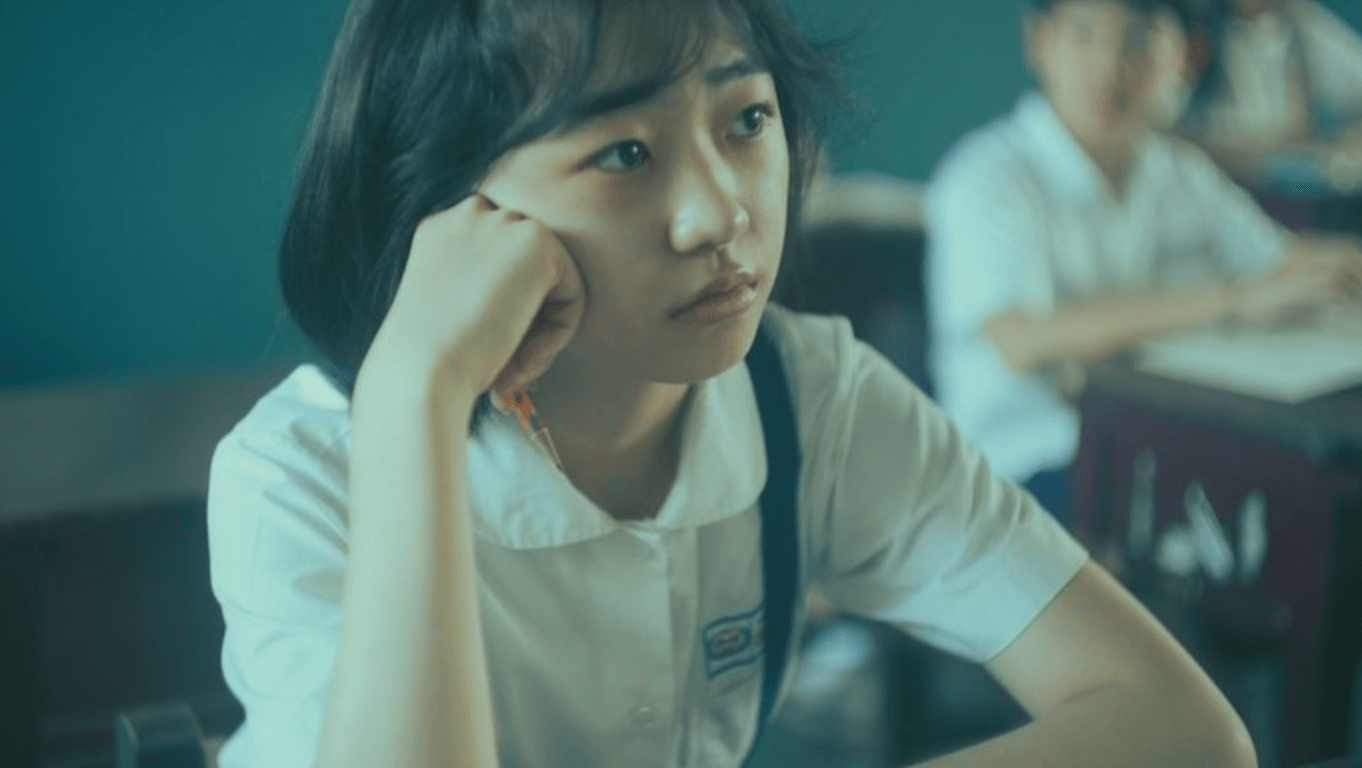

Shu Qi’s directorial debut is deeply personal, and teases out the pain and potential of girlhood in ’80s Taiwan.
Adolescence is rarely tidy. It’s unruly, bewildering, and often defined by the kind of pain we only learn how to name years later. In Girl, her semi-autobiographical directorial debut, Taiwanese star Shu Qi turns that ache into cinema. Known primarily for her collaborations with Hou Hsiao-hsien and her iconic screen presence in films like Millennium Mambo, Shu steps confidently behind the camera to examine the quiet devastations of growing up, and the fragile, stubborn hope that somehow survives them.

Premiering as the Opening Film of the 2025 Singapore International Film Festival, Girl unfolds in late-1980s Taipei and follows Hsiao-lee (a remarkable Bai Xiao-Ying), a withdrawn schoolgirl whose daily routine consists of bracing herself for her mother Ajuan’s (9m88) simmering contempt and hiding in a zip-up wardrobe at night to evade her alcoholic father’s (Roy Chiu) unpredictable rages. Life begins to shift when she encounters Li-li (Lin Pin-Tung), a sharp-tongued, radiant new transfer student who expands Hsiao-lee’s world in ways neither girl can fully articulate.
Shu’s homage to Hou Hsiao-hsien is unmistakable, but never derivative. She adopts his patience, the long, drifting takes; the wistful distance, but filters it through a distinctly feminine, deeply protective gaze. The camera feels like an older self watching the younger with equal parts tenderness and helplessness: wanting to intervene, knowing it cannot. The production design, from the cramped apartment where doors become shields to the soy milk and sticky-rice breakfasts and humid streets, old fruit machines in mom-and-pop shops, grounds the story in a richly textured sense of place. Taipei is not a backdrop but a living memory, one that smells of hair salons, scooter exhaust, and the salty heat of summer. From roaming the streets, walking the roads and crossing bridges, all of this firmly creates a strong sense of place that helps immerse us firmly in the film.

Crucially, Shu understands how a child sees the world. She often keeps the camera at eye level, letting rooms loom large and adults loom larger. As the film progresses, its palette gently warms, subtly reflecting the tiny rebellions and new possibilities that Li-li introduces into Hsiao-lee’s life. The film occasionally lingers too long or indulges in imagery that feels more emotionally extravagant than narratively necessary, but its honesty never wavers. Shu is unafraid to depict violence, neglect, and the wordless way children swallow pain because crying has stopped being useful.
Anchoring the film is Bai Xiao-Ying, whose debut performance is astonishing in its quiet precision. Her portrayal of Hsiao-lee barely speaks, yet her flinches, her posture, her hesitant smiles tell the story of a girl trained to leave no trace. Bai makes Hsiao-lee’s inner life feel vast. Her fear, her longing, and her hunger for safety, for tenderness, for something she cannot yet name, ripples beneath every frame. Her eyes are wide and expressive, and wordlessly, she conveys inner pain in the subtlest of glances.

Opposite her, 9m88 delivers a raw, complex portrayal of Ajuan, a woman crushed by poverty, patriarchy, and her own unresolved wounds. She oscillates between harshness and heartbreak with startling authenticity. Scenes such as slapping Hsiao-lee in front of the whole class, would easily position Ajuan as a villain. Yet Shu Qi refuses easy moralising. We see Ajuan on the verge of breaking down after being beaten by her husband; we watch her shut the door to avoid his rage tearing the house apart after standing up to him, and we notice how she softens the moment her youngest asks for a fried egg. These contradictions allow the film to explore something more painful and more honest than simple cruelty: the bruised girl inside the weary mother, beaten down so thoroughly she has learned to aim her anger downward, toward the one person even less protected than she is.
Roy Chiu’s turn as the family’s destructive patriarch is effectively repugnant, though his narrative thread is the film’s least nuanced. Shu attempts to extend empathy to every character, but Chiang’s cruelty is so persistent and so exhaustive that the tiny glimpses of his humanity feel both late and unnecessary. His monstrosity is already well established; his backstory adds little except to thoroughly establish him as irredeemable.

If the first half of Girl feels suffocating in its repetition of hardship, it is Li-li who brings air back into the film. Lin Pin-Tung plays her with magnetic confidence: brash and funny, yet vulnerable in ways she hopes no one notices. Her friendship with Hsiao-lee is the film’s emotional axis: two girls who recognise the bruises in each other, even when they manifest differently. Their friendship culminates in one of the film’s most liberating sequences. Li-li skips school and pulls Hsiao-lee with her—literally through a hole in a wall—into a world Hsiao-lee did not know she was allowed to access. They sneak into a video-rental cinema to watch an adult film, giggling and dancing in the dark; they hop onto the scooters of older boys, the wind turning their momentary freedom into something tactile and thrilling. Shu’s camera captures their interlocking hands as the scooter races down the stretches of road, the city blurring away into possibility. For a brief moment, Hsiao-lee feels the world widen.
But freedom can also sharpen despair. Shortly after, Hsiao-lee, overwhelmed by the knowledge that life could be different yet believing she will never reach it, contemplates ending her life. The scene is stark and unembellished; the camera simply stays with her, refusing to sensationalise, refusing to look away. It is one of the film’s quietest scenes and one of its most shattering.

Everything converges in the rain-soaked confrontation between Hsiao-lee and Ajuan. After running away, Hsiao-lee returns home only to find herself separated from her mother by the metal gate of their apartment building—a barrier that clarifies what they have always been to each other: close, but never connected; dependent, yet unable to meet in the middle. Hsiao-lee begs her mother to divorce her husband, insisting that all of them deserve better. But Ajuan refuses, whether from fear, habit, self-loathing, or a misguided hope that life might still turn out differently. When mother and daughter finally speak, it feels less like reconciliation than recognition: both understand the gulf between them, and both understand that the damage may be beyond repair. The rain falls harder. For the first time, neither tries to hide their hurt.
The epilogue, set years later, shifts tone but deepens the film’s emotional architecture. Revisiting Hsiao-lee as a young adult, it reframes the earlier violence not as an open wound but as a scar—one she has learned to carry without letting it define her entirely. The final image, quiet and unexpectedly tender, suggests that healing rarely arrives as forgiveness bestowed by others, as we watch Hsiao-lee eating a bowl of noodles, sobbing and releasing years of emotion at last as her mother fetches tissues for her. More often, it is something we grant our younger selves, belatedly, in the only language we have left.

Though tonally distinct, this epilogue deepens the story rather than diluting it. It transforms Girl from a chronicle of suffering into something more tender—an adult’s attempt to look back at her own girlhood with honesty rather than bitterness. Its final image, quiet and unexpectedly graceful, invites a soft forgiveness that neither character could voice as a child. Girl is occasionally unwieldy and finds itself treading just a little too long in sorrow, but it is made with unmistakable heart. It is lush in atmosphere, wrenching in its performances, and attentive to the small, vital gestures of survival.
More than anything, it is a film about the fragile courage of girls who grow up unseen, and the women they become despite it. By the time the credits roll, the pain has not disappeared. But it has been witnessed, acknowledged, and felt by an audience. And sometimes, that is the beginning of healing: the moment you finally turn toward the child you once were, hold her gaze, and whisper that she deserved so much better.
More information about Girl available here
The 36th SGIFF runs from 26th November to 7th December 2025. More information available via their website here
 Bakchormeeboy