

When Girl opened the 2025 Singapore International Film Festival at Marina Bay Sands, the theatre was filled to its edges, with filmmakers, industry regulars, influencers, and longtime fans gathered to witness one of Asia’s most beloved stars step into a bold new role.
For Shu Qi, who has spent decades defining onscreen charisma, the packed house represented both the reputation she’d built up over the years, as well as testament to the strength meant something deeper than prestige. It meant a story she had spent years shaping in private was finally ready to be shared. And Girl, a hushed, devastating portrait of childhood resilience in 1980s Taipei, proved to be the kind of opening film that lingers long after the applause has faded.

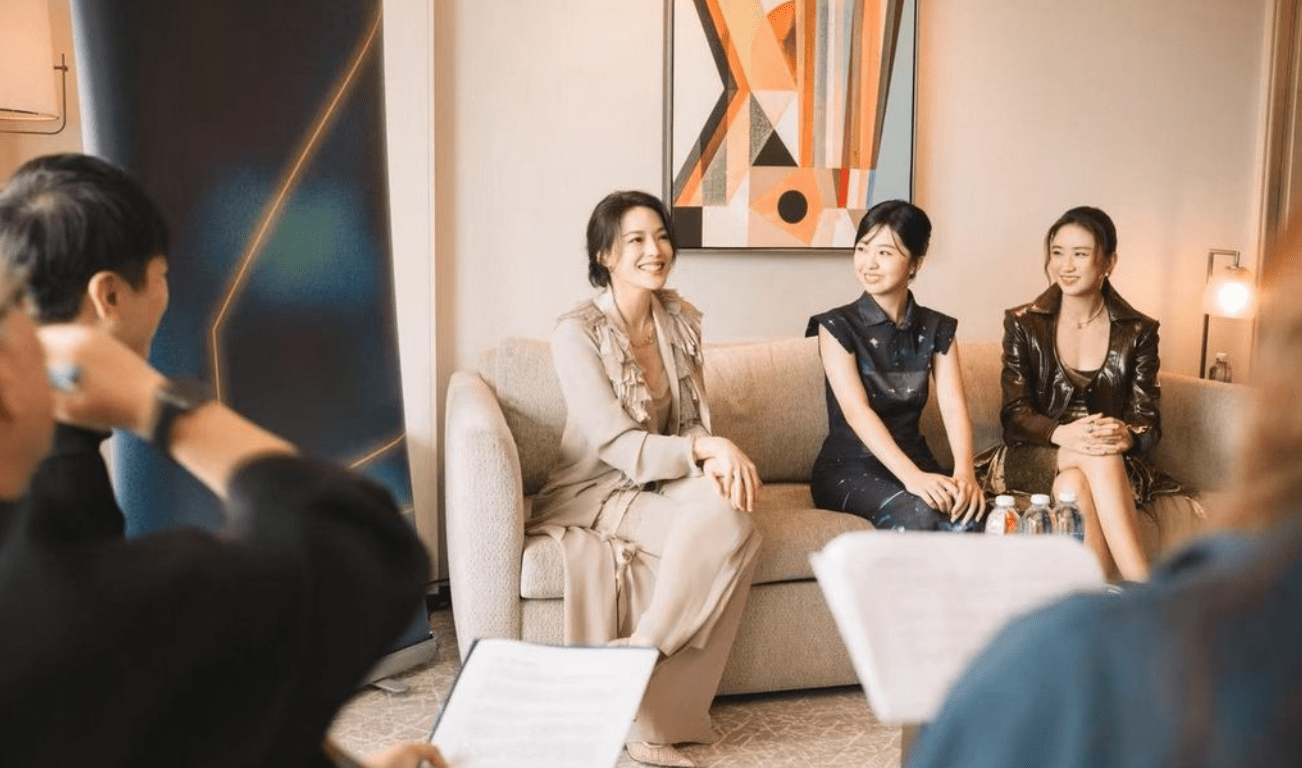
In a roundtable interview with the media, Shu Qi freely admits she resisted directing for years. “Hou Hsiao-hsien told me many times, ‘You should direct.’ But I always laughed. It felt too huge,” she says of her longtime director friend. “But eventually the story began speaking louder than my fear.”
That story became Girl, a semi-autobiographical tale about Hsiao-Lee, a teenager navigating poverty, parental neglect, and the fleeting warmth of childhood friendship. Writing the script took her through countless drafts and unexpected emotions. “At one point it was 27,000 words… then 34,000… then back to 27,000,” she says. “Every time I rewrote something, I cried. Not because it was painful, but because the children reminded me of their bravery.”
Hou’s influence appears in the film’s patient gaze: long takes, stillness, attention to the mundane details of domestic life. Yet the film’s lush colours, the bruised blues, sunlit amber tones, and sharp, neon-tinged shadows, are distinctively Shu Qi. “Children notice beauty even in cramped spaces,” she says. “I wanted the visuals to honour that.”

The film’s 1980s Taipei is not just mentioned for nostalgia’s sake, but keenly felt in its production design recreates a city on the cusp of rapid modernisation: peeling apartment walls, narrow overpasses, cheap plastic wardrobes, salon chatter, and the jostle of night markets. Even school uniforms and street posters were reconstructed with archival precision.
The era becomes a character in itself. A time when children slipped through institutional cracks, when patriarchal norms were unquestioned, when poverty shaped every gesture, all because Shu Qi wanted viewers, especially younger ones, to feel the unspoken rules of that world. “Back then, many children carried heavy things quietly,” she says. “I wanted to honour their silence without romanticising it.”

Bai Xiao-Ying, now 18, embodies the lead role of Hsiao-Lee with a performance almost entirely internal. Onscreen, her shoulders curl inward; her gaze stays low; her silence speaks at a frequency the film invites the audience to lean in and hear. “Shu Qi jie told me Hsiao-Lee ‘speaks with her back,’” Bai says. “So I focused on her breathing, how she tries to disappear.”
Filming the scenes inside the zip-up wardrobe was unexpectedly transformative.
“At first I panicked; that space was really small. But it became like entering her inner world. Shu Qi would sit beside me and breathe with me when it got intense. I always felt safe.”
Her dynamic with Lin Pin-Tung, who plays the worldly transfer student Li-li, brings unexpected warmth. “We became friends fast,” Bai says with a shy smile. “A lot of the scenes were just us being kids.”
Shu Qi beams when talking about her young lead. “Xiao-Ying understands stillness. That’s something even experienced actors struggle with. She has an old soul.”

If Hsiao-Lee is the quiet centre of Girl, her mother Ajuan, played by Taiwanese R&B musician 9m88, is a volatile presence orbiting her. Ajuan is exhausted, brittle, often hostile toward her elder daughter yet affectionate toward her younger one, as though tenderness itself must be rationed.
“I didn’t want her to be a monster,” 9m88 says. “I wanted people to feel her shame, her disappointment, her lack of choices. Once I understood her wounds, her coldness made sense. It’s tragic, but human.”
The school confrontation scene, where Ajuan slaps her daughter in front of classmates, was one of the most emotionally taxing. “I kept asking Xiao-Ying if she was okay,” she says. “After the take I collapsed in the dressing room from guilt. She came in, hugged me, and told me to watch Stephen Chow movies. I laughed through my tears.”
Shu Qi says watching 9m88 transform was remarkable. “She kept doubting herself at first. But once she found Ajuan’s heartbreak, she unlocked everything.”

Though Roy Chiu, who plays the father, is rarely the centre of the camera’s attention, his presence is a shadow that stains the apartment. He is the embodiment of patriarchal violence, not stylised or theatrical, but frighteningly ordinary. The film portrays him not as a single-source villain but as the product of familiar social structures: alcoholism normalised, masculine frustration unexamined, tenderness untrained.
The choice to keep him partially offscreen was a deliberate one. Rather than sensationalise violence, Girl shows how fear lives in anticipation, in footsteps on the stairs, in the trembling fabric of a wardrobe door. His impact is measured not in wounds but in flinches. This restraint makes the father one of the film’s most chilling elements, both unpredictable and one of its most realistic.

Despite the heaviness of its subject, Girl was made with extraordinary gentleness. Shu Qi took care not to let her young cast absorb the darkness of the narrative. “I didn’t want them to understand the violence in an adult way,” she says. “We played games. We built trust. Respect creates safe spaces, and safe spaces create truthful performances.”
Bai confirms this. “Shu Qi-jie never rushed me. If a scene felt heavy, she just held my hand. I always felt protected.”

For all its bleakness, Girl is illuminated by kindness: a classmate carrying Hsiao-Lee after she faints, Li-li’s impulsive affection, a rare moment of fun on the rooftop. “The hope isn’t loud,” Shu Qi says. “It’s a small flame that refuses to go out.”
Ultimately, Girl is a film about noticing: children noticing each other’s small kindnesses, mothers noticing their own disappointments, and one filmmaker noticing the quiet bravery of survival. “I hope young viewers feel seen,” Shu Qi says softly. “Not judged. Not pitied. Just seen.”
For 9m88, this is the film’s emotional core. “Ajuan is stuck. But Hsiao-Lee is still looking for a way out. That search is the heartbeat.” And Bai puts it simply: “Even when she’s silent, she’s still fighting.”

Premiering as the opening film of the 2025 Singapore International Film Festival, Girl arrived with a sense of anticipation—and poignancy. The Marina Bay Sands theatre was filled to capacity. The screening ended with a long, standing ovation that left Shu Qi momentarily overcome. “I thought I would be calm,” she says. “But at all the screenings I attended, when the lights came on, I cried. Strangers understood the film. That made all the difficult moments worth it.”
“Directing made me confront myself,” she adds. “It forced me to ask: Why am I telling this story? Who am I responsible to? And the answer was always the same—I wanted to honour people who rarely get the spotlight. Children, women, the quiet fighters.”
She explains that Girl taught her a different kind of authorship, one rooted less in aesthetics than in accountability. “As an actor, I focus on one role. As a director, I have to protect the entire world of the film. Every choice carries weight. I felt responsible for the children’s emotional safety, for portraying poverty without exploitation, for showing pain without stealing dignity. That responsibility changed me.”

When she considers the possibility of making another film, it’s no longer a matter of reluctance, but intention. “If I direct again, it will be because the story has a purpose. Not because someone tells me to, not because it’s fashionable. It must be something only I can tell—something truthful.”
She pauses, thoughtful. “Maybe there’s another story waiting for me,” she says finally. “Let me rest a little first… but my heart isn’t closed to it.”
Photo Credit: Singapore International Film Festival
More information about Girl available here
The 36th SGIFF runs from 26th November to 7th December 2025. More information available via their website here
 Bakchormeeboy