
The Amara Hotel ballroom is not where literary glamour usually lives. On this January evening, there are no red carpets or flashing cameras, just round tables, polite applause, and the low hum of people who care deeply about books. Editors, writers, publishers, teachers, and industry figures fill the room. It feels, fittingly, like what Edmund Wee later calls “the book ecosystem”.
“It is quiet, unglamorous and absolutely essential,” Wee tells the room. “Thank you all for being a part of it.”
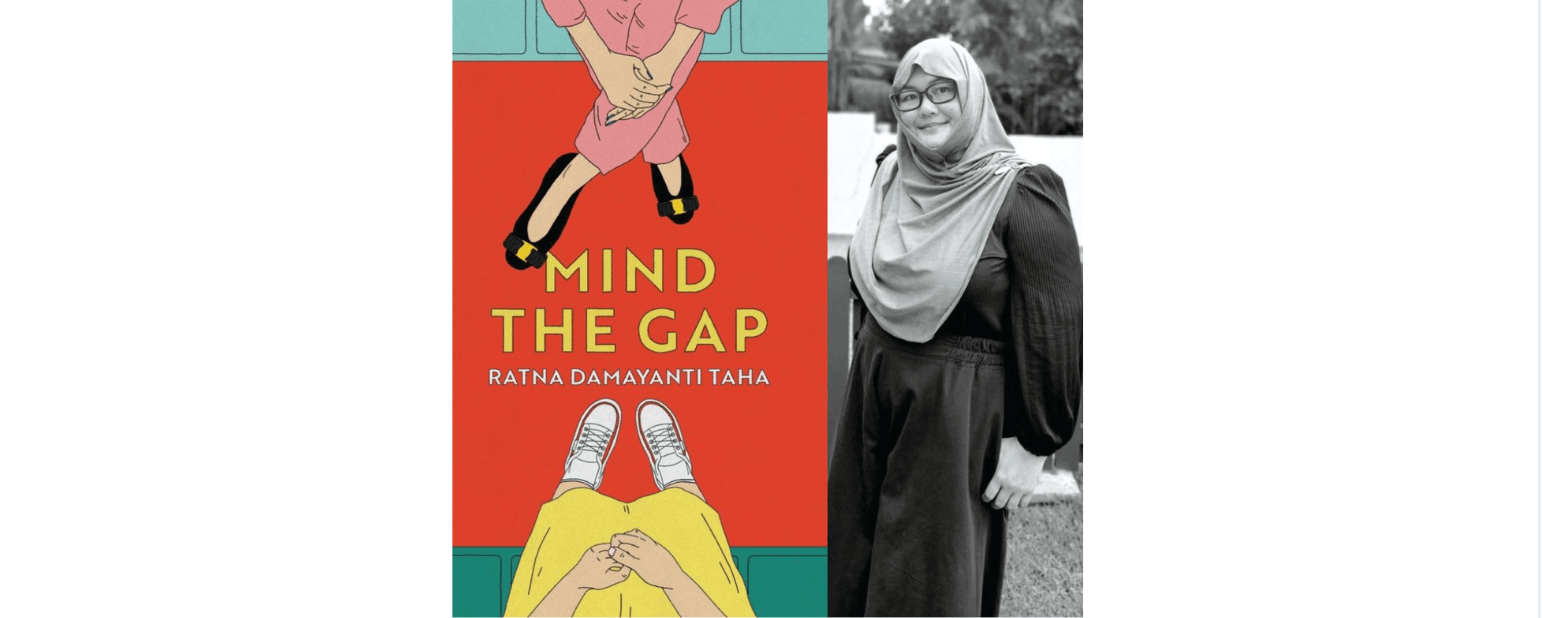
That ecosystem, built slowly, painstakingly, often out of public view, is what the Epigram Books Fiction Prize has spent a decade nurturing. And tonight, it is also what has brought Ratna Damayanti Taha to the stage as the winner of the 2026 prize for her debut novel, Mind the Gap.

Mind the Gap follows Nora, a precocious Malay girl with a love for data, charts and logic, as she grows up alongside Singapore’s MRT lines—from the 1990s to the present day. It is a coming-of-age story, but one that resists sentimentality. Instead, it pays close attention to the space between ambition and reality, promise and payoff.
When Ratna Damayanti Taha takes the stage, her speech is deeply personal. “Thank you from the bottom of my heart for believing that my voice is one that has legs,” she says, “and that it might reach all over Southeast Asia.”
She traces her love of stories back to her parents. Her late father, she recalls, told bedtime stories “complete with made-up songs” and little concern for plot holes. “Imagination was key for him,” she says. From her mother, who taught herself English through Singapore’s public libraries, she learned “the value of reading and the discipline of writing”.
She thanks her teachers (“none of us can make it without them”), her four children, and finally her husband, her “best friend”, “soulmate” and “pillar of strength”. “Sometimes my faith in myself wavered,” she admits. “But his belief in me remained steady.”
She adds, with a laugh, that her husband has yet to read Mind the Gap. “But now that it’s going to be published, he has no excuse.”

Judging panel member Anthony Chen, who admits he “barely slept for two whole weeks” trying to finish reading the four shortlisted manuscripts while juggling film post-production, describes the novel as something more than personal.
“The book’s structure mirrors Singapore’s own development,” he says. “The innocence of the ’90s gives way to the transformations of the 2000s, culminating in this ongoing, uncertain transition into adulthood and nationhood.”
For Chen, the novel captures a feeling many Singaporeans recognise: “a country and its citizens perpetually in motion, promised connectivity, but often confronted with complex interchanges and unspoken destinations.”
What sets Mind the Gap apart, he adds, is its refusal to stop at the surface. “It moves beyond the protagonist’s coming-of-age to dissect the machinery of meritocracy, race and governance. Nora’s internal monologue—full of charts, mental footnotes and sharp, often hilarious observations—feels compelling and authentic. It’s an essential, unforgettable journey.

One detail that struck Chen only late in the judging process: all four shortlisted writers were women. “We read everything cold,” he says. “We had no idea who the writers were. It was only today that I realised, all women. And I thought: what talent.”
The shortlist reflected a broader confidence in Southeast Asian storytelling. Jaclyn Lim’s A Strange Case of Erasure uses surrealism to explore invisible domestic labour and motherhood; Kwan Ann Tan’s A Family Inconvenience examines elder care and familial duty; and May Thanakhar’s Take Me Back to Yangon weaves migration, memory and spiritual belief into a portrait of loss and resilience.
Together, the four novels form a quietly radical body of work, showcasing stories rooted in domestic life, emotional labour, and questions of belonging rather than spectacle.

The night also marks a turning point for the organisation behind the prize. In 2025, home-grown publisher Epigram Books formally restructured to become the Epigram Literary Foundation, a non-profit entity aimed at ensuring long-term sustainability, and making a stronger case to donors that literature is cultural infrastructure, not a vanity project.
“The Foundation was set up to make sure that what we’ve built together does not depend on any one individual,” says Wee, “and does not disappear quietly over time.”
He emphasised that publishers, booksellers and rights partners are not passive players. “You help shape what gets written, what gets published, what gets circulated, and ultimately, what is remembered.”
That philosophy underpins Epigram’s most ambitious move yet: a multi-territory co-publishing agreement that will see all four shortlisted novels released in the greater region; not just in Singapore, but also in Indonesia, Malaysia, Thailand, the Philippines and Myanmar.
“It’s the equivalent of signing 68 rights deals in one fell swoop,” Wee says, for novels “yet to be published, or even written”. The breakthrough, he explains, came from a decision to “not talk about money first”, but to focus instead on shared belief in Southeast Asian stories.

As the evening winds down, it’s clear that this has been a win for literature and how it continues to flourish here, through teachers, libraries, patient publishers, and an ecosystem that rarely demands the spotlight.
In a city obsessed with speed and outcomes, Mind the Gap asks readers to notice what lies between stations. And the Epigram Literary Foundation, now entering its next chapter, is betting that those in-between stories are worth sustaining—for the long haul.
The 2027 Epigram Books Fiction Prize is now open for submissions from 22 January 2026, 12:00 AM SGT, to 1 August 2026, 11:59 PM SGT. Writers across Southeast Asia are invited to submit a full-length, original and unpublished manuscript written or translated into English. More information available here
 Bakchormeeboy