
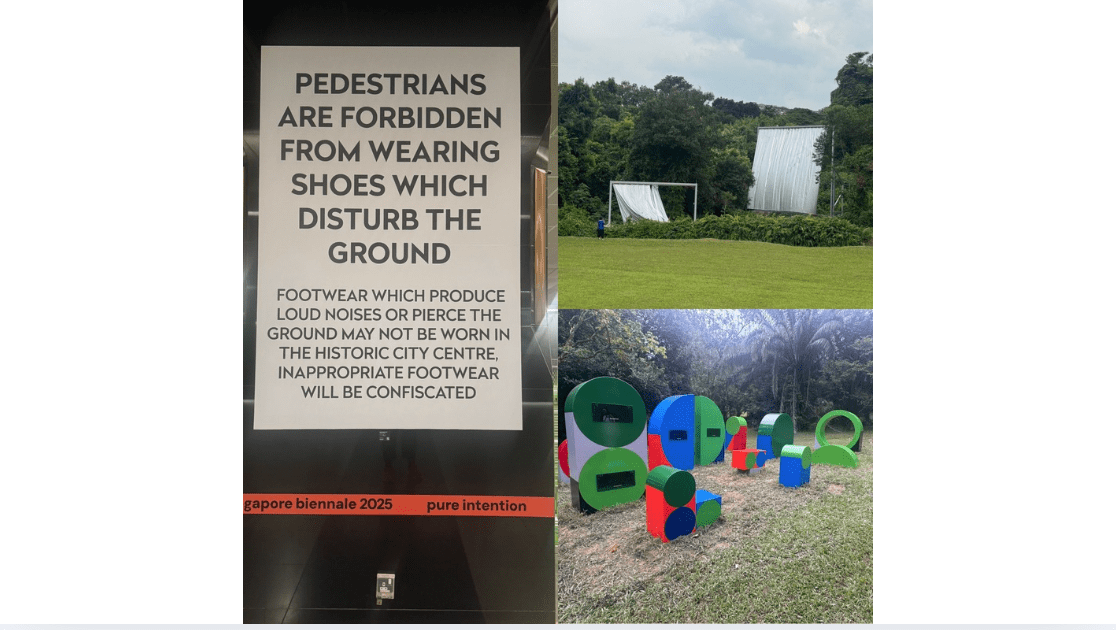
Art doesn’t always ask for your full attention. Sometimes, it waits patiently, be it by a footpath, at a neighbourhood field, or quietly above an MRT escalator, ready to meet you wherever you are. With the launch of three new site-responsive works, Singapore Biennale 2025: pure intention continues to blur the boundary between art and the everyday, inviting viewers to encounter creativity not in white cubes, but while walking, waiting, resting, and returning.
Unfolding during Singapore Art Week 2026, these new commissions extend the Biennale’s theme of pure intention, foregrounding rituals, care, memory, and desire across vastly different city sites: a wooded clearing, a neighbourhood field, and some of Singapore’s busiest MRT stations.
Two Who Remember the Sea

Apichatpong Weerasethakul (Thailand) & Guo-Liang Tan (Singapore)
Wessex Estate, forested clearing behind Wilton Close
Hidden behind a dirt path in Wessex Estate, Two Who Remember the Sea reveals itself slowly, much like the work itself. Suspended sheets of silver polyester fabric hover between metal scaffolding, moving gently in response to sun and wind. There is no fixed choreography. Instead, the installation is animated by the natural rhythms of the day.
For Apichatpong Weerasethakul and Guo-Liang Tan, the work grew from a shared fascination with cinema as atmosphere, memory, and ritual. Here, the fabric becomes a kind of porous screen: light passes through it, shadows appear and disappear, and the surrounding landscape continually enters the frame.
Guo-Liang describes the work as cinema in an “extended field”, both painterly and cinematic without being fully either. The sun powers the motors that move the fabric, while also illuminating it, creating a second source of animation. Time unfolds at multiple speeds: the slow folding of fabric, the passing of clouds, the quiet grazing of animals nearby. The lead he took from Apichatpong: ensure that there is ‘more mystery’.
Apichatpong developed the work through sketches, daydreams, and patient layering. There is no fixed meaning here. Instead, viewers are invited to let weather, light, and their own thoughts drift while watching. The installation evokes gentle, wandering ghosts—figures drawn in part from mid-century Thai illustrations by Hem Vejakorn, connecting folklore to political memory without ever becoming heavy-handed.
Set within Wessex Estate, a neighbourhood shaped by colonial military history and later repurposed as residential housing, the work quietly acknowledges layers of presence and absence. It becomes a meditation on remembrance, resilience, and the way landscapes hold traces of lives lived before us. This is a work best encountered more than once at different times of day. No two visits are ever the same.
Field Library

Emily Floyd (Australia)
Open field outside Blenheim Court, Wessex Estate
A short walk from the forest clearing, Field Library announces itself in bright, joyful colours. Australian artist Emily Floyd transforms an open field into a hybrid space, becoming part playground, part reading room, part social hub.
The installation consists of sculptural seating elements that double as storage for pamphlets and texts. Visitors are encouraged to sit, read, climb, gather, and talk. Children treat it like a play structure; adults linger with booklets that explore themes such as migration, feminist pedagogy, reciprocal care, and alternative educational models.
Floyd comes from a family of toy makers, and that lineage is felt here. The work is deliberately approachable and tactile, designed not just to be seen, but used. Learning, in this space, happens socially and informally, through conversation, shared curiosity, and chance encounters.
The texts are presented in bite-sized extracts, making complex ideas accessible without diluting their depth. Field Library builds on Floyd’s long-standing interest in how knowledge is created and circulated outside Eurocentric frameworks, particularly within the Asia-Pacific context. It asks: how might we learn differently, and how might care be embedded into the act of learning itself?
Crucially, the work’s potential lies in its openness. It is a place to wait, to meet neighbours, to strike up conversations with strangers. As the pamphlets and programmes continue to arrive, the work will keep evolving—shaped as much by its users as by the artist’s intent.
Rules for the Expression of Architectural Desires

Debbie Ding (Singapore)
HarbourFront, Orchard & Fort Canning MRT Stations
Installed across HarbourFront, Orchard, and Fort Canning MRT stations, Debbie Ding’s Rules for the Expression of Architectural Desires takes the form of poster interventions that mimic the language of official civic instruction. At first glance, they blend seamlessly into the visual noise of transit spaces. Look closer, and their tone begins to shift.
The posters present speculative devices, schemes, and rules for redesigning the city, inviting viewers to imagine how desire, emotion, and imagination shape the built environment. The work leaves open an essential question: would these desires make the city better, or simply different?
Placed intentionally at busy intersections where commuters are often rushing, the work gently asks people to slow down. There is humour here, but also a quiet sadness, the recognition that many will pass by without noticing. And that, too, becomes part of the work.
For Ding, cities are not just made of concrete and glass, but of ideas and gestures, small interventions that push against established norms. By situating the work in transit spaces, she inserts imagination into routine, offering a brief pause for reflection amid the seriousness of daily commute.

Together, these three works form a constellation of experiences that unfold at different speeds. One asks you to linger in a forest clearing, another invites you to sit and talk in a neighbourhood field, and the third meets you mid-stride on your daily commute.
While they do not demand attention, they certainly reward it.As Singapore Biennale 2025 continues through Singapore Art Week 2026, these new commissions remind us that art can live with us, shaping how we move through the city, how we gather, and how we imagine what comes next. Sometimes, all it takes is slowing down enough to notice what’s already there.
The Biennale runs from 31st October 2025 to 29th March 2026. Admission to SAM at Tanjong Pagar Distripark is ticketed at SGD15 for Singaporeans and Permanent Residents, and SGD25 for tourists and foreign residents. Local and locally-based students and educators enjoy free admission.
All other Biennale venues are free and open to all. Singaporeans may also use their SG Culture Pass credits to redeem admission. Complimentary shuttle buses will operate on weekends, connecting key Biennale sites for visitors to explore the different venues across the city. More information, including full list of artists, artworks and programmes, is available at www.singaporebiennale.org.
 Bakchormeeboy