
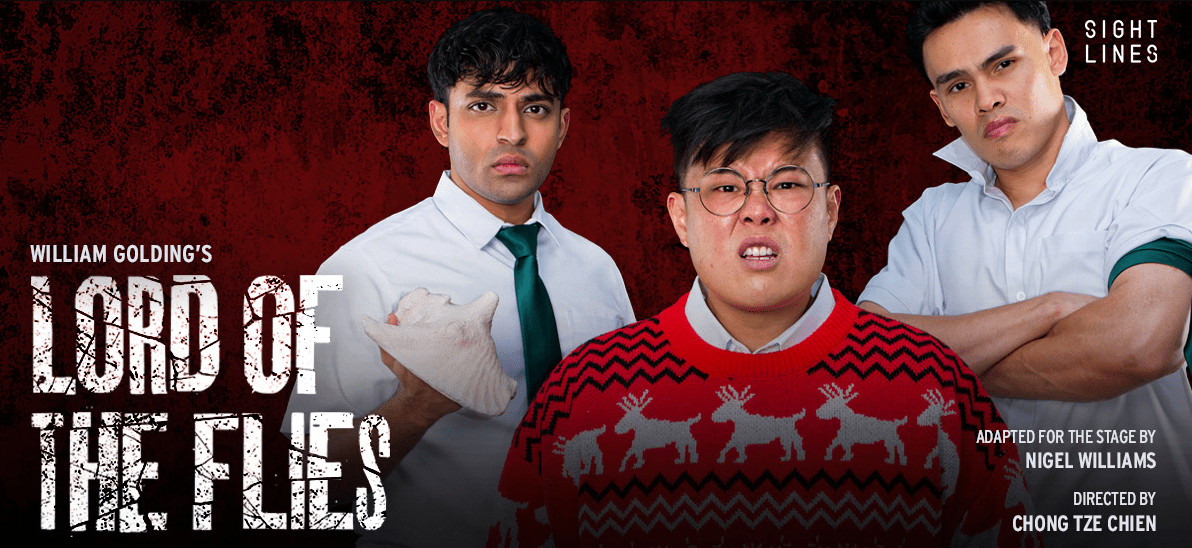
Metatheatrical interpretation of Golding’s classic is ambitiously and visually arresting, if occasionally more evocative than incisive.
By now, Sight Lines Entertainment has carved out a distinct niche with its pragmatic approach to theatre, balancing original work with canny programming aimed at student audiences, a strategy that ensures both relevance and sustainability in a competitive arts landscape. Their latest offering, a new staging of Lord of the Flies adapted by Nigel Williams, continues that trajectory. A perennial O-Level text, the novel’s inclusion here feels as much pedagogical as artistic, though not without ambition.
A decade after the company’s previous 2016 staging, director Chong Tze Chien revisits Golding’s island with a distinctly metatheatrical frame. Staged at the KC Arts Centre, Wong Chee Wai’s imposing set immediately commands attention: a looming wall of stacked school chairs, teetering in precarious configurations. It evokes both an urban jungle and a fragile social order, an apt visual metaphor for Golding’s central preoccupation with the thin veneer of civilisation, always on the brink of collapse under the weight of human impulse.
This tension between order and chaos sits throughout Golding’s novel, where the boys’ descent is not caused by the island but revealed by it. Chong’s production gestures toward this idea through its framing device: the cast begin as contemporary schoolboys in crisp white uniforms, suggestive of a certain elite institution in Singapore, before slipping into their roles. The metatheatrical conceit of students performing Lord of the Flies offers a promising lens, hinting that the savagery of the text is not distant, but latent within even the structures of modern society itself.
As the boys “play,” imagination takes hold, and the boundary between actor and character begins to blur, immersing themselves within Golding’s world, most effective when it underscores Golding’s enduring question: how easily civility gives way when authority dissolves. The performances themselves are largely compelling. Shrey Bhargava’s Ralph is less assured than the original novel, charting a convincing arc from confident leader to increasingly shaken figure, worn down by the consequences of failed authority. Opposite him, Salif Hardie’s Jack is magnetic and a standout in the cast, his feral charisma lending weight to the boys’ allegiance, and subtly complicating the moral binary. In Golding’s novel, Jack represents the seduction of power unbound by rules, and here, that seduction is palpable, even alluring, where even the audience finds themselves strangely drawn to this wild man.
As Piggy, Andrew Marko leans into a more abrasive interpretation, amplifying the character’s rigidity and insecurity. While this sometimes veers toward caricature, it also sharpens the tension between intellect and instinct that defines Piggy’s role in the original text, and he’s given the opportunity to redeem himself in a genuine show of bravado later on. The supporting ensemble, including Irsyad Dawood, Jamil Schulze, and Ryan Ang, collectively capture the shifting group dynamic, from playful camaraderie to something more volatile and fractured.
Design is where the production most consistently excels. Wong’s aforementioned set also hides plenty of ladders and hiding places from which cast members climb and emerge or disappear into, allowing for it to feel like a wasteland playground, as director Chong keeps their movements rapid and constant. Genevieve Peck’s lighting is particularly striking, conjuring shifts from harsh daylight to ominous darkness with precision, while Jing Ng’s soundscape, where the conch’s call becomes a bellow and school bells warp into something uncanny, effectively destabilises the familiar. Peps Goh’s fight choreography takes its time to build, and by the final confrontation between Jack and Ralph’s tribes, it reaches fever pitch where you can clearly follow the action of each individual character while feeling enthralled by the tension and conflict.
Yet for all its strengths, the production does not always fully cohere. The metatheatrical frame, so promising in its opening, feels unevenly sustained, with choices that seem more gestural than purposeful. The boys’ visible reliance on scripts, later repurposed as props, blurs the line between device and distraction, at times reading less as intentional commentary than under-rehearsal. Similarly, the use of annotated panels listing the boys’ names, or the abrupt return to pristine uniforms, hint at ideas about role-playing and the permeability between fiction and reality, but remain underdeveloped. Even the late substitution of the naval captain with a teacher figure, quickly reversed, feels like a meta flourish without sufficient dramaturgical payoff, undercutting rather than deepening the production’s internal logic.
Some of Nigel Williams’ adaptation choices compound this sense of diffusion. In attempting to draw out the themes of Lord of the Flies, the script occasionally overstates what the novel leaves unsettlingly implicit. Jack’s tribe, for instance, is pushed toward an exaggerated, performative “primitivism” that risks caricature, externalising the boys’ descent rather than revealing it as an intrinsic collapse of order. While this may gesture toward colonial anxieties, it lands ambiguously, provoking more uneasy laughter than critical reflection. Likewise, the decision to literalise the “beast”, with Marko reappearing as a physical embodiment following Piggy’s death, offers a striking image but softens Golding’s central idea: that the true horror lies not in any external physical form, but within the boys themselves.
Still, there is much to appreciate. As a production clearly attuned to its student audience, it opens up space for discussion: on interpretation, adaptation, and the elasticity of classic texts. Even if it does not always land with the full brutality of Golding’s original, it nevertheless engages meaningfully with its ideas, even when its reach exceeds its grasp. Ultimately, this Lord of the Flies may not always bite as sharply as it intends, but it is undeniably ambitious, bolstered by strong design and committed performances. As both an introduction to and reinterpretation of a literary staple, it succeeds in sparking curiosity, and perhaps that, in itself, is a worthwhile achievement.
Lord of the Flies played from 5th to 15th March 2026 at the KC Arts Centre. More information on Sight Lines’ upcoming shows here
Production Credits:
| Adapted for the stage by Nigel Williams Director Chong Tze Chien Cast Shrey Bhargava, Andrew Marko, Salif Hardie, Irsyad Dawood, Jamil Schulze, Ryan Ang Set Designer Wong Chee Wai Lighting Designer Genevieve Peck Sound Designer/Composer Jing Ng Action Director/Stunt Coordinator Peps Goh Costume Coordinator Tan Jia Hui Head of Production and Propsmaker Jesy Choo Producer Derrick Chew Assistant Producer Mark Chong |
 Bakchormeeboy