

Timely dystopian climate-change play sees children inherit a broken planet and the power to decide who pays for it.
Dawn King’s The Trials imagines a near future in which the climate crisis has passed the point of no return. The air is barely breathable, natural disasters are commonplace, and resources are increasingly scarce. In response, society has turned to a radical form of justice: children now sit in judgment over the generation that came before them. Quite literally, a group of teenagers are selected to form a twelve-member jury, spending two weeks hearing the cases of adults on death row. Each defendant is given a final opportunity to explain their choices and justify their actions before the jury decides whether they deserve to be euthanised or spared.
It is a provocative premise that raises thorny questions without easy answers. How much responsibility should individuals bear for a crisis created by entire systems? Is ignorance a defence when the consequences were already known? At what point does justice become revenge? And can one generation fairly condemn another for participating in the very structures that made modern life possible? These moral dilemmas sit at the heart of King’s play, which functions as much as a thought experiment as it does a piece of theatre.
The work is also particularly well suited to a youth training company. Many youth productions rely on devised work to ensure every performer receives meaningful stage time and ownership over the material. Choosing an established script instead presents a different challenge: serving the needs of the play while simultaneously showcasing the abilities of a large ensemble. With twelve actors remaining central to the action throughout, director Daniel Jenkins must constantly balance creating a compelling piece of theatre with giving every performer a chance to shine.

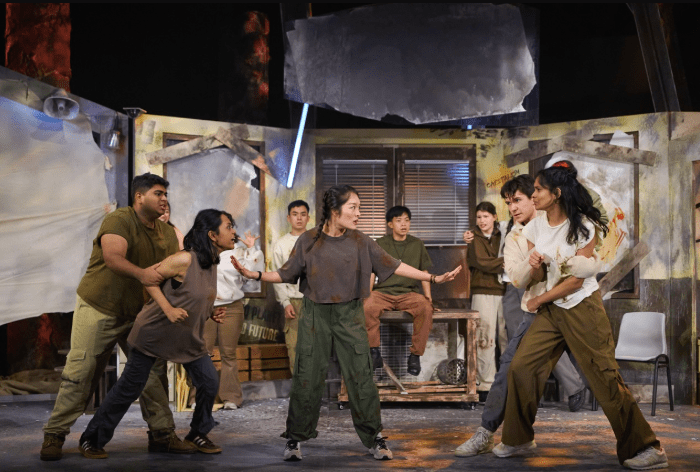
In that respect, this latest production by SRT’s The Young Company largely succeeds. From the moment audiences enter the theatre, the production creates a vivid sense of a world in decline. Studio Vagabond’s set design presents a dilapidated structure seemingly on the verge of collapse, its walls covered in anti-adult, pro-environment graffiti. The performers are largely dressed in casual dark clothing, with subtle distinctions in colour hinting at differences in social class and privilege. Effective multimedia sequences patch together images of climate protests, news broadcasts and environmental catastrophe, reinforcing the sense of a society reckoning with the consequences of decades of neglect. Together, these elements quickly establish the dystopian world the jury inhabits.
With twelve central characters, King’s script wisely relies on broad but distinctive characterisation. The sympathetic Manali (Dayna Cardona Naidu) consistently gives defendants the benefit of the doubt, while Salma (Ameera Shuhaila) carries the trauma of losing her parents, and the privileged Keona (Tinotenda Zimhunga) struggles to reconcile her own memories of carbon-intensive holidays with the values she now espouses. The characterisation is rarely deep, but it is effective enough to ensure the jurors remain identifiable as the narrative progresses.
Among the ensemble, Lena Chan stands out as Ren, the jury’s elected leader. Maintaining a calm composure throughout much of the proceedings, she projects a natural authority that makes her position entirely believable. Later developments allow her to reveal greater emotional complexity, lending nuance to what initially appears to be a straightforward role. Ashlyn Poo is also particularly impressive as Ada. Despite having comparatively little dialogue, she demonstrates a strong awareness of physicality and reaction, creating a character whose presence remains felt even in moments of silence.

The production’s greatest achievement, however, lies in its ensemble work. Keeping twelve performers engaged and visible throughout a full-length play is no easy task, particularly when each actor must be afforded opportunities to demonstrate their abilities. Jenkins manages this balancing act with considerable care, ensuring that no one disappears entirely into the background while maintaining a clear sense of collective storytelling. It is precisely the sort of challenge that can overwhelm a youth production, yet the cast remain disciplined and attentive throughout, and he manages to bring out both the weight of the issues and balance it with occasional lighter or more reflective moments, be it an imaginary plane ride, a poetry recital, or a meditation session (backed by thumping rave music).
Where the evening falters is in the script itself. Structured around three defendants: a family man (Rishi Budhrani), an artist (Vanessa Vanderstraaten) and a corporate executive (Julie Wee), the play unfolds as a series of debates that occupy roughly equal portions of the running time. While each defendant introduces a different perspective on culpability and responsibility, the format inevitably becomes repetitive. Each new case resets the dramatic momentum, and the moral arguments begin to echo one another.
The three professional performers playing the defendants also bring an additional level of polish and confidence to their scenes. Their testimony carries a dramatic weight that occasionally draws focus away from the younger ensemble, highlighting the relative inexperience of some cast members. As for their performances themselves, given the limited opportunities each juror has to develop across the script, many of the younger performers understandably gravitate towards heightened emotional states, particularly anger and confrontation. While these choices fit the material, they can occasionally feel like the default register of the play rather than the product of deeper character exploration.

The Trials often proves more compelling as an intellectual exercise than as a dramatic one. The questions it raises are fascinating: whether ordinary citizens should be held accountable for systemic failures, whether intent matters when harm is collective, and whether punishment can meaningfully address historical wrongdoing. Yet the play rarely complicates these dilemmas beyond their initial presentation. Instead of deepening the debate, later revelations largely reinforce positions the audience has already formed. Even the final twist feels less like a genuine challenge to the audience’s assumptions than a confirmation of suspicions many will already have entertained. As a result, the play sometimes struggles to generate a genuine sense of escalating stakes. While the jury is repeatedly reminded that lives hang in the balance, the debates themselves can feel curiously predetermined, with certain character decisions appearing driven more by dramatic necessity than by established logic.
Ultimately, The Trials can feel repetitive and occasionally more didactic than dramatically compelling. Yet as both a training vehicle and a cautionary tale, it achieves much of what it sets out to do. Much of that credit belongs to Jenkins, whose direction successfully navigates the difficult demands of the piece while ensuring each performer has room to contribute. His programme note describes the director’s role as creating the conditions in which young actors can shine, and by that measure this production is undoubtedly successful. And if King’s script does not always match the complexity of the issues it raises, those issues remain urgent enough to linger long after the verdict has been delivered. More than a dystopian downer, The Trials serves as a warning about the future we may yet create, and a reminder of who will ultimately inherit it.

Photo Credit: Singapore Repertory Theatre
The Trials played from 19th to 21st June 2026 at the KC Arts Centre. More information available here
Production Credits
| Playwright Dawn King Cast Ashlyn Poo, Cheang Chan Ling, Lena Chan, Roy Chua, Nicholas Loh, Ameera Shuhaila, Dayna Cardona Naidu, Josiah Tan, Alicia Hua, Shridhar Raj, Rida Minha, Tinotenda Zimhunga, Mark Joshua Hodges, Jenke Jessie Bronkhorst, Rishi Budhrani, Vanessa Vanderstraaten, Julie Wee Director Daniel Jenkins Set Designer Studio Vagabond (Reyn & Teng) Lighting Designer Andrew Wijaya Sound Designer Yalee |

