

International collaborations produce clean, thematically-resonant double bill that proves T.H.E’s dancers are still at the top of the game.
Contemporary dance often gravitates towards the intangible: memory, emotion, systems of power, the invisible forces that shape how we move through the world. Elusive, T.H.E Dance Company’s latest double bill presented as part of cont·act Dance Festival, pairs two international collaborations that approach these concerns from opposite directions. While Italian-German duo Panzetti/Ticconi’s CARILLON externalises its ideas through dazzling repetition and collective spectacle, South Korean choreographer Kim Bora’s O:ro turns inward, exploring grief and care through quiet acts of bodily communion.
Though neither work feels radically groundbreaking in terms of themes offered, both offer compelling visual metaphors for universally resonant experiences, helped by being staged in the round. Together they showcase the remarkable versatility and stamina of T.H.E Dance Company’s dancers, who navigate two vastly different worlds over the course of a rewarding evening.

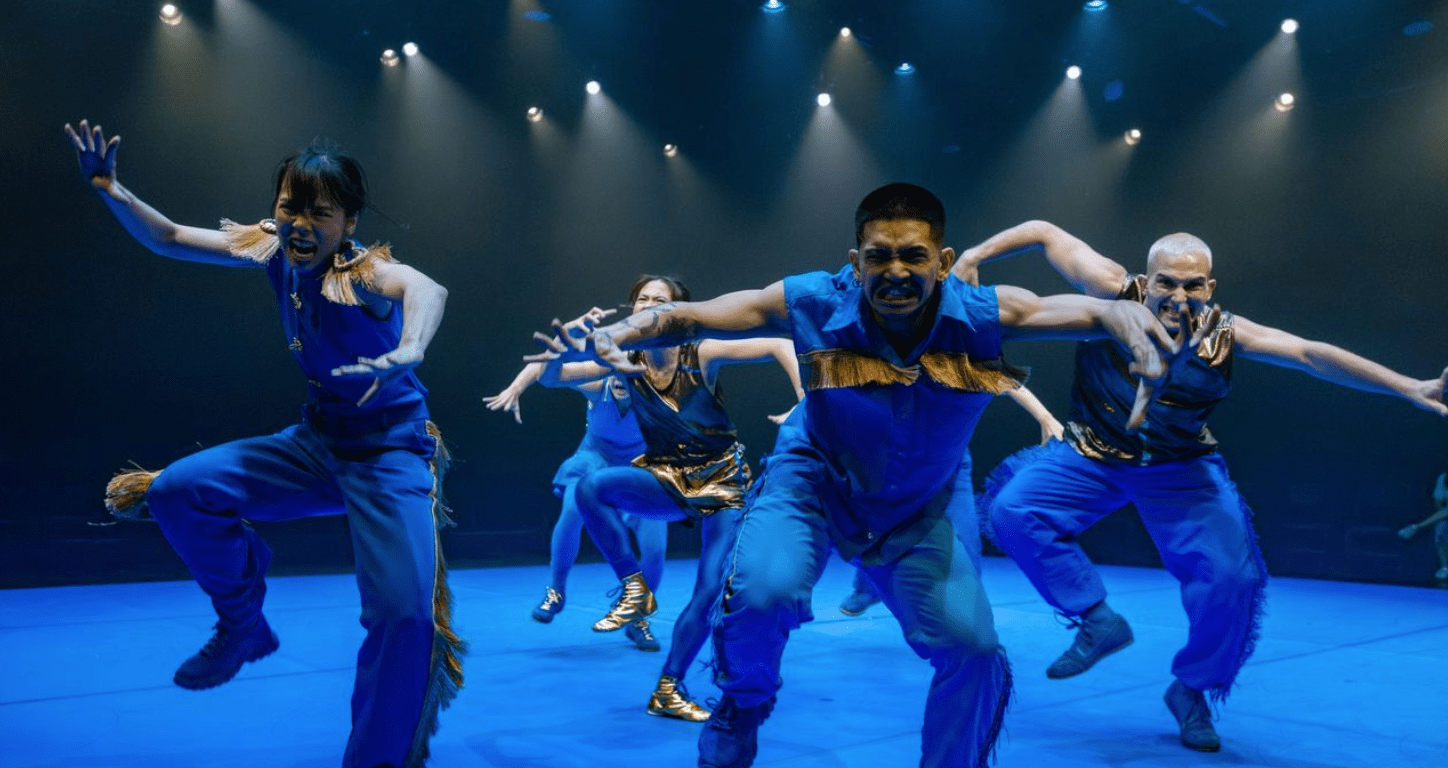
The stronger of the pair is undoubtedly CARILLON, which takes inspiration from the mechanical music box. Set against a striking blue stage floor and smartly costumed by Angeline Oei, the work begins with a buoyant sense of collective celebration. The dancers move in tightly coordinated formations, at times resembling a cheer squad, at others a living machine. Their bodies rotate around invisible axes, lines ripple across the stage, and repeating movement phrases accumulate with hypnotic precision and high energy that feels akin to a pop concert, immediately arresting and riveting to view.
What initially appears joyous gradually reveals a darker undercurrent. The choreography, created by Panzetti/Ticconi in collaboration with the performers, exploits repetition not kist as an aesthetic device but as a dramatic engine. As movements recur and intensify, one begins to sense the strain beneath the surface. Breath becomes audible and fatigue seeps into the choreography. What began as exuberance starts to feel compulsory, where you can hear the machine winding up again even when they want to rest, a kind of nightmarish Toy Story.

This tension between pleasure and exhaustion is where CARILLON finds its greatest power. The dancers perform with extraordinary commitment, executing high leg extensions, intricate synchronisations and relentless sequences that make visible the physical labour underpinning the work. The precision required is immense, and the performers rise admirably to the challenge.
Particularly memorable are moments when the choreography shifts from entertainment towards something more unsettling, marking a point of rebellion and rage against the machine. At one point, dancers literally form a collective platform, transforming bodies into architecture, and providing an elevated space for them to express their dissatisfaction, unbridled freedom from the machine.

Elsewhere, handkerchiefs are drawn across faces, evoking images of protest and resistance, contrasting their earlier, more gentle waving into intense, forceful slaps across the floor. The association is never overstated, but it introduces a provocative political resonance into a work ostensibly inspired by a mechanical toy.
Adrian Tan’s lighting design contributes significantly to this evolution. Bright, festive images gradually give way to more confrontational atmospheres, occasionally overwhelming the stage with an intensity that mirrors the dancers’ mounting emotional and physical exertion. Demetrio Castellucci’s sound design likewise propels the work forward, reinforcing its cyclical momentum while hinting at the instability lurking beneath its polished surface.

If CARILLON examines the pressures of collective conformity, O:ro concerns itself with what happens after rupture. Created by Kim Bora in collaboration with the dancers, the work approaches mourning not as an event but as an ongoing state of relation. Where the first piece is expansive and theatrical, O:ro is intimate, patient and quietly absorbing.
The visual palette shifts dramatically. The intense blue and gold world of CARILLON gives way to a softer, white circle, creating a softer environment that immediately alters the audience’s relationship to the performers. Kim Eunkyoung’s distressed, hole-ridden white costumes suggest vulnerability without becoming overly symbolic, while Adrian Tan’s lighting once again demonstrates impressive versatility, creating gentle transitions that seem less concerned with dramatic effect than with holding space for contemplation.

The work unfolds as a gradual search for connection. The dancers enter cautiously, gathering within the circular space and leaning into one another as if testing the possibility of trust. Early sequences feature subtle vocalisations and curious movements of the tongue, suggesting communication before language. Meaning is not articulated so much as felt, as they test the ground and attempt to forge connection with each other.
At times the performers appear animalistic, surrendering to instinct rather than social convention. Bodies stretch, fold and seek contact. Touch becomes both comfort and inquiry. The choreography often feels improvisational, even when its structure is clearly controlled, creating the impression that we are witnessing a community discovering its own shared vocabulary in real time.

The sound world, much of it generated through breath, voice and embodied action, reinforces this sense of collective searching. Unlike the assertive sonic landscape of CARILLON, O:ro embraces quietness. Its rhythms accumulate gently before dissolving again, producing an atmosphere that is mournful without becoming oppressive.
As the work progresses, moments of explosive release punctuate its otherwise restrained surface. The dancers scatter, rush and regroup, evoking what feels like different stages of grief. Yet the choreography resists any neat psychological reading. Rather than moving towards closure, it continually returns to the idea that loss remains present within the body, shaping relationships long after an absence has occurred.

While O:ro never achieves the same level of theatrical impact as CARILLON, its strengths lie elsewhere. It is a work of sensitivity rather than spectacle, one that rewards attention to subtle shifts in energy and relation. The performers handle these demands with impressive control, sustaining an atmosphere of vulnerability without sacrificing choreographic clarity, as if taking us through a process of grieving, and healing through community.
Taken together, the two works form an intriguing dialogue. One examines the exhilaration and exhaustion of systems sustained through endless repetition; the other explores how bodies continue to carry traces of what has been lost. Both are interested less in narrative than in sensation, constructing emotional landscapes through movement, image and atmosphere.

If Elusive occasionally feels more evocative than revelatory, that is perhaps because both works prioritise the creation of moods over the development of radically new choreographic languages. Yet there is considerable value in how effectively they realise their respective worlds. The dancers of T.H.E Dance Company anchor both pieces with exceptional physical commitment, moving seamlessly between the extroverted demands of CARILLON and the introspective textures of O:ro.
The result is a thoughtfully curated double bill that may not redefine contemporary dance, but nevertheless offers two distinct and engaging perspectives on what it means to endure, connect and persist. In a festival landscape often crowded with grand statements, Elusive finds strength in its willingness to linger within ambiguity.
Photo Credit: CRISPI
Elusive—A Double Bill ran from 19th to 21st June 2026 at the Esplanade Theatre Studio. Tickets and more information available here
cont·act Dance Festival 2026 (16th edition) runs from 8th to 28th June 2026. Full programme and tickets available here
Production Credits
| CARILLON Choreography Ginevra Panzetti & Enrico Ticconi in collaboration with the performers Music Composition & Sound Design Demetrio Castellucci Lighting Design Adrian Tan Costume Design Angeline Oei Performers Fiona Thng, Klievert Jon Mendoza, Chang En, Carmelita Nuelle Buay, Michail Logothetis Alafragkis, Priscilla Chan O:ro Choreography Kim Bora in collaboration with the performers Stager Park Sangmi Rehearsal Assistant & Archivist Choi Soyoung Music Composition & Sound Design Cheo Uzong Lighting Design Adrian Tan Costume Design Kim Eunkyung Performers Fiona Thng, Klievert Jon Mendoza, Chang En, Carmelita Nuelle Buay, Michail Logothetis Alafragkis Producer (Art Project BORA) Lee Mijin Artistic Consultant Jang Hyejin Sound Engineer Lee Dongjune |

