
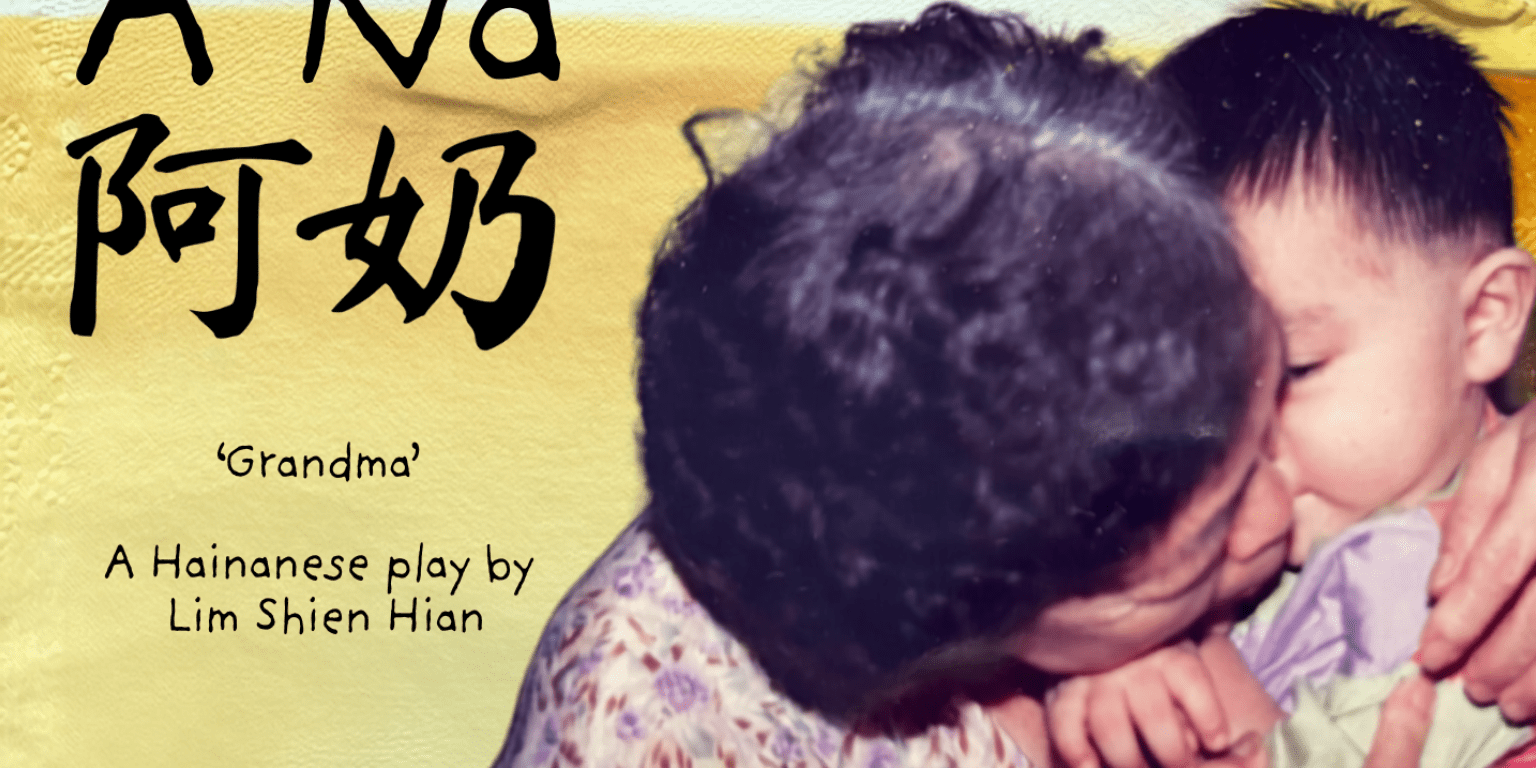
Disarmingly simple, straightforward and sincere script and staging brings theatre back to basics through reminiscing on patchwork memories with his late Hainanese grandmother.
Lim Shien Hian has been in the theatre scene for a while now, wearing various offstage hats ranging from assistant directing to producing, before trying his hand at playwriting. But never has he staged a one-man show before. Originally conceived during a playwriting workshop last year, A Na (Hainanese for Grandma) is part letter, part memoir, and ultimately a patchwork monologue pieced together from what Shien Hian remembers of his late grandmother.
Staged in the Rehearsal Studio at 42 Waterloo Street, the space is makeshift and cosy, furnished with cushions and folding chairs, with very little distance between audience and performer. Shien Hian sits at a desk, reading from his laptop, while the script is projected in Mandarin, Hainanese and English. With little indication of what to expect, the performance begins almost absentmindedly, as if he were simply thinking aloud after being reminded of a memory.
A Na feels deliberately unrehearsed and raw. At first, Shien Hian occasionally rushes through the script, his emotions ebbing and flowing without obvious theatrical emphasis. As memories surface one after another, you find yourself waiting for them to build towards something bigger, to excavate a hidden family history or uncover some larger universal truth.
Yet they never do.
The memories drift back and forth through time without a clear dramatic throughline. Characters appear briefly before disappearing again, and even Shien Hian himself remains more storyteller than fully realised stage persona. He recalls childhood meals lovingly prepared by A Na (“It’s true, all Hainanese grandmothers know how to make chicken rice”), snippets of Hainanese culture and lingo he gradually picks up, afternoons spent playing cards and mahjong with relatives, fleeting mentions of university life.
Eventually, you realise the play simply isn’t interested in becoming anything more than what it already is. Rather than shaping memory into conventional drama, A Na embraces memory in its natural state: associative, incomplete and often meandering. It is theatre stripped back to its essentials: one person remembering someone they loved, memorialising her, and perhaps reconnecting with her eleven years after her passing.
Once that expectation falls away, you begin listening differently, not as an audience waiting for a revelation, but as a friend listening to someone reminisce. You become quietly invested in these fragments of a life: the family’s trip to Melbourne, the only overseas holiday they shared together; the photograph of A Na dressed up proudly for a cousin’s wedding; the tension when his parents fought and she tried to keep the peace; or the recurring hospital scenes, where long admissions slowly blur into one another as illness stretches on.
Throughout, Shien Hian also explains Hainanese words and customs, from his grandmother’s exasperated cry of “wei du mai” whenever she scolded him, to the advice she offered after his first heartbreak. These seemingly insignificant details become the emotional fabric of the performance. Their relationship was never defined by grand declarations, but by accumulated acts of care: the familiar route to her flat in Toa Payoh, shared meals, quiet conversations, and simply growing up in each other’s presence. It is precisely this ordinariness that makes their bond feel genuine.
One of the production’s strongest moments arrives towards the end, when Shien Hian recounts the belief that the deceased will visit loved ones in a dream a hundred days after their passing. While on university exchange, he dreams of A Na standing high above him in a towering building overlooking a steeply curving road, watching him silently as atmospheric music fills the space. He wakes and immediately messages his family. The sequence gains additional weight after his earlier recollection of keeping vigil beside her hospital bed, only to fall asleep and awaken to discover she has stopped breathing, haunted by the possibility that she may have regained consciousness one last time while he slept.
As much as A Na remains an imperfect work, with its uneven pacing, occasionally inconsistent vocal delivery and loose dramatic structure, its sincerity is never in doubt. It is also a rare opportunity to hear Hainanese spoken onstage. Shien Hian reveals afterwards that it had been almost a decade since he had last spoken the dialect at such length, yet the language returns as though he is unearthing another memory.
In the final scene, he speaks directly to his grandmother in Hainanese. It feels less like performance than conversation, an attempt to reconnect, to make peace, and perhaps to say the things left unsaid. Tears fill his eyes, and there is little doubt that what we witness is genuine. A Na may never quite achieve the dramatic precision or narrative cohesion one hopes for, but there is something quietly affecting about its refusal to be anything other than an honest act of remembrance. In a theatre landscape often eager to make grand statements or dazzle with spectacle, there is value in a still raw work content simply to preserve a relationship, a language and a memory. Sometimes, that is enough.
A Na 阿奶 Grandma played from 26th June to 29th June 2026 at the Rehearsal Studio 42 Waterloo Street. Stay up to date by following Shien Hian on Instagram @shienofhian

