
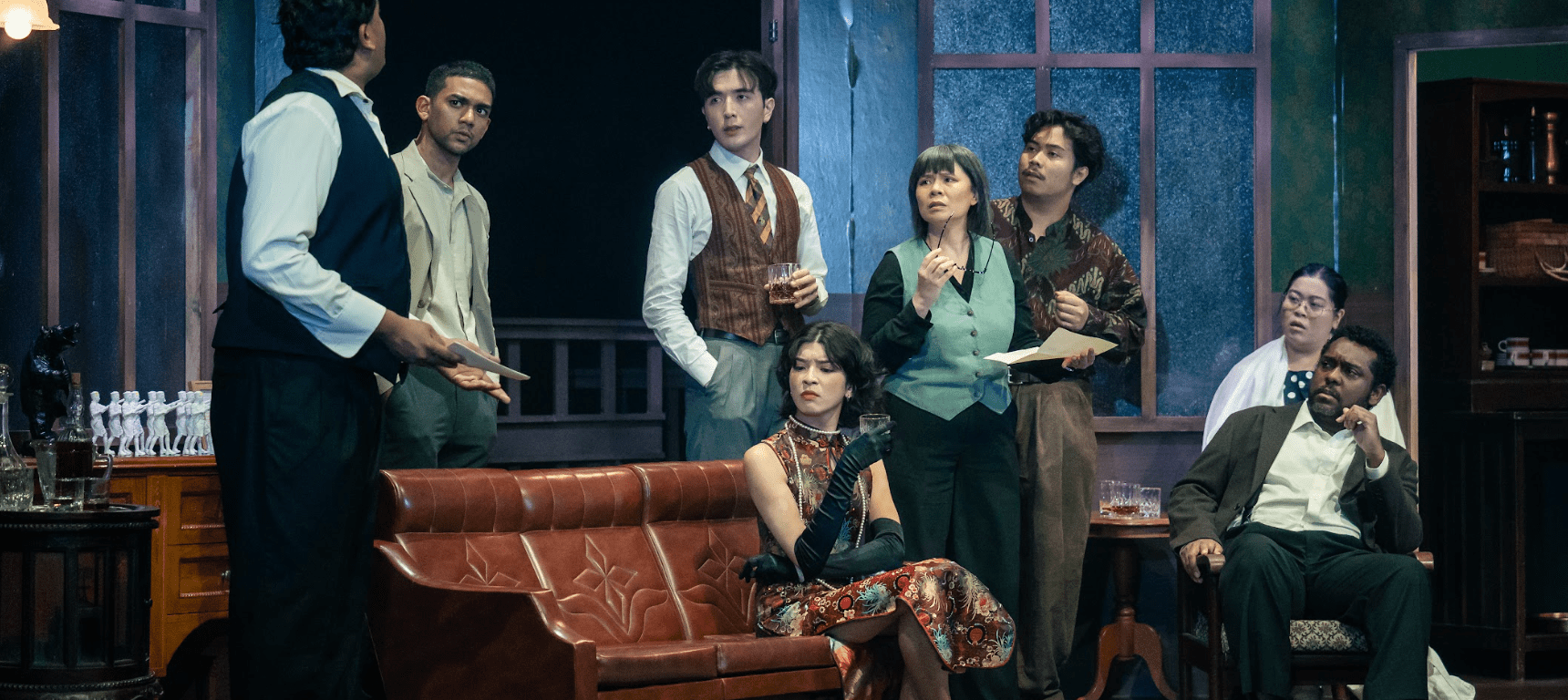

The Winter Players’ ambitious staging of And Then There Were None is a flawed but encouraging step forward for the young company.
There is no questioning the ambition behind The Winter Players’ latest production of And Then There Were None. Agatha Christie’s celebrated murder mystery is one of the most demanding works to stage, requiring a large ensemble, meticulous technical precision and sustained suspense over two tightly wound acts. It is a daunting undertaking even for established companies, making it an especially bold choice for an emerging collective still finding its artistic voice.
The beloved classic mystery follows ten strangers who are invited to a secluded island mansion under mysterious circumstances. Cut off from the mainland, they soon discover that each harbours a dark secret from their past. As an unseen voice accuses them of crimes that escaped justice, the guests begin dying one by one, forcing the survivors to confront not only the identity of the killer among them, but also the guilt they have spent years trying to bury.

Directed by Feroz J. Malik, the production embraces that challenge wholeheartedly. This is The Winter Players’ largest cast to date and the culmination of the company’s two-year residency with Singapore Repertory Theatre. Throughout the evening, there are flashes of excellent theatre that demonstrate the company’s ambition and potential. Yet opening night also revealed the growing pains of a production attempting to juggle an enormous number of moving parts.

Rather than treating the play purely as a realist mystery, Feroz approaches it as something closer to psychological horror. The mystery itself often takes a back seat to the emotional burden carried by each character, with guilt, paranoia and the inevitability of judgement becoming the production’s true driving forces. Throughout the evening, reality feels strangely suspended. Time passes, yet morning never seems to truly arrive. Flashes of lightning, rolling thunder and the ever-present sound of crashing waves create the sensation that Soldier Island exists outside the ordinary world altogether.
Onstage, Studio VAGABOND’s set immediately establishes an intimate playing space, placing audiences almost inside the isolated island mansion alongside its doomed guests. The proximity works well for Christie’s increasingly claustrophobic mystery, allowing every accusation and uneasy glance to be observed up close. However, the illusion begins to wear as the evening progresses. The repetitive exterior visible through the windows makes the island feel surprisingly static, while there are odd details, such as characters returning from supposedly torrential rain with dry costumes and ponchos. The result is an atmosphere that feels less like an isolated island than a kind of purgatory and personal hell, where the guests are trapped not simply with a murderer, but with the weight of their own pasts.

Where the production finds its strongest footing is through several standout performances. Ebi Shankara delivers the evening’s most accomplished performance as General Mackenzie. His years of stage experience are immediately evident, not through theatrical excess but through remarkable restraint. Every pause, glance and quiet recollection of his late wife carries genuine emotional weight, allowing grief to emerge naturally rather than through heightened performance.

Ramzie Tahar gives William Blore an assured and grounded presence, bringing quiet authority to the retired police officer without resorting to caricature. His measured delivery and natural stage presence make Blore one of the more believable figures among the ensemble, particularly as suspicion begins to turn on everyone in the house. Meanwhile, Adeeb Fazah brings measured sincerity to Dr. Armstrong, gradually revealing the doctor’s mounting guilt beneath an outwardly composed façade. Nishanth Kumar is quietly effective as Thomas Rogers, while Rishi Vadrevu continues his steady ascent as one of the more dependable emerging actors on the local stage. As Philip Lombard, he carries himself with an effortless confidence and charisma that suit the role perfectly, before revealing greater emotional vulnerability in the closing scenes. It is another assured performance from an actor who has quietly grown from strength to strength with each production.

Feroz also finds thoughtful ways of revealing character through smaller moments. Emily Brent’s instinctive recitation of biblical scripture, drawing from Ezekiel 26, a passage associated with destruction and downfall, shows how she desperately attempts to absolve herself. It becomes more than simply a religious gesture, instead an insistent act of self-preservation, revealing a woman clinging to faith as the moral certainty she has built her identity upon begins to crumble. Such understated choices add welcome psychological texture to Christie’s familiar mystery.

As such, one of the production’s defining features is its cross-generational ensemble, bringing together seasoned performers alongside a younger generation of emerging theatre-makers. It is an admirable ambition and reflects The Winter Players’ desire to create meaningful opportunities for artists at different stages of their careers.

However, it also presents the production’s greatest challenge. The difference in experience is difficult to ignore. Veteran performers command the stage with vocal assurance, confidence and emotional precision, while several of the younger cast members are still visibly finding their footing within Christie’s heightened theatrical style. The contrast is especially noticeable when experienced actors share scenes with newer performers, exposing inconsistencies in projection, pacing and emotional credibility.

This is not so much a reflection of talent than experience. And Then There Were None is an unforgiving play that demands absolute precision from its ensemble. Every entrance, exit, pause and revelation contributes to the mystery’s carefully engineered tension. With a cast this large and varied in experience, the production occasionally feels as though it is balancing two objectives at once: mounting one of theatre’s most technically demanding mysteries while also serving as a valuable learning ground for emerging performers.

That balancing act is admirable, but it contributes to the unevenness of opening night. The decision to perform without microphones further exposes these differences. While several cast members project confidently throughout, others struggle with clarity and diction, occasionally making important dialogue difficult to catch despite the intimacy of the venue.

Similarly, the production’s choice to adopt British accents proves distracting. Although the story has been relocated to Langkawi, the varying accents are inconsistent across the ensemble and sometimes become more noticeable than the performances themselves. A more natural local delivery may have allowed the actors to focus more fully on character while giving the production an identity that felt uniquely its own.

Technically, the production also feels like one still settling into itself. Several scene transitions lack the precision needed to sustain suspense, while occasional line stumbles and missed cues interrupt the rhythm that Christie so carefully constructs. None of these issues feel insurmountable, and many will likely tighten as the run progresses, but together they create the impression of a production that could have benefited from a little more time to fully find its footing.

The evening’s strongest sequence arrives towards the conclusion, when Vera Claythorne and Justice Wargrave are left to confront one another. Here, Feroz’s direction becomes noticeably more assured, relying less on dialogue and more on physical storytelling. The Judge’s almost supernatural dominance over Vera is vividly realised through a series of carefully choreographed movements, as she corners, restrains and seemingly exerts an invisible grip over her victim without ever directly carrying out the murder herself. The sequence blurs the line between psychological manipulation and physical reality, creating one of the evening’s few moments of genuine unease. It is a reminder of the compelling theatre that emerges whenever every element of the production falls into place.

Ultimately, And Then There Were None is a production whose ambition exceeds its execution, but such boldness is not something to dismiss lightly. Few young companies would choose to tackle a Christie mystery of this scale, and fewer still would do so while bringing together performers across generations with the hope of learning from one another. That spirit of collaboration is evident throughout the evening, even when the production doesn’t always reach the standard it sets for itself.

While the production contains exposed rough edges in both performance and technical execution, there is enough here to suggest a production that will continue to improve with more experience and time. More importantly, there is a company willing to challenge itself rather than play it safe.

It may not be the definitive staging of And Then There Were None, but still, it is an earnest, ambitious and encouraging effort, one that showcases both the promise of The Winter Players and several performances that remind us why Singapore’s next generation of theatre-makers’ journey is worth following and watching.
Photo Credit: Yu Khing
And Then There Were None plays from 25th to 28th June 2026 at the KC Arts Centre. Tickets available from BookMyShow
Production Credits
| Director Feroz J. Malik Playwright Agatha Christie Cast Adeeb Fazah as Dr. Armstrong Miriam Cheong as Emily Brent Nishanth Kumar as Thomas Rogers Medli Dorothea Loo as Vera Claythorne Sharon Mah as Justice Wargrave Barathan Naicker as Fred & Understudy for General Mackenzie Ebi Shankara as General Mackenzie León Saint Claire as Anthony Marston Shannen Tan as Ethel Rogers Ramzie Tahar as William Blore Rishi Vadrevu as Philip Lombard Tasha Chang, Understudy for Vera Claythorne and Ethel Rogers Sameer Haque, Understudy for Dr. Armstrong, Anthony Marston, Fred and Philip Lombard Co-Producer:Marwyn Ho Co-Producer Mark Benedict Cheong Production Manager Tan Yin Qi Stage Manager Bree D’Souza Assistant Stage Manager Nicole Ooi Set Designer Studio VAGABOND Lighting Designer Andrew Wijaya Sound Designer Eric Larrea Costume Designer Cipta Afreen Brand Manager & FOH Manager Corliss Tay |


2 thoughts on “★★★☆☆ Theatre Review: And Then There Were None by The Winter Players”