
Theatre is essentially an act of human connection: between actors, between performers and audience, and between a story and the people who receive it. But what happens when you remove one of the things theatre usually relies on to make that connection work: the rehearsal?
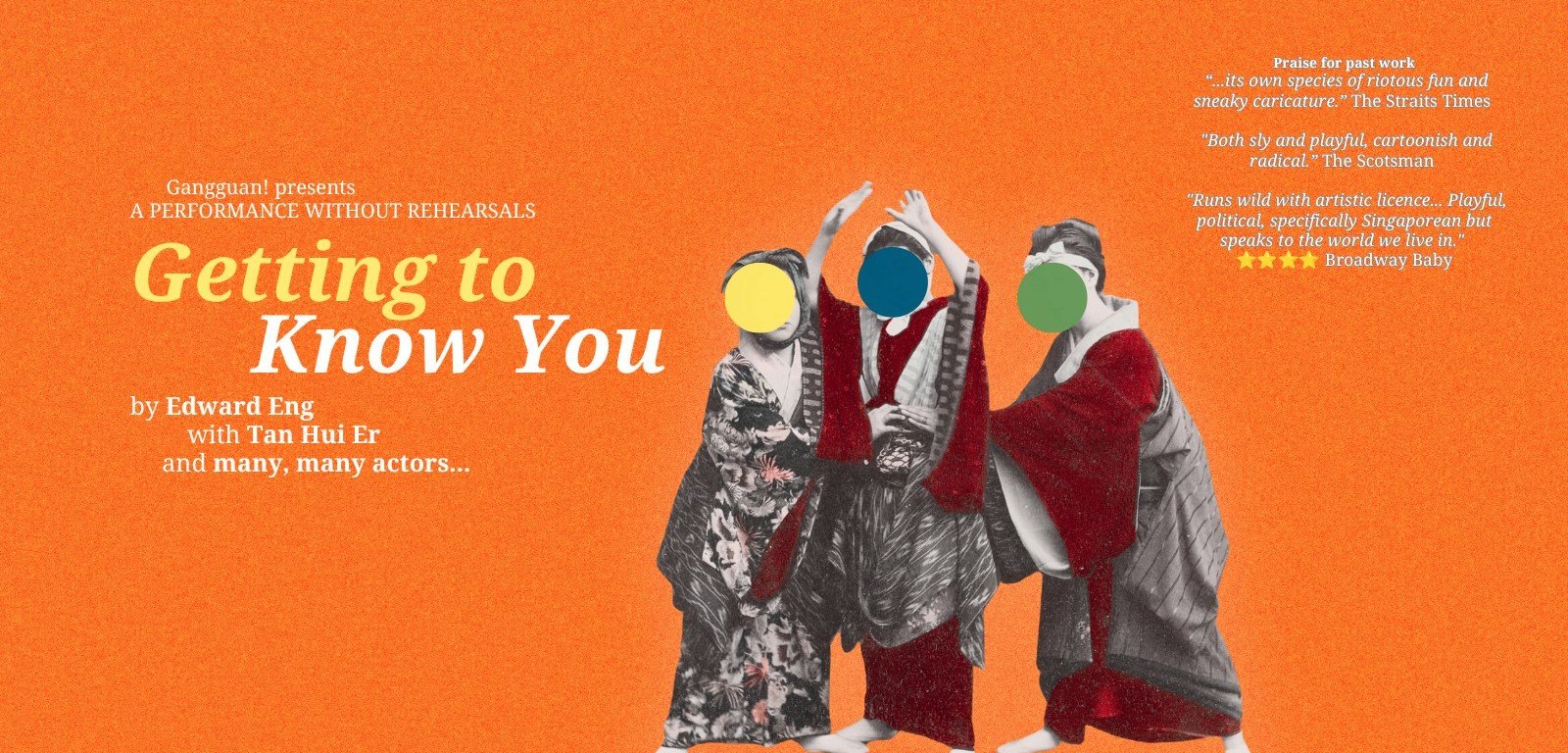
For the actors in Gangguan! Theatre’s Getting To Know You, there will be no conventional rehearsal. Each night, a new pair of performers will encounter Edward Eng’s script for the first time as they perform it, without having read or rehearsed it together beforehand. They will have the words on the page, its directions, and each other.
“It’s a play without rehearsals,” Eng says. But the experiment, he insists, is less about throwing actors into the unknown than about what happens when a group of people chooses to trust one another enough to let go.
The idea itself came much later than the original story though. Around two years ago, Eng wrote a play under the mentorship of playwright Haresh Sharma, originally titled Talking To My Grandfather About Love. He had been thinking about writing a conventional play about how we respond to living in a time that feels different from the generations before us.
He was also thinking about a line from Simon Stephens’ play Song From Far Away: “How do we know we are living in a golden age? Can we know? Or can we only know after we have left the golden age?”
Initially drawn to the uncertainty of that question, as the play developed, he became increasingly interested in another kind of uncertainty: what happens when a story is passed from one person to another. “In theatre, we’re always trying to transmit these complex emotions and story,” Eng says. “And just as interesting is the more metatheatrical process of how this story gets told and retold.”
That eventually became the form of Getting To Know You, which follows Eri and Alex, two people who meet again in a nightclub on New Year’s Eve after years apart. As they wonder why there are so few coming-of-age stories about people in their 30s, the play becomes an exploration of friendship, belief and the people we give our hearts to.
The experiment, then, is not separate from the story, but a way of enacting it. If the play is about how people find and lose and rediscover connections, its creation asks the same of the people making it. The actors have to trust one another. The directors have to trust the actors. The designers have to respond to what is happening in front of them. And, eventually, the audience has to trust that whatever unfolds is worth watching.
When Eng first approached Tan Hui Er about co-directing, she had been considering taking a break from theatre. “Honestly, I told myself to take a break from theatre,” she says. “Then even going into the story he told me the dramaturgy and I was hooked.”
Tan, who works across film and theatre, says one of the questions she often asks is why a particular story needs to be told through a particular medium. “This is a literal test of this question,” she says.
She was also intrigued by the possibility of creating an entire world with just two people and the words they say. During one workshop, an actor described the project as showing “the alchemy of live theatre”.

That idea has stayed with her. The more they developed the show, the more Getting To Know You began to describe not just its narrative but its entire process: getting to know the script, getting to know a scene partner, and getting to know what happens when you stop trying to control every outcome.
It is a process that has required the directors to let go, too. Eng initially thought the concept would be relatively straightforward. Tan suggested they workshop the play, and those sessions quickly revealed how much more complicated the process was from an actor’s point of view.
Without conventional rehearsal, the writing itself has to do much more work. “A lot of actors ask, ‘Are you going to direct us? Is it like improv?’” Eng says. “It’s not like stand-up comedy. It’s just a performance with lines and directions on a piece of paper.”
The distinction is important. The actors are not being thrown into chaos. They are being given a carefully constructed set of conditions in which they can respond intuitively. The script has gone through multiple versions as Eng and Tan have tested those conditions in workshops, bringing in different actors to see what happens when they encounter the work.
“The lines are so fun,” Tan says. “And there are so many moments where it’s acutely relatable in experiences, where they’re genuinely making a connection with someone in real time.”
The workshops have also forced Eng to become more precise as a writer. “The literal words written on a page need to be precise,” he says. “So I had to be very specific about the way I worded both the dialogue and stage directions on the page to ensure that we would bring about a certain result each time.”
That might sound contradictory: a production built around unpredictability, but one whose script has been meticulously crafted. But it is that contradiction that is part of the point. The lack of rehearsal does not mean a lack of preparation. Instead, preparation is being used to create the conditions in which people can safely let go.
Before each performance, the actors will work through practical and safety considerations, particularly around physical intimacy. They will have a deliberate warm-up, including exercises designed to awaken particular senses and create a connection with their scene partner. The aim is to prepare the actors to be receptive to one another. “One thing we try to be careful about is boundaries,” Eng says. “Think about how we’ll probably only let a kid run around a playground and go wild as long as we know the swing won’t collapse.”
The playground metaphor has become central to the way they think about the production. “That’s the balance,” Tan says. “How can we make sure that people feel safe enough to take [risks]?”
And that trust extends beyond the actors. Tan wanted the designers to be part of the show rather than simply operating behind the scenes. Sound designer Louis Quek and lighting designer Visual Purple will respond live, helping to create the world around each new pairing of actors. “We’re trying to create a playground where everyone can dare to take risks,” Tan says.

In that sense, everyone involved is practising the same thing. The actors have to listen to each other. The designers have to listen to the actors. The directors have to listen to what emerges from the process. Even the casting became part of that experiment, where Tan and Eng did not begin with a rigid set of criteria for who should be paired with whom, instead allowing the pairings to organically come from instinct, familiarity and curiosity.
Tan chose a range of actors, such as those she had watched for years, including Sharda Harrison and Lian Sutton, whom she describes as mentors. Risa Ann Wong and Xuan Ong are good friends who had never performed together. Vanessa Toh and Izzul Irfan interested her because of the differences in their creative processes. “And Karen and Noorlinah,” Tan says, “well, being the veteran actresses they are, we just want to see what they make of it! It’s fundamentally interesting to see how each pair of actors approach this process.”
That curiosity is important because neither Eng nor Tan wants to know exactly what will happen. Eng sees the project partly as a return to an older kind of theatre, before productions necessarily had to run “like clockwork”. “We’re cutting back to an original level of theatre where things are not literally well-rehearsed,” he says, pointing to traditions such as bangsawan and Shakespearean theatre, where actors were more intuitively involved in embodying a story.
But there is a paradox at work. Although the production appears to be giving up control, an enormous amount of thought has gone into deciding what can safely be surrendered, with unspoken rules that run through the script that ensure certain outcomes. “Theatre is full of tricks,” Eng says. “But we’re pulling back the curtain in a way. It’s a trick within a trick because I tell you all of this but still being very careful and deliberate with how we design the process.”
For Eng, the most interesting part is seeing what changes when the actors are finally left to the work. “You think there’s something they’ll keep to,” he says, “but then you go, ‘Oh my god’, and realise it’s so different.”
That unpredictability is not something they are trying to eliminate. It is what they are trying to protect. The actors have to trust the words, their scene partner and their own instincts. The directors have to entrust the work to the actors. The designers have to respond rather than simply execute. And the audience has to accept that they are watching something that cannot be repeated in exactly the same way.
There is no definitive version of Getting To Know You waiting backstage. There is only the version that happens that night. For Eng, that act of entrusting a story to someone else is part of a much larger human impulse. “We are all oral historians of our own culture,” he says. “And seeing that transmit across different people, well, hopefully something does happen as it moves from one person to another.”

That transmission is what initially drew him to the idea. Now it has become the central principle of the production. Eng hopes audiences will think about the friendships and relationships in their own lives, but he does not want to dictate what they should take away.
“From a selfish and extreme level, I do want them to think about all the friendships and relationships in their life,” he says. “But I think that, at a more theatrical level, I hope that they gamely and excitedly undergo this transformation with the actors and directors.”
Tan’s hope is similarly open-ended. When asked what she wanted the audience to feel afterwards, she came back to the same basic idea that runs through the production: connection. “Ultimately what we’re doing with the narrative and the device we’re exploring is the celebration of human impulses and connection,” she says. “There’s something really beautiful about that.”
Perhaps that is why the title has become more than just the name of the play. Getting to know someone is inherently uncertain. You listen, respond, misread, surprise each other, reveal something, hold something back. You cannot rehearse a friendship into existence.
And so, every night, Getting To Know You asks its actors to do something similar. They meet the play for the first time. They meet each other. The directors meet a new version of their own work. The designers respond to what is happening in front of them. And the audience gets to witness the whole thing.
The hope is not necessarily that audiences leave with a neat understanding of what they have just seen. It is that, somewhere in all that uncertainty, they recognise something familiar: the strange, difficult, often inexplicable ways that people find their way towards one another. There are, Eng says, “deep human desires” beneath all the forms of entertainment we have learned to reach for. “Deep down people have a desire to watch, learn and connect,” he says.
For Getting To Know You, the invitation is simply to trust that impulse, and see where it takes them, the actors, and the audience each night.
Photo Credit: Gangguan! Theatre
Getting To Know You plays from 10th to 13th September 2026 at the Goodman Arts Centre Black Box. Tickets available from BookMyShow
Cast for 10 September: Noorlinah Mohamed, Karen Tan
Cast for 11 September: Risa Ann Wong, Xuan Ong
Cast for 12 September: Sharda Harrison, Lian Sutton
Cast for 13 September: Izzul Irfan, Vanessa Toh

