
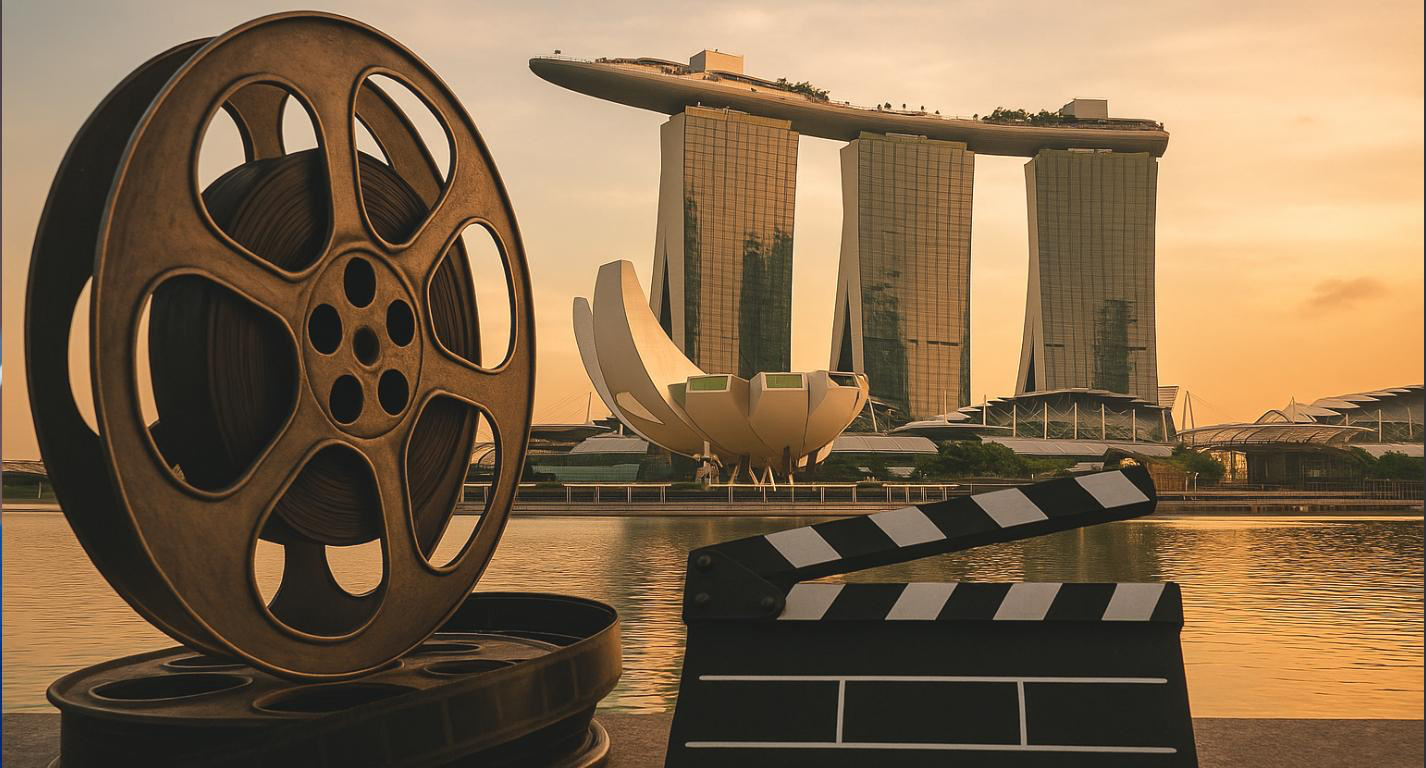
Few cities have managed to transform their skyline into a cinematic brand quite like Singapore. Long before “Crazy Rich Asians” splashed Marina Bay Sands across billboards worldwide, filmmakers were already turning to the island nation as a stage where futurism and tradition collide.
Part of the lore stems from geography. To Hollywood and other international studios, Singapore offers something rare. A single location that can convincingly stand in for the past, the future, and everything in between. For directors, that means instant visual storytelling, starting with…
Crazy Rich Asians (2018)
The undeniable crown jewel of Singapore’s filmography, Crazy Rich Asians was far more than a hit film. It was a cultural phenomenon. With a staggering $238.5 million gross at the worldwide box office, it shattered expectations. Its impact was so profound that its snub for Best Picture at the Oscars became major news in itself.
Director of Photography Vanja Cernjul’s camera made Singapore a star. To convey the grandeur of the city, he purposefully used wide, steady, and brilliantly saturated shots. The most well-known was the shot at the Marina Bay Sands infinity pool. The production had unique access to the famous pre-dawn scenes. MBS’s casino and opulent culture were central to the narrative’s focus on extreme wealth.
The casino and luxury culture of MBS weren’t just a backdrop. They were fundamental to the story’s theme of extreme wealth. This portrayal powerfully cemented Singapore’s global image as a nexus of finance and high-stakes entertainment.
This reputation is rooted in a very real, dual-tiered system: the glittering integrated resorts like Marina Bay Sands and a strictly regulated online casino landscape. For international viewers captivated by the film’s depiction of this aspect of local culture, you can find out more about the current state of Singapore online casinos in this CasinoBeats article. This includes the legal frameworks and available options for digital play, providing a fascinating real-world context.
This reputation stems from an actual two-tiered system: The highly regulated online casino industry and glitzy resorts like Marina Bay Sands. Knowing the current situation of gaming offers an intriguing real-world context for viewers captivated by the movie’s portrayal of this facet of local culture. The sophistication portrayed on screen also extends to the contemporary digital sphere. It’s a field that is frequently examined for its appeal and market trends.
Equals (2015)
Drake Doremus’s sci-fi romance Equals presents a very different, but no less compelling, picture of Singapore, even though it isn’t as popular as Crazy Rich Asians. Despite earning a more modest $3.1 million at the global box office, the film found its audience as a cult classic.
The movie, which stars Kristen Stewart and Nicholas Hoult, shows a heartless future society. Doremus and cinematographer John Guleserian used Singapore’s architecture as a co-star to create this sterile utopia. They just used a soft-focus, ethereal lens to frame the city’s existing landmarks.
The Gardens by the Bay Supertree Grove is the most famous site utilized. With their alien-like shapes, these imposing bio-mechanical structures made the ideal backdrop. The movie is a master class in how the city’s distinct urban setting can inspire imaginative narrative.
Agent 47: Hitman (2015)
To be clear, nobody expected Shakespeare when they entered Hitman: Agent 47. The critics certainly didn’t, as evidenced by its 8% rating on Rotten Tomatoes. However, by using Singapore as the ideal setting for a high-octane rampage, this overly stylised action romp makes up for its lack of narrative depth. Because it delivers nonstop action, the movie made a respectable $82.3 million worldwide.
First-time director Aleksander Bach views Singapore’s skyline as a high-end commodity. He gives the Marina Bay Sands an almost artificial sheen, transforming the famous infinity pool and the ArtScience Museum’s angular shapes into a stunning battlefield for the movie’s final gunfight.
The chase, however, is where the true magic lies. The iconic “durian” domes of The Esplanade flash by in a blur of adrenaline as Agent 47 screeches along the waterfront along Raffles Avenue. Ideal for a genetically modified killer.
Resurgence on Independence Day (2016)
To put it bluntly, Resurgence was a disappointment. With a box office receipt of $389.7 million, which felt insignificant given its $165 million budget, and a 29% critic score on Rotten Tomatoes, it failed to recreate the original’s enchantment. However, the total destruction of Marina Bay Sands was one of the most iconic scenes in blockbuster history for Singaporean viewers.
Roland Emmerich made our famous skyline the focal point of his destructive symphony. And that’s the strangest and highest compliment a world-renowned movie can give a city. It seems the aliens’ efforts were in vain, however, as Marina Bay Sands is now planning a massive expansion, complete with a fourth tower.
Blackhat (2015)
Michael Mann’s cyber-thriller Blackhat was a complete failure when it came out, earning only $19.7 million worldwide and drawing harsh criticism. However, time has been extraordinarily forgiving. It is now hailed as a misinterpreted masterpiece that explores the world of high-stakes cybercrime. Furthermore, Mann used Singapore as the central, pulsating core of the film’s paranoid aesthetic.
As a hacker released from prison, Chris Hemsworth plays a surprisingly intelligent character in this authenticity-obsessed movie. Mann, who is well-known for his meticulous research, views Singapore’s infrastructure as a tangible representation of the digital world.
Mann’s camera senses the city, not just sees it. He captures the humid glow of Geylang’s neon signs reflecting off wet asphalt. This isn’t a tourism ad. Rather, it’s an atmospheric thesis on how financial networks and fiber-optic cables spell international crime.
Crouching Tiger, Hidden Dragon: Sword of Destiny (2016)
Yes, Sword of Destiny has an infamously low rating of 0% on Rotten Tomatoes, but that says nothing about the unadulterated martial arts bliss this movie offers and everything about snobbish critics. Fans of the genre will see this as a love letter to wuxia, choreographed by the one and only Yuen Woo-ping (Kill Bill, The Matrix), rather than a failed sequel.
Yuen was smart enough to avoid trying to imitate Ang Lee’s poetic stillness when he took over as director. Rather, he focused more on his speciality: gravity-defying action that has a dance-like quality.
This connection to Singapore has to do with the city-state’s function as a contemporary centre of Pan-Asian entertainment and the profound love for the wuxia genre among its patrons. This movie was created for viewers who recognise that a flight can combine both spectacle and soul.
 Bakchormeeboy