

Five decades of Hong Kong history told across case files and investigations.
Even if you’ve visited Hong Kong before, the next time you return, there may be the sense that something within the city has fundamentally shifted. If it’s one thing about the city’s character, it’s that nothing ever stays the same, and the Hong Kong of the past is no longer the Hong Kong of the present, whether in terms of its landscape or its people. All of this comes to light in Chan Ho-Kei’s novel The Borrowed, which traces the career of Hong Kong police officer Kwan Chun-Dok, rising from the ranks of constable to senior superintendent, as we go back in time, decade by decade, to see where it all began in 1967.
Adapting the work for the stage is Hong Kong experimental theatre company Zuni Icosahedron, who presented the Singapore premiere of 13·67 at the Singtel Waterfront Theatre as part of the Esplanade’s 2024 Huayi – Chinese Festival of Arts. Co-adapted by Carson Chung and Zuni Icosahedron co-artistic director Mathias Woo, and also directed by Woo, 13·67 is set in 2013, where Kwan must now revisit some of his most significant mysteries across the decades, to get to the truth behind his final case before retirement.

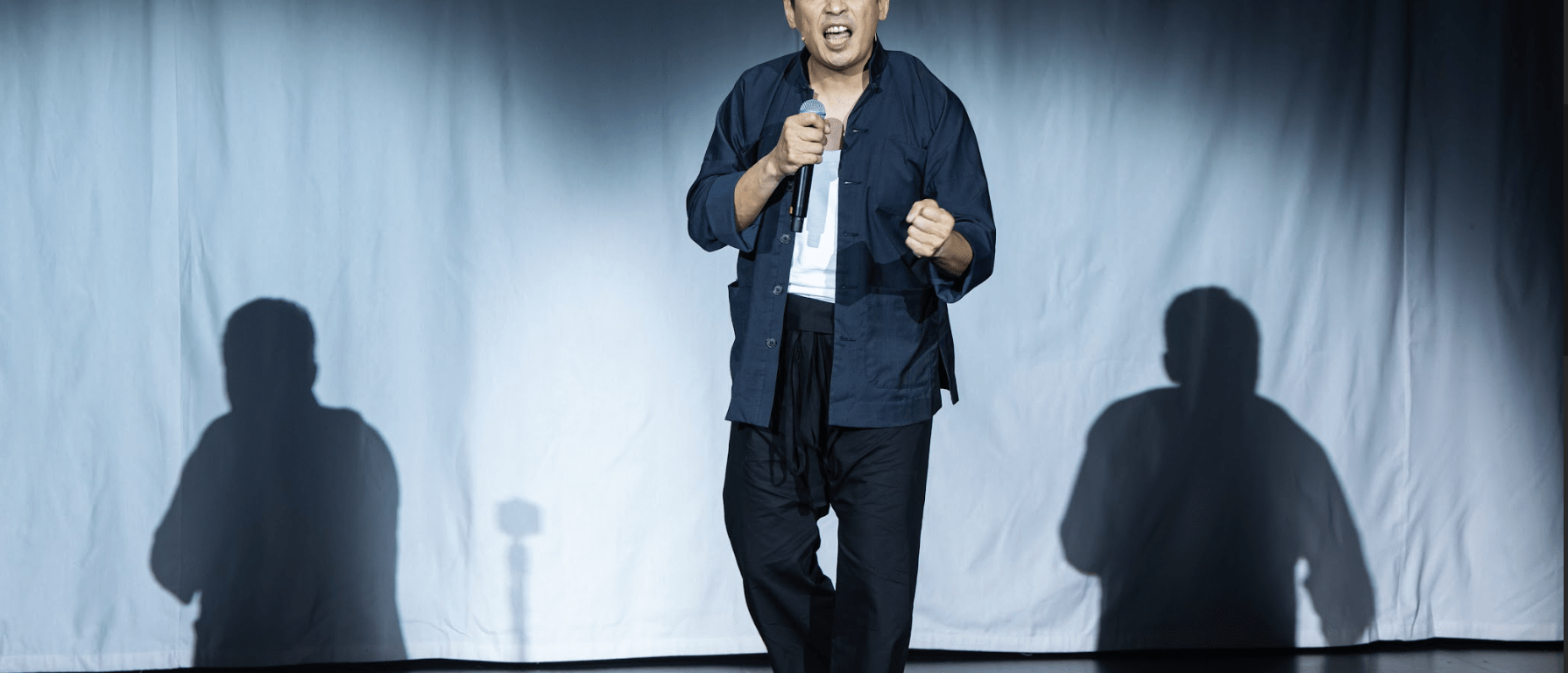
There is always the sense that time is running out, as the play begins with the sound of clock chimes, reminding us how time goes by far too quickly, while So Cho Yan comes out onstage in a retro black dress, singing a Cantonese song, lulling us into an almost neo-noir atmosphere as we wind back the years. We are introduced to Kwan (David Yeung) on his last day of work as senior superintendent, having served in the force for 32 years since the age of 18. He swells with pride as he strikes a pose like Bond, while a younger policeman (Zachary Pink Yung), new to the force, enters, and they delve into Kwan’s past.
The play covers six distinct eras, each one set against a key incident in Hong Kong history – the riots of 1967, the conflict between the HK Police and the ICAC (Independent Commission Against Corruption) in 1977, the Handover in 1997, the SARS epidemic in 2003 and lastly 2013, when Hong Kong is turning into a police state, foreshadowing the Occupy Central movement. As an experimental theatre company however, these are not told in a simple, straightforward manner, but utilise innovative theatre technology and multimedia to elevate each case, such as the German immersive audio technology used that changes the volume and depth of each actor’s voice depending on where they stand onstage.

In a similar vein, technology is also precisely what exemplifies and characterise each decade, changing with the times and often a key factor towards solving each case. From the invention of PDFs, to the LINUX operating system, to even Hong Kong’s Octopus travel card to the rapid rise of the mobile phone in the 90’s and beyond, we are left to wonder how our own lives are shaped by such technology. One particularly prominent case even sees pagers, then the most modern technology available back in the 1980s, key to cracking a case, as policemen developed complex yet creative coded language to send messages to each other via numbers alone.
The cases covered are varied, such as an acid attack in Mongkok in 1997, all told in their own unique, experimental way. Different mediums are used to flesh out the intricate details of the case, from a segment told entirely through comic strips onscreen, to how a live feed of Kwan speaking into a camera makes it feel as if we’re in the interviewee’s shoes under interrogation. These scenes are also brought to life with simple yet effective staging, where ‘cones’ and police tape mark out the perimeter of the crime scene, while red and white lights come together with smoke and gunfire to create the sense of chaos, while Hong Kong’s beloved Cantopop hits also feature strongly, with a montage of familiar songs used to represent the rise of the genre.

What also makes 13·67 rather engaging is its willingness to give audience members a chance to think for themselves and make sense of what’s going on, rather than spoon feeding them with every single answer. The segment surrounding 1967 in particular requires us to listen to the investigation, pay attention to what’s going on, and break down the story before making a fair assessment to decipher the truth. Later on, in 2003’s segment (titled ‘Correct Code’), we are presented with a story told from multiple angles, and constantly determining who really is telling the truth, as we listen to an account from a girl in a bloodied jacket.
There are so many ways to solve a case, and if anything, what 13·67 leaves us with is the realisation and reminder that fate is never pre-determined, and always in our hands. As Cho Yan sings, she wonders about the situation she finds herself in, in turn extending to the idea of Hong Kong as a whole and making its choice about how it wants to shape its future. A production originally crafted for high school students, with so much history behind it, the only way forward is to carve yet another path anew, and figure out what the next decade of Hong Kong will be like, as technology, culture and more is shaped by the next generation.

Photo by AlvieAlive, courtesy of Esplanade – Theatres on the Bay
13·67 played from 16th to 17th February 2024 at the Singtel Waterfront Theatre . More information available here
Huayi – Chinese Festival of Arts runs from 16th to 25th February 2024 at the Esplanade. Tickets and full programme available here
Production Credits:
| Original Novel Chan Ho-Kei Director, Set and Arts Tech Design Mathias Woo Adaptation Mathias Woo, Carson Chung Music Directors Yu Yat Yiu, Cedric Chan Comics / Illustrations Lai Tat Wing Cast Carson Chung, So Cho Yan, David Yeung, Zachary Pink Yung International Exchange Director/Producer Wong Yuewai General Manager (Programme) Doris Kan Senior Manager (Programme) Ho Yin-Hei Lighting Design Mak Kwok Fai Sound Design Can. Ha Video Dan Fong Benny Woo Johnny Sze Costume Design Twinny Cheng Creative Coordinator Cedric Chan Senior Manager (Production and Technical) Chow Chun Yin Technical Coordinator Johnny Sze Deputy Stage Manager Carmen Cheng Assistant Stage Manager Onki Chan Rehearsal Assistant Chloe Li Make Up Billie Siu Hair Styling Lim Tiong Wah, Wai Sock Han Wardrobe Bonnie Chan Sound & Music Editing Kairos Sou |
 Bakchormeeboy