
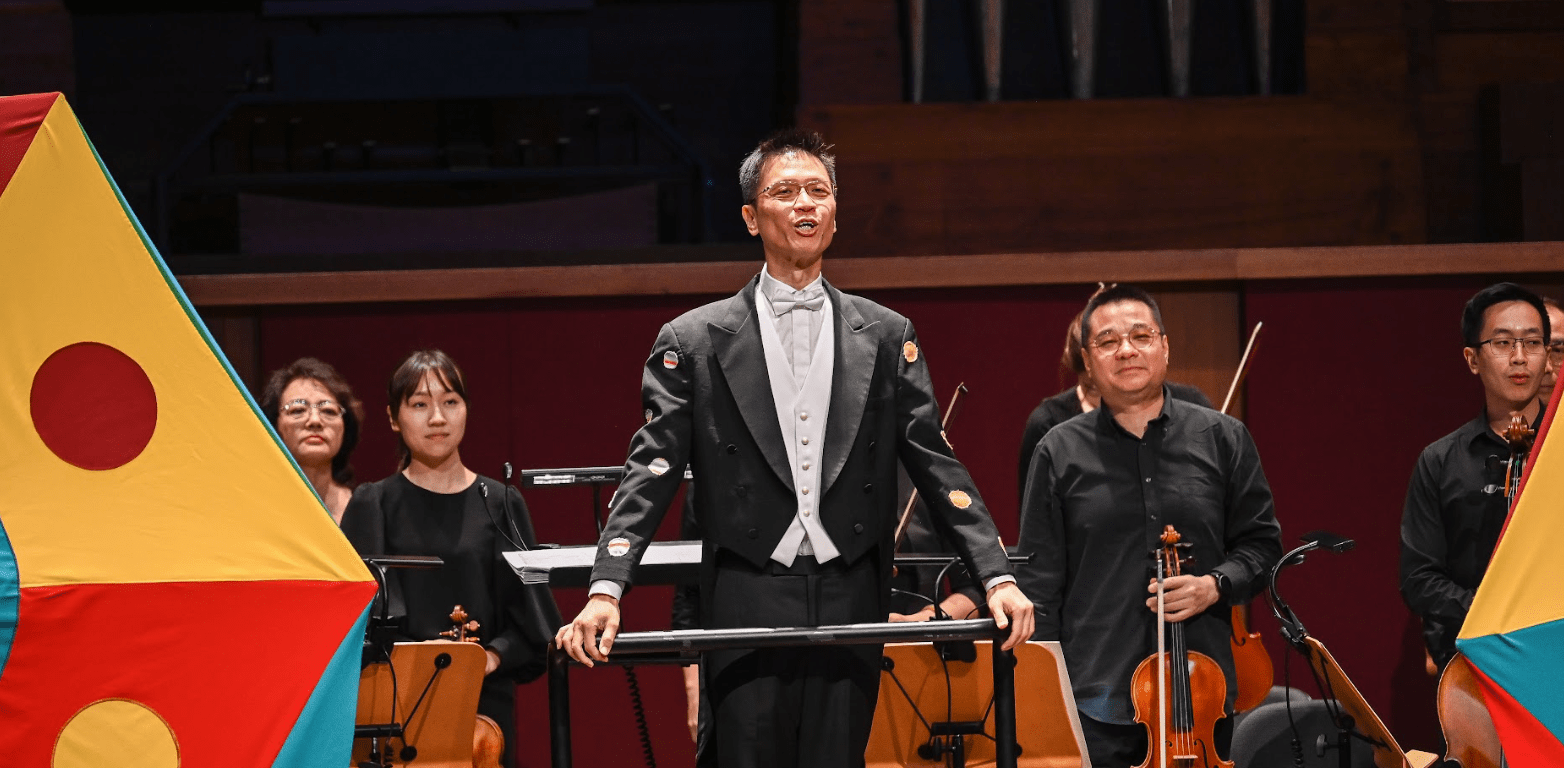
There is no better opportunity to show off what our national orchestra is capable of than on National Day, as the Singapore Symphony Orchestra (SSO) returns with their annual Temasek Foundation x SSO National Day Concert on 11th August. Taking on the theme of Legacy & Future, the concert will feature a diverse program of local works, both from our own musical forefathers and contemporary composers, reflecting our nation’s musical legacy and hope for the future. Also of note would be the winning pieces from the NDC 2024: Call for Compositions, bringing newer composers to the fore on a national platform.
And while the musicians themselves are and always have been the most important part of a concert, it takes a conductor to bring them all together and lead them in a cohesive effort. This year, the SSO will be led by conductor Dr Leonard Tan, who has worked both locally and internationally, taking on positions such as the Music Director at the Philharmonic Winds and as an Associate Professor of Music at the National Institute of Education (NIE), all in the hopes of expanding the reach of Singaporean music, and nurturing young music talent. Speaking to Dr Tan, we found out more about what exactly it means to stand in front of an orchestra and conduct, his thoughts on the local music scene, and what we can expect from the upcoming concert.

“The work of a conductor can be mysterious to others, and I think what a conductor truly does can be broken down into three parts – the seen, the semi-seen and the unseen,” says Dr Tan. “What people see is the public concerts and the final products, where he is at the front waving a baton, and guiding the musicians. He is always there to inspire the musician, always seeing where you are now, and what lies ahead in the piece, which makes the role a means of navigating playing and the audience’s listening. Meanwhile, the semi-seen would refer to the rehearsals, where it is only the orchestra that sees your work where you’re maximising every rehearsal.”
“But the least talked about would be the unseen – there is a lot of time we spend with the composer and the music we’re playing, and making sense of the notes, as well as what the composer is trying to convey. It’s an intimate experience trying to develop this image, and then conveying that to the musicians during rehearsal and working out how to achieve that during public performances,” adds Dr Tan. “This unseen work can take weeks and months, and whatever you see onstage is just the tip of the iceberg, built up over months of analysis, rehearsals, and even before that, the years of training and studies that go into it. Of course, when you see a conductor onstage, what he does is to convey the music and emotions through gestures, and what I ultimately decide on is how I’ve interpreted the music in my own, natural way, not so much imitating what has been done before, but making sure it’s true to myself and the composer’s intent.”

Of course, Dr Tan’s roles extend beyond conducting alone, and as an educator, he revels in the chance to meet, educate and learn from students and fellow teachers. Spending several years pursuing his PhD at the Jacobs School of Music, Indiana University Bloomington, Dr Tan relishes in how there was so much going on, from the sheer number of operas in a year, to having multiple orchestras around, as he balanced his studies, educating and conducting in this conservatory setting. “That was a real joy, and when I came back to Singapore, I also think about my role at NIE, where students aren’t just training to be music teachers, but also musicians in their own right. There’s a saying by Hungarian composer Kodály I believe, which goes along the lines of how a single bad performance can ruin a night, but a bad educator can ruin the love of music for generations,” says Dr Tan.
“To that end, I do think the SSO has been doing a great job of spreading the love of music to Singapore, such as our demonstration concerts to school bands, and I’m so honoured and happy to be part of that. The sky’s the limit, but it’s more important to be proactive, to imagine the possibilities, to think about the future, and that’s where you truly make history,” he adds. “Sometimes I like speaking about the music before the pieces as well – it’s like having an omakase where the server will tell you about each dish before you eat it, and you end up enjoying the meal more when you learn about it. It takes time, but our goal is to demystify music for the general audience, and train them to open their minds and ears and open themselves up to a brand new horizon.”

For the upcoming concert, the team has been working on the repertoire for over a year, curating and deciding on just the right pieces for an ideal 59th National Day celebration. “59 is a beautiful age – where it’s the last year of a decade. The theme behind this concert is to start off with legacy pieces from forefathers, and the second half looking towards the future, and the newer composers in the scene. It’s like taking stock of our local music scene and achievements, and it’s almost like two symphonies across both halves, starting rousing, slowing down, then rousing again as it concludes,” says Dr Tan. “We’re starting off with Leong Yoon Pin, often considered the doyen of Singapore composers, and he was actually one of my benefactors when I was younger. I came from a humble background and I went to him for music lessons back in the ’90s, showing off what I could do. In his own unassuming way, he gave a chuckle when I asked if he could teach me, and graciously charged me just $10 an hour for a very rigorous course in harmony. In essence, he was not just a good composer and educator, but also a wonderful human being who taught me so many life lessons as well. Most of all, he was very sure of his own identity, always seeking out his own Asian voice despite a rigorous foundation in Western techniques.”
“Next, we’re performing works Cultural Medallion recipient Eric Watson, who was also my teacher at one point, before moving on to Dr Emily Koh. There’s this sense of a continuum throughout the whole repertoire – Watson wasn’t born in Singapore, but made it his home, taking on many influences from Southeast Asia. Dr Koh is now a professor in composition in the USA, and her work lets us reach out to future generations,” he adds. “But I’m most excited about how we’ll be presenting three works from an open call for compositions instead of just commissioning work. Lim Han Quan’s ‘Our Story: Passage Through Time’ is one of those works, before moving on to Felicia Teng’s ‘Red Dot Dreaming’ and Gu Wei’s ‘Illuminating The Skies’. We end off with Lee Jinjun’s medley of Singapore songs, and then Terrence Wong’s ‘Yesterday, Today, Tomorrow’ to wrap up. Beyond the SSO, we also reached out to and will be featuring 140 school choir and band members and the youth musicians and choristers from the Singapore Symphony, making about 200 people onstage to really home in on what a grand celebration this is.”

On how hopeful he is for the classical music scene in Singapore, Dr Tan has nothing but optimism. “I really appreciate how schools have the CCA system – even if you have no formal music training, you can have access to bands and orchestras, much like I did when I was younger. I had joined the school band and once went to a friend’s house, saw some Beethoven cassettes and listened to them, that’s what first got me interested in classical music,” says Dr Tan. “I ended up in the Music Elective Programme in school, playing with the youth orchestra during my JC days, and also became the student conductor of my JC band. I guess I really enjoyed it, because I went on to study conducting. My own instrument of choice is the tuba, and back in the 90s, people were so shocked when they saw me applying for a tuba exam. These days, I can only imagine both the tuba and all the other instruments have flourished since, and there are so many ensembles now – we’re really spoilt for choice, and music is everywhere.”
“I’m glad that for this concert, there’ll be a livestream that even friends overseas can watch and enjoy Singapore music live from home, and I think if anything, there’s been so much positive development and community engagement that will continue to grow in future,” he concludes. “As we approach our 59th National Day, I recognise how far we’ve really come. We are a lighthouse for the meeting between East and West, and if you look at how much we’ve achieved in such a short time, you will be impressed. I hope the scene continues to flourish and grow, and carry on shining for all to see.”
Photo Credit: Singapore Symphony Orchestra
The 2024 Temasek Foundation x SSO National Day Concert plays on 11th August 2024 at the Esplanade Concert Hall. Tickets available here. This concert will also be streamed live on the Singapore Symphony YouTube channel.
 Bakchormeeboy