
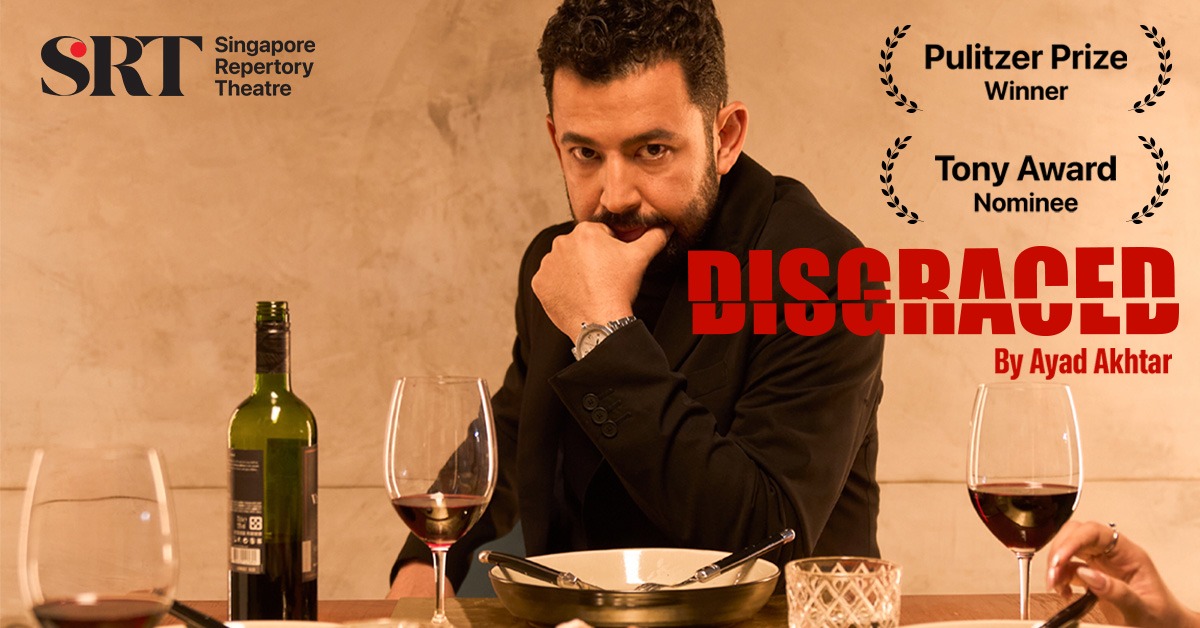
In 2016, Singapore Repertory Theatre (SRT) presented a sold-out run of Ayad Akhtar’s Pulitzer Prize-winning play Disgraced, gripping audiences with its provocative subject matter, dealing with race relations in a post 9/11 America. Eight years on, SRT is bringing it back for a second run this August, with a brand new cast and creative team, and perhaps, more relevant than ever before.
Leading the team is director Daniel Jenkins, who was acting in the 2016 production, while Malaysian actor Ghafir Akbar will be taking on the lead role of Amir, a successful lawyer with South Asian Muslim roots, after previously playing the role of Abe, Amir’s younger nephew, who will now be played by Shrey Bhargava. They will be joined by American actors Simone Policano, who plays Amir’s wife Emily, and Eboni Flowers and Jeremy Rishe, who play husband and wife Jory and Isaac, as the cast makes magic in an explosive dinner party. We spoke to director Daniel, along with Ghafir and Shrey, on how it feels to revisit the play, its newfound relevance today, and the conversations it hopes to provoke.
“Coming back to this play feels like a brand new experience – as much as I do know the script, it’s still a new process of preparing for the play together, with a new director and new cast. Playing Amir, I was a little nervous considering it was Gaurav (Kripalani, SRT’s artistic director) who previously played the role, and I wanted to make the role feel like my own without emulating it,” says Ghafir. “But I think enough time has passed since then, where my performance is based on the work I’m doing with the new actors and Daniel’s new vision for the play, and I feel more detached from the pressure of the previous role. Amir’s own relationship with religion resonates with me, and I can empathise and understand where he’s coming from, especially living in America in a post 9/11 world, which I will be tapping into.”

For Daniel, who previously played Isaac, he too echoes Ghafir’s views, and expresses his excitement at the chance to revisit Disgraced. “My memory of the play is hazy, and approaching the play as a director is a new experience for me and feels like a new play. We’re exploring where we can take this story with this new cast, building up chemistry, and finding new relevance in the text,” says Daniel. “One of the big reasons we’re staging it again is because of the upcoming elections in the USA, and the hot button topics are very much present in Disgraced. I recall the talkback sessions in 2016 – where Trump had just been elected, and everyone was talking about how different the world would be. Interesting how Trump is still here, but now we’re moving away from politics, and focusing more on the war in the Middle East and race relations with this iteration of the play.”
“As a director, my goal is to create as relaxing and pleasant an atmosphere that allows for more freedom and openness, where everyone is enjoying themselves while creating this work, all to produce some excellent theatre,” he adds. “It’s interesting how we did our casting for our American actors – there’s only so much you can pick up from a Zoom audition, and I was initially concerned that when we came together we might have very diverse, even opposing views. But once they came to Singapore and we got to know each other, that was far from the case, and we had some very open conversations about what America was like, especially considering race and religion, and it was all just very honest where we gave everyone that chance to talk about their opinions as much as freely as possible.”
For Shrey, who’s somewhat newer to the theatre scene and has been on a roll with productions this year, there is a sense of immense respect he holds for his fellow cast members and director. “This is my first show with SRT, and interestingly, Disgraced in 2016 was also Ghafir’s first show with SRT, so it’s almost this weird full circle experience – even seeing how Trump is back for another election,” says Shrey. “I’ve always looked up to Ghafir and the work SRT does, and it’s been such a pleasure learning so much while here, and for the opportunities I’ve been getting this year in both theatre and television. I still think that Singapore produces some of the world’s best theatre outside of New York and London, with good, passionate practitioners both onstage and offstage, and it’s always a joy coming back to theatre, which I consider my first love, and exciting to be onstage.”
On the topic of playing uncle and nephew, Ghafir and Shrey share more about their experiences in the theatre, and how they’ve also both just come off in the Singapore International Festival of Arts (SIFA) show The Prose and the Passion. “Working with Ghafir on that play, seeing all these choices he was making, it was so nice to witness, and when I found out I was working with Ghafir again on this, I was just wow, because it was such a comfortable project to work together on, and it never felt intimidating to work with a more experienced actor like him,” says Shrey. “It was always welcoming and comfortable, and here in the rehearsal room, I feel like I can contribute ideas and bring part of myself to the play as well.”
“When I was asked to do this play, I felt lucky, because all the offers I’ve received have always been with people I respect and admire, and each successive play has built on previous experiences that I can bring into the next – like how The Prose and the Passion was about identity, and I bring that in part to this play as well,” says Ghafir. “Acting well also has to do with being responsive to the people around you and reacting to what each actor brings to the stage, like a good game of tennis where you’re volleying the ball back and forth. It’s been a truly collaborative environment here, and fertile ground for creativity whenever we talk and chat and rehearse.”

As for whether they see any parallels between their characters and themselves, there are certainly slivers that both actors have drawn out from their own lives that shape their performance and approach to playing them. “For Abe, he may be American, but this country also doesn’t seem to understand him and his people and his faith. He believes what he believes but goes down a rather dangerous path, and for me, I think about when I was younger, and had a real fiery sense of justice, maybe more naive and believed I could change the status quo,” says Shrey. “Looking back, I could have been more tactful, but I still admire the fire that my 21 year old self had. So to see Amir and Abe’s interactions, there’s this understanding why Amir wants to tell him why he’s going about it wrong, while still admiring his fervour. You see this kid, initially as chirpy and lovable, but then what happens to him? How did he go down this path? It makes me think about what kinds of conversations and interactions we need to have with those at risk of radicalisation, the ones who are feeling estranged or misunderstood in society.”
“It’s a real luxury to get to revisit this work in a different role – I was much younger back then, and more naive, but now having lived a little more, with a greater understanding of politics, race and religion and how they affect different countries, I’m coming into this production of Disgraced more hopeful, more ready to explore, and more able to believe that we’ll be able to get out of this mess, where I can clearly see where Amir is coming from, and think about how different my own points of view are,” says Ghafir.
“Shrey, Ghafir and Gaurav are three very different actors, and my job as director is to mould the characters based on the actors, each one bringing their own spin to their character, rather than simply re-producing the previous staging,” says Daniel. “That means even the accent work, while important, our focus is still on keeping it believable and keeping it authentic. We don’t want audiences to be distracted by whether actors hit the accent or not, but simply immerse themselves into the world of Disgraced.”

In considering the sensitivity of the show, which deals with topics such as Islamophobia and extremism, both Daniel and the actors are careful about the shows they choose to take on – not to cause trouble, but certainly to put on challenging shows to encourage conversation. “We have to be sensitive of course, but it’s important to have such shows out there to provoke thought about these important issues,” says Daniel. “Disgraced also doesn’t take sides, and presents every conversation, leaving it for the audience to decide how they want to approach these issues, and have thoughts on how they can be sensitive in their own discussions without shoving opinions or political views down people’s throats.”
“These characters are not villains and not inherently bad people. They’re complex people, with their own deeply-seeded understandings of race and religion – the audience isn’t here to identify with them entirely, but focusing on their words, and wondering whether they might have said or thought something like that before,” says Ghafir. “You might have had these conversations with friends or family, and by the end of the play, you’re not happy or settled. Even if you’ve seen the play before, it’ll be a different experience now, with a different world we’re living in, and you yourself might have changed in 8 years, where you think about the prejudices that still exist, and think about whether your reaction to these issues onstage will be different.”
As to what they hope audiences bring home with them, the answer is simple – to think a little harder about various lived experiences, and how to have proper conversation in the hopes of understanding rather than demonising. “There are big issues of radicalisation in this play, and there remain a lot of unanswered questions such as whether the characters really are radicalised or not, or even if they ever will act on those supposedly radicalised mindsets,” says Shrey. “Islamophobia stems from a fear of the other, something that featured quite strongly in the wake of 9/11. Thankfully, in Singapore we don’t have that, but the play still raises important ideas, about whether we can talk about these things in a way that’s productive, and how we can have proper conversations with people with different beliefs. It’s intense, but it’s also a great opportunity to pick friends you might want to bring along with you to continue those conversations over drinks or walking back after the play.”

“I really had to watch Fox news, Al Jazeera and ask how far I can take the energy of this character and sit with it from 10am to 7pm during rehearsals, and understand him within your body,” says Ghafir. “It’s interesting because you do let go a little when you go home, but not too much, because you still have to bring him back the next day as well. It’s been making me think about the way we approach someone, and I think we need to have more empathy and seek to understand. The play doesn’t end when it ends, because you take those topics and bring them to the discussions you’ll have after, regardless of whether you loved it or hated it, perhaps even thinking ‘did you ever think that way about me…?’, and it carries on into your real life even after leaving the theatre.”
“Without a doubt, theatre can be the medium to get people thinking and talking about such issues, and to do that, you need exciting theatre that’s well-written, with fully-rounded characters and a great storyline that takes you on a journey,” concludes Daniel. “Disgraced is that play, and full of surprises as it questions everything you thought you knew, challenges your thoughts and beliefs, and makes for a fantastic source of conversation thereafter.”
Photo Credit: Singapore Repertory Theatre
Disgraced plays from 13th August 2024 at the KC Arts Centre. Tickets available here
 Bakchormeeboy