
Deconstructing the idea of Nanyin music to find relevance in today’s age.
As important as traditional art forms are, many of them end up endangered with how niche the audience tends to be, and how newer generations may no longer be as aware or appreciative of them. To that end, the Siong Leng Musical Association has been consistently contributing impressive efforts towards the preservation and presentation of Nanyin music, not only performing it during concerts, but consistently integrating and collaborating with other artists and art forms to refresh it and explore new ways of appreciating it, garnering a loyal following and audience as they wait to see what the Association comes up with next.
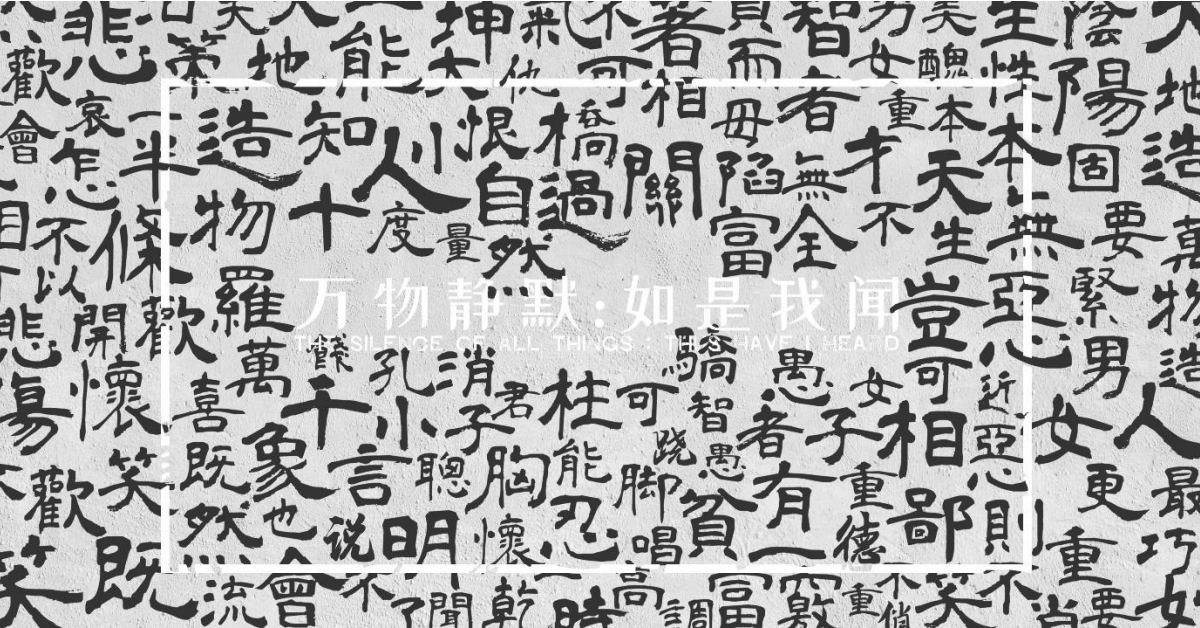
In their latest production, Siong Leng Music Association collaborates with experimental theatremaker Liu Xiaoyi to create Thus Have I Heard, the first in a trilogy entitled “The Silence of All Things,” using Nanyin and its practitioners as a starting point to explore the deep connections between Eastern philosophy and contemporary Asian art. Rather than a traditional concert, Thus Have I Heard focuses instead on deconstructing the concept of Nanyin, and will draws upon the philosophical reflections on sound from Buddhist classics such as the Heart Sutra. As a theatremaker, Xiaoyi’s influence on the work is clear – visuals take centrestage in this performance, as performers attempt to explore Nanyin in all its facets.
Across the performance, the musicians rarely, if ever, perform as you would expect a musician to. Early on, seated in a single row, the musicians mime the playing of instruments, focusing instead on the movements that have since become second nature to them after practicing for so many years. Throughout, there is a recurring theme and imagery of water, quite literally displayed as a sea onscreen, bringing to mind ideas of crossing oceans, and how Nanyin itself has survived through the years.
Midway through, Principal Artist Seow Ming Xuan even steps forward, alone onstage as he delivers a monologue, admitting he doesn’t even enjoy Nanyin that much – instead, what sometimes keeps him going is the sense of camaraderie with his fellow musicians. Indeed, that seems to be the central question then – what is the relevance of Nanyin today, and why try so valiantly to maintain and promote it when it only seems to be straying further and further from its original form, and becoming harder to find a fully-invested audience?
What Ming Xuan says next then strikes a chord; when the ensemble goes up to China to train and reconnect with their roots, learning from those who still actively practice Nanyin, listening to them and being as one with their routines, Nanyin seems to gain some kind of meaning and cultural significance again. In thinking about the show’s title, The Silence of All Things: Thus Have I Heard, one then considers how we need to listen more closely, beyond the noise and to listen perhaps to the heart, our heart specifically.
In pushing the musicians out of their comfort zone by performing such physical, theatrical work, director Xiaoyi seems to find new ways for the team to explore what Nanyin means to them, beyond the music, as they consider who they are as people. We watch as the Chinese character 我 (translating to ‘me’) flashes across the screen, over and over, a call to look into one’s own inner self. The ensemble blindfolds themselves, as if blocking out other sensory distractions, and begin to walk the space, and we think of them crossing oceans, overcoming obstacles as they climb and leap off the chairs, blind faith allowing them to carry on unscathed.
While it does feel to a certain extent like warm-ups and theatre games, what is clear is that the team have amazing stage chemistry, where everyone feels like they have a strong sense of camaraderie, inherently trusting each other never to bump into one another while maintaining the speed of movement. They are silent, never speaking and instead allowing for us to listen as they do. Perhaps through it all, they have found some form of re-centering, clearing the air and allowing each other to bond once more, and find meaning for themselves in what they do.
In the final phase of the performance, we hear the opening announcement once again, except after telling us to hold our applause till it is over, the voice continues on to expand the idea of the title itself, to listen to hear to focus and understand that meaning and relevance sometimes goes beyond what is immediately obvious, and instead, something more invisible and internal. As they finally pick up their instruments and begin to play, guest performer Didik Nini Thowok comes out onstage, a mask behind his head, as he performs a work of dance-theatre to the ensemble playing. Despite him being Indonesian and his training somewhat removed from Nanyin as an art form, the collaboration yields surprisingly fruitful results, as he moves and responds to the music, this character playing and enjoying himself in the unexpected connectivity of it all.
Through the act of deconstruction and breaking Nanyin down to its most fundamental parts, even beyond its music, The Silence of All Things: Thus Have I Heard allows the Siong Leng Musical Association to re-consider and re-think what Nanyin means to them, and what it could potentially be. And as they pick themselves up, stronger again as a team, they are confident, reassured of the power of Nanyin music. And for the full audience in the theatre studio watching them, we too gain a newfound appreciation for Nanyin, better understanding what Siong Leng is trying to do, and perhaps, finding a piece of ourselves in the process of following them on their journey.
The Silence of All Things: Thus Have I Heard played from 11th to 12th October 2024 at the Esplanade Theatre Studio.
Production Credits:
| Producer Celestina Wang Artistic Director Lin Shao Ling, Liu Xiaoyi Director Liu Xiaoyi Performers Seow Ming Foong, Seow Ming Xuan, Lim Ming Yi, Joel Chia, Wong Hai Rong, Goh Shou Yi, Didik Nini Thowok Music Director Ng Kang Kee Assistant Producer Seow Ming Xuan Assistant Music Director Seow Ming Foong Sound Designer Ng Kang Kee, Yong Rong Zhao Lighting Designer Gabriel Chan New Media Artist Ong Kian Peng Set Designer Liu Xiaoyi Sound Engineer Yong Rong Zhao Production Manager Clarisse Ng Stage Manager Vivi Agustina Video Director William Loh Assistant to Director Cheng Kam Yiu |
 Bakchormeeboy