
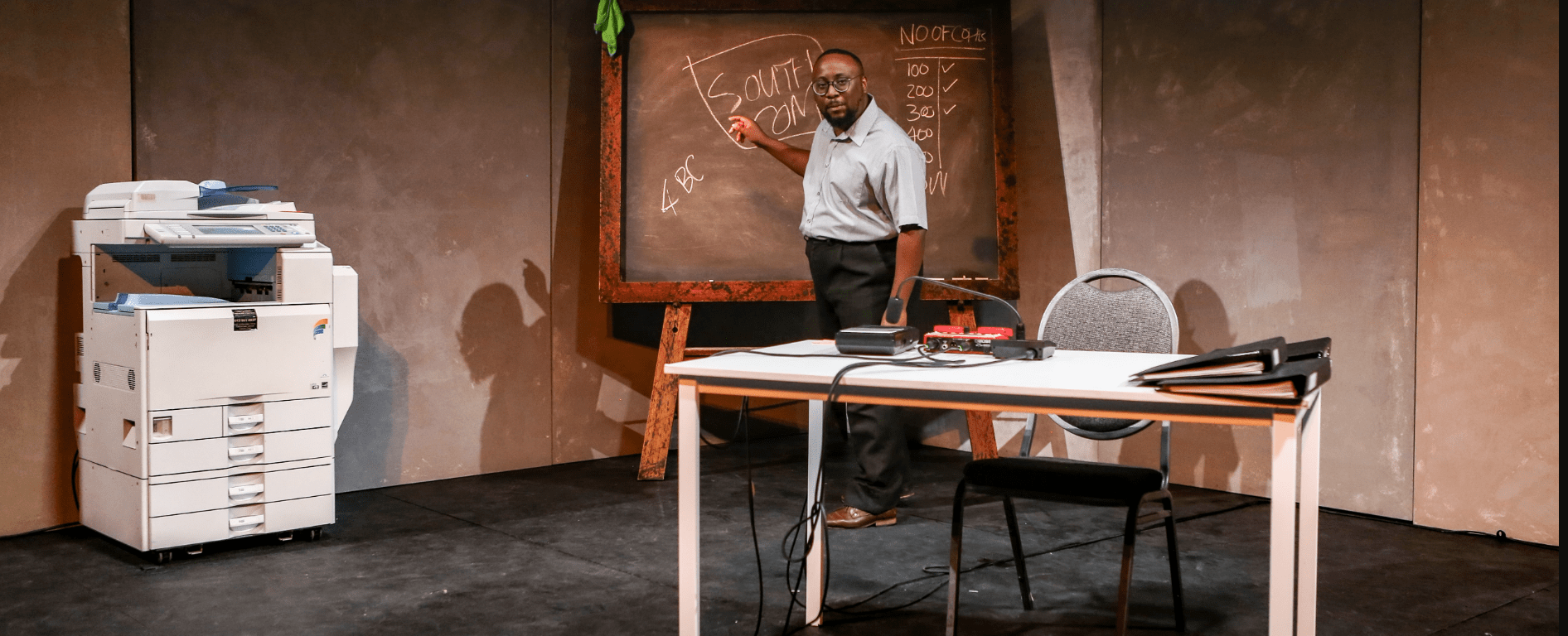
A history of violence, corruption and cover-ups, buried in paper and archives.
Of all the places to discover violence, one would least expect to find it within the four walls of a tiny basement office of archival documents. But that is precisely what Noma Yini does with their work Commission Continua, which made its world premiere last week at the M1 Singapore Fringe Festival. Last in Singapore in 2023 with Kafka’s Ape, about the harm we deal to others based on prejudice, the same powerhouse team of director Phala O Phala and performer Tony Bonani Miyambo return to once again explore the harm we dispense to each other, albeit in a very different form.
Where Tony played a powerful, physically impressive ape in Kafka’s Ape, he now embodies a rather different type of character – Bright Maluleke, an odd but well-meaning civil servant who takes pride in his work as an archivist. Dressed in a suit and suspenders, he giggles to himself as he arranges and photocopies documents, walking with an awkward gait, and muttering things that sometimes get lost in his excitement. This basement office is his playground, frugal in its set-up, but one he knows like the back of his hand; a large industrial-strength photocopier and printer; a cassette player; a drawer of documents and papers; and a large table with several files, post-it pads and a microphone atop it, the word ‘commission’ as a nameplate clearly on it, indicating his work copying and archiving official documents.

Bright doesn’t seem particularly interesting as a character at first, with him going about his daily work, ready to give you an entire lecture on the origin of paper with plenty of glee in his voice. He is a man of precision and rules, delicately placing a tiny sign labelled ‘IN’ along a faint line on the floor, before walking over to the other side and ensuring that the corresponding’OUT’ sign is aligned properly. He makes his rounds, testing the photocopier by placing his hand on the scanner, then placing these in the ‘outbox’, before commenting on how South Africa uses countless reams of paper a year, whether in the toilet, in printing paper money, or of course, for the printing of documents.

Walking over to the cassette player, he inserts a tape and a song begins to play. At first, he seems calmed by the music, before he begins to repeat, over and over ‘Bheki can’t hear’. This makes no sense – who is Bheki after all, especially when all of us in the room can clearly hear the sound playing. But then this is where we learn of the horrifying truth buried beneath the papers. Commission Continua is less a straightforward theatre piece than it is a work of performance art; Tony, as Bright, takes a seat at the table, and begins to read off official transcripts and court records. These records are plagued with minute details and questions that lead nowhere, the inefficiencies adding up to wasted time. Utilising a loop machine on the table, Bright creates a live soundscape as he plays and replays phrases such as ‘truth’ and ‘I swear an oath’, directly juxtaposing against his reading of these documents and hinting at falsehoods amidst these declarations. These form a whirlwind, louder than what Bright can speak into the microphone, and only cements how much truth is lost among the inquiries and disorganisation.

The horrors are only amplified further still from this point; Bright projects a document that defines what a violation of human rights is, and then showcases a seemingly endless list of names that have been subject to such violations. He reads out specifically, the account of a mother who returns home to find that her usual cup of tea is missing, something her eldest son Sipho prepares without fail each day. Temporarily becoming this mother, he yells to the audience on both sides – ‘Sipho! Sipho!’, with fear for the worst in his voice. It turns out Sipho has been brutally murdered, the degree of gore and violence he is subjected to described in vivid detail. Elsewhere, we also learn at last who Bheki is, similar punished for his involvement in revolutionary activities in South Africa, and punished for it.

Bright is no longer shy and reserved, but now brimming with anger and on the verge of tears. He is overcome by emotion realising that he can no longer sit idly by and simply file these documents away, knowing how much injustice lies between the sheets of paper. He gets up from his seat, and begins to read off, in chronological order, a list of commissions into inquiry in South Africa over the last 140 years, ranging from queries into student protests, to the downright bizarre – hotdog stands and pasteurisation of milk. His voice wavers more and more, his tone incredulous, unable to believe that so much time and money is wasted on all this. Every so often, he punctuates his words with a question – ‘where is the inquiry into slavery?’, filled with primal rage at how much has been swept under the rug, how much corruption goes ignored and the people remain distracted by these ridiculous inquiries. At some point he screams for a ceasefire, forcefully throwing files and papers on the ground.

His voice quieting, he reveals an origami butterfly that he has folded out of paper. He considers the nature of the butterfly, how many species exist in the world, and the sheer number that are in South Africa alone. He makes an offhand plea – that the people of South Africa would gain the ability to taste with their feet, just as butterflies do, and as they walk barefoot on the soil of their land, taste the blood-soaked earth accumulated from years of violent suppression. He looks sadly at how the inquiries grow, but there are never any solutions or outcomes. There is something deeply disturbing about the way this contrasts with the yelling and rage of before – it is a bitter, quiet moment of grief, as he begins to walk away, to the photocopy machine. In silence, he photocopies his hand, his face. Projected onscreen, these appear to be images of anonymous people reaching out for help, or the ghosts of their faces fading away, clearly referencing all the lives lost over the years due to neglect.

Sparse in its script but deadly effective in its approach, Commission Continua is itself an inquiry and investigation that questions the corrupt practices of the authorities covering up their own lavish lifestyles or refusal to engage with the more pressing issues of the nation. It is a revelation of how insidious bureaucracy can be, far more than a mere annoyance for its ability to cause actual harm and take the lives of innocents, whose voices are buried under all the paperwork, the drafts, the mounting evidence. It is an act of protest, calling out the broken system in South Africa that will in turn break its people, performed with harrowing emotion by Tony, who completely disappears into his character, and shows how there is so much undeniable violence that even the ordinary person can and should be affected, and feel a rage building up in them. What is clear is that while it may seem hopeless, one cannot succumb to death by a thousand paper cuts – one must resist apathy, and speak out against injustice. Perhaps if there is enough critical mass, enough people that no longer wish to exist in such a painful state, that we finally break away from the same issues, copied year after year, into a new dawn.
Photo Credit: Zivanai Matangi
Read our interview with Noma Yini here
Commission Continua played from 17th to 18th January 2025 at the Esplanade Studio Theatre.
The 2025 M1 Singapore Fringe Festival ran from 8th to 19th January 2025. More information available here
To contribute towards the Fringe Festival Fund, visit donate.necessary.org or Giving.sg.
Production Credits:
| Conceptualiser, Writer and Director Phala Ookeditse Phala Conceptualiser, Writer and Performer Tony Bonani Miyambo |
 Bakchormeeboy