
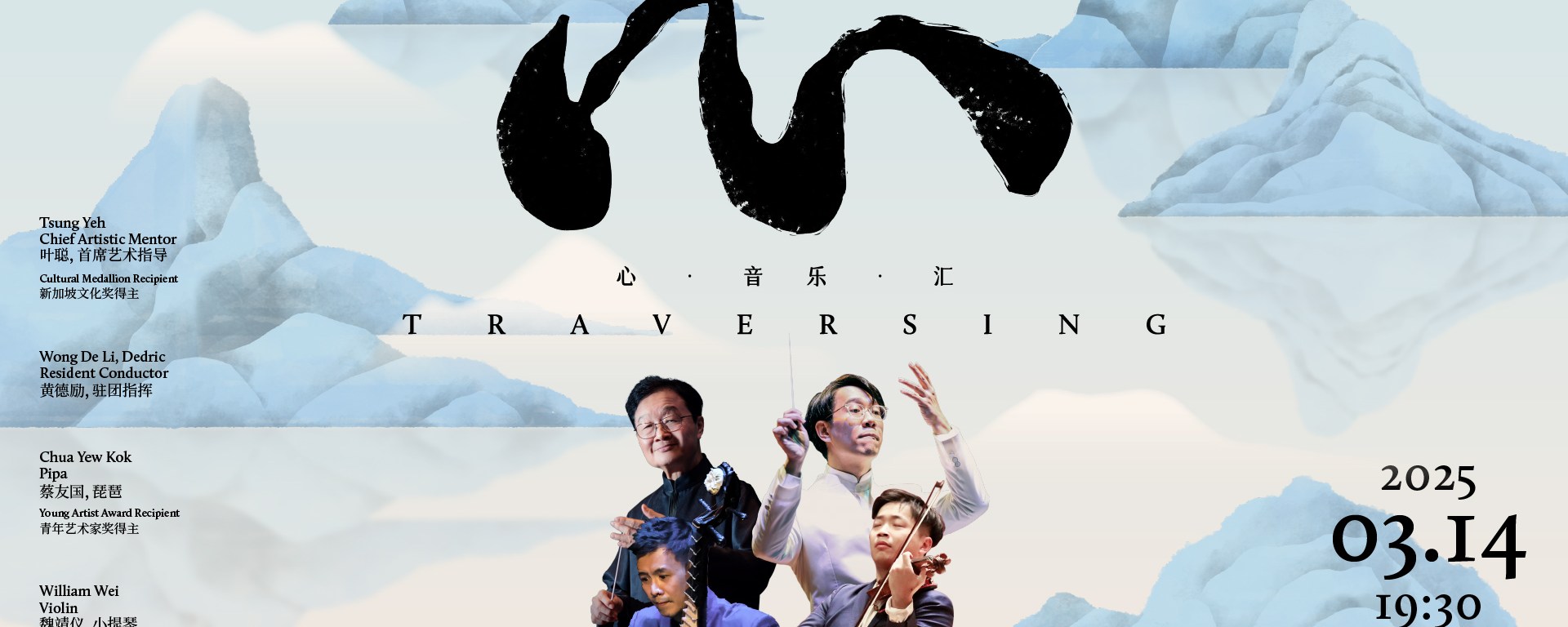
Bridging time and space once more with the third edition of Ding Yi’s Traversing concert to open their 2025/26 season.
Now in its third edition, Ding Yi Music Company’s Traversing series has always been about connections—between cultures, eras, and musical traditions, as Singapore’s foremost Chinese Chamber music company pushes and stretches the genres with each new concert. This year, Traversing opens their 2025/26 concert season, and brings their mission to new levels, not only celebrating the ensemble’s evolution over 18 years, but also a reflection of Singapore’s own multicultural history as it marks 60 years of independence.

The evening opened with Glory, composed by Wang Jianmin, and conducted by Ding Yi Resident Conductor Wong De Li, Dedric. A fitting start to the concert and season as a whole, the piece is resplendent with a sense of triumph and new beginnings. It begins gently, its melodies rising with a measured grace, before swelling into a full-bodied celebration—much like the arc of Singapore’s own development over the past six decades. There is an undeniable sense of optimism embedded in the piece, an assurance that this new season for Ding Yi, and this pivotal year for the nation, will be one of promise and progress.

The mood shifts dramatically with Snow of June, a quintet by Li Binyang inspired by Dou E Yuan, the tragic Yuan Dynasty opera by Guan Hanqing. The story of Dou E, a wronged woman executed under false accusations, is one that resonates deeply, and that pain is translated into sound. Under the baton of the revered conductor Tsung Yeh, who receives warm applause the moment he steps onto the stage, the piece unfolds with stark, frigid beauty. The guan, played by Jacky Ng Yong Hoe, becomes the anguished voice of Dou E herself, wailing in the wind of her unjust fate. The drums, played by Low Yik Hang, adds percussive bite, evoking the cruel frost of a snowstorm in June. Pipa player Zhang Yin shines, her rapid, agitated plucking reflecting the tension and turmoil of the protagonist’s suffering. The performance is haunting and its chilling sorrow lingers long after the final note fades.

Closing off the first half is one of the evening’s highlights, Rama, composed by Wang Chenwei and adapted for a chamber ensemble. The piece takes inspiration from the Indian epic the Ramayana, and while it was originally composed for a full orchestra, this chamber arrangement does not lose any of its grandeur. Tsung Yeh, fully immersed in the music, moves fluidly with the rhythms, guiding the musicians through a narrative of triumph and challenge. The energy of the piece is relentless, demanding dexterity and precision from the ensemble. Pipa virtuoso Chua Yew Kok leads the charge, his fingers a blur as they weave intricate melodies. The ensemble does more than just play; they chant lyrics at key moments, transforming the performance into something ritualistic, evocative of ancient oral storytelling traditions. A projected slideshow traces the plot, culminating in the climactic moment when Rama’s divine arrow strikes down the villainous Ravana. What makes Rama particularly significant in the Traversing context is its embrace of a non-Chinese epic, showing how Chinese chamber music can absorb and reinterpret stories from across the world. Even the rhythm of the piece is influenced by the anustubh meter found in Sanskrit poetry—a testament to the fluidity of musical and cultural exchange that guides Ding Yi.

After a brief intermission, conductor Wong De Li, Dedric returns for The Seven Sages by Li Nixia. Inspired by the famed intellectuals of the Wei-Jin period, the piece takes on a mystical quality, with each instrument representing a different sage. The music invites listeners into a serene bamboo grove, where the sages retreat to contemplate life and art. It is delicate, meditative, and reflective, a calm contrast to the fiery intensity of the preceding Rama.

The final two pieces feature Taiwanese violinist William Wei, a laureate of the 2015 Queen Elisabeth International Violin Competition. In Introduction et Rondo Capriccioso, Op. 28 by Camille Saint-Saëns, adapted by Phoon Yew Tien, the mood shifts to one of European elegance. Unlike the narrative-driven earlier pieces, this is a showcase of virtuosity, a dance of capricious, cheeky flourishes. William’s dexterity is on full display as he navigates the demanding shifts in tempo and intricate passages with apparent ease.

The grand finale, Violin Concerto No. 1 by Zhao Jiping, adapted by Law Wai Lun, brings East and West together in full force. Commissioned for the National Centre for the Performing Arts in 2017, the piece is lush and romantic, a sonata that speaks of universal love and personal introspection. William’s playing is lyrical and expressive, his violin almost singing under his command. With Tsung Yeh once again at the helm, the Chinese chamber ensemble blends seamlessly with the violin, bridging traditions in a way that feels both natural and inevitable.

By the end of the evening, it is clear that Traversing is more than just a title—it is the philosophy at the heart of Ding Yi Music Company. As Singapore celebrates 60 years of independence, Traversing also affirms the country’s identity as a cultural melting pot. Just as Ding Yi seamlessly fuses different musical traditions, so too does Singapore embrace a multiplicity of influences, always moving forward, always bridging past and future. Through a carefully curated program, the concert showcases how Chinese chamber music can transport audiences across time, space, and emotion, while integrating elements of Western music to create a boundary-crossing experience, moving through histories, landscapes, and emotions to prove that Chinese chamber music is as transportive as it is transformative.
Photo Credit: Ding Yi Music Company
Traversing (2025) played on 14th March 2025 at the Victoria Concert Hall. More information available here
 Bakchormeeboy