
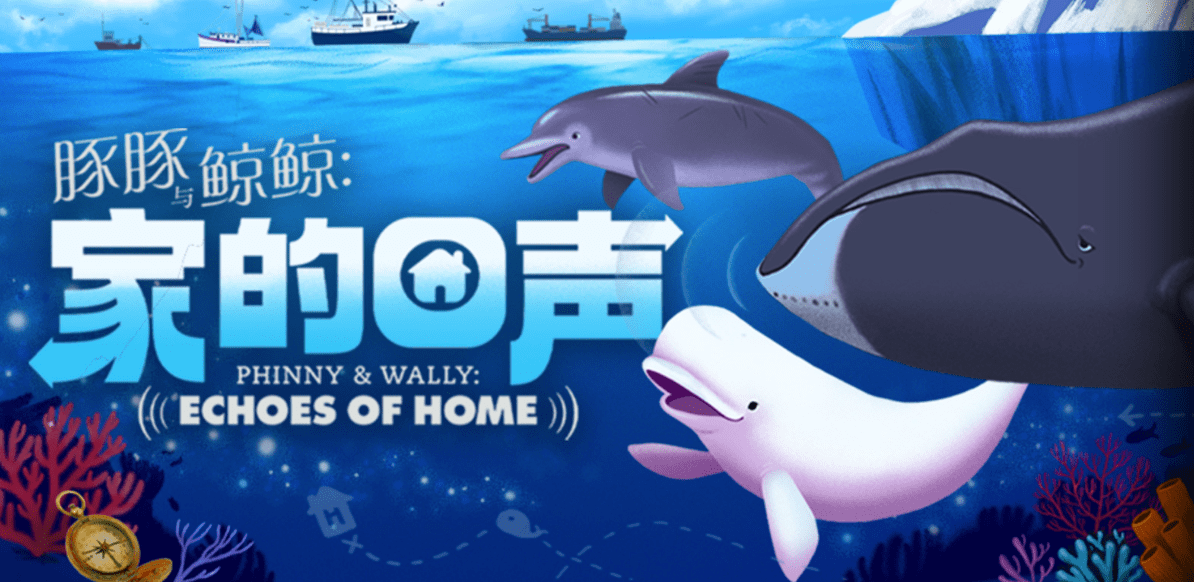
Following the heartwarming success of their debut children’s production Phinny & Wally in 2024, Nine Years Theatre (NYT) is diving deeper into the world of Theatre for Young Audiences (TYA) with Phinny & Wally: Echoes Of Home, a brand new, standalone sequel running from 22 to 31 August 2025 at the Drama Centre Black Box.
Aimed at children aged 5 to 8 and performed in Mandarin, this new production continues the adventures of the beloved dolphin and whale duo, weaving together environmental awareness, imaginative storytelling, and the joy of live performance. And behind the scenes, what shines through most is the sheer delight and passion the creators bring to making TYA, an experience as transformative for the artists as it is for young audiences.
For playwright Cherilyn Woo, the story began as a quiet idea in the pages of a book. “Initially, it started as a story written for a book,” she recalls. “But as I developed it, I began to see the potential to expand the universe.” What started as a one-off tale soon became something more, and after seeing how the first show resonated, especially with younger audiences, Cherilyn knew there was more to explore.
“Phinny and Wally became a voice for ocean conservation. That felt really special,” Cherilyn, who also directed the debut production last year, shares. “If we can bring awareness through storytelling, that’s meaningful to me. And the most powerful thing was how excited the audience was – I really appreciated how it created a shared experience for kids and their guardians and parents bringing them along, and memories to look back on and talk about in the days to come.”

But this new chapter wasn’t just born of sentiment. NYT had already set its sights on creating a new TYA production each year. That long-term vision was to nurture a new generation of Mandarin theatre-goers, and guided the company’s next steps. Nelson Chia, NYT’s co-founder and Artistic Director, explains: “We considered whether to tell a new story or continue this one, especially with how ephemeral theatre as a medium is to begin with. But we saw value in returning to these characters. And it was exciting enough to say, ‘Let’s go on another adventure with them. If kids are growing up with Phinny and Wally, it could be like how I remember growing up with Mat Yoyo; that kind of connection stays.”
Mia Chee, NYT co-founder and producer, reflects, “It was really a delight to see the kids coming in and enjoying the show that much, weaving in all these environmental issues and educational potential that the show introduced, it made sense to continue on, and carrying on by entertaining and educating kids and parents about environmental awareness.”
Phinny & Wally: Echoes of Home introduces a new character: Arlo, a shy young bowhead whale who has lost his way. As Phinny and Wally help him navigate icy waters, dodge danger, and search for his family, the trio slowly learns that home goes beyond just a physical space, where safety, love, and connection are at the heart of this moving story. As Cherilyn puts it: “The story explores what home means, not just as a place, but as textures, people, and sounds. Because we all share this earth, and we only get one shot at protecting it, and I think we, as humans, we don’t share a lot of things. But we do share this earth. And I think one of the important things for me at the end of this show is that audiences come away with the understanding that we’re sharing this one earth that we need to care for everyone living on it.”
“In addition, the environmental lens has shifted,” Cherilyn says. “Last year focused on plastic pollution and waste. This year, it’s about climate change, which is more complex, even for adults. Not to mention, there’s still the core theme of friendship – like what do you do when your friend has made a new friend, and how do you deal with feelings of jealousy? We all have an impact on others, our actions have consequences. While people can speak up when affected, other life forms can’t. So, we must find ways to honour and protect them. Phinny & Wally is ultimately about friendship, how meaningful bonds can grow over time, and how friends can return to help one another. That’s the real power of friendship.”
For Deonn Yang, who directs this year’s production, that message resonated deeply. “When Cherilyn called and said, ‘We’re doing a sequel,’ I reacted like an audience member: ‘What? A series?!’ I was excited.”
Yet that collaborative spirit is exactly what defines the NYT process. Deonn stepped into the director’s chair with full support, and quickly found her footing. “It’s my first Mandarin TYA,” she shares, “and while I don’t speak it fluently, the environment at NYT has been very supportive, and directing in English has been possible, and what a blast it’s been to go through the process. It’s been quite useful actually, because I’m able to put myself in the children’s shoes and if certain words or concepts seem a bit too difficult, we can pare it down for them too.”
Indeed, multilingualism is woven into NYT’s DNA. “People think of NYT as a Mandarin theatre company,” Cherilyn says, “but internal communication is often in English or a mix. It feels natural, and there’s always someone who can help. It feels quite Singaporean actually.”
And while the concept was originally Cherilyn’s, she wanted to give the story more room to breathe, and see what other artists did with it. “I’m like that Homer Simpson meme where I’m just disappearing into the bushes,” she says. “I’m really leaving it to Deonn to decide how she wants to handle the show, with me coming in to help with the pre-show experience and some world-building. But other than that, it’s her show. Coming up as a director in the past few years, that’s the last thing you want as a director for people to just be like, oh, you should be doing this. The point of art making is that people have different voices and including different collaborators and different perspectives, which I think is the joy of making theatre.”

So what’s it really like creating theatre for children? “It’s not any easier than a show for adults,” Cherilyn says emphatically. “There’s a misconception that kids will accept anything. But they’ll call it out if they sense something amiss, like if they see the strings holding things up, or decide to just say ‘That’s not a real dolphin!’ You have to earn their buy-in.“ It’s got this special quality, more wonder, more openness. But it needs empathy, not simplification.”
Nelson agrees. “Cherilyn told the team from day one last year: Don’t talk down to the kids. Don’t assume they won’t get it. That set the tone.” That trust paid off. From children dressing up as dolphins to bringing plush toys to the show, the response was positive.
Adds Mia: “I remember thanking a mother for coming, and she said, ‘Anytime. I’ll bring my child again without hesitation.’ That kind of reaction is priceless. I remember even a Russian mother bringing her child, and how much she seemed to appreciate the experience, it’s a show that transcends language and culture.”
And it wasn’t just kids who were moved. “We had one performance where the entire audience was adults, where one of our partners, Berries, brought their staff down,” Nelson laughs. “They came to learn how to better engage children. And it turned out that they were very game for it, so much that they were even louder and more responsive than the child audiences!”
This year’s production features a new cast: Cheryl Ho returns from last year’s production, and joined by Jodi Chan, and Vester Ng as new character Arlo. And as both Deonn and Cherilyn can attest to, the rehearsal process was filled with energy and play. “They’ve all done TYA before, and it shows. They really jumped right in,” Deonn shares. “We revisited things like the handshake from last year, rewatched videos, relearned tail movements, and once they put the tails on, their body language completely shifted. They’re so good at telling what we’re looking for and so giving, sometimes we just tell them ‘you need to be…’more whale’ And they just, get it.”
Every rehearsal starts with a warm-up game, where cast members try to keep a ball in the air for as long as possible, to build ensemble spirit and shared goals. Set and costume design, too, have evolved. “Last year, we leaned heavily on recycled materials,” Cherilyn says. “This year, we’re moving through multiple landscapes, so the set is more dynamic, with built environments and shifting forms.”
“Although the environmental themes are still there, the priority is now on creating a flexible, transformative space that visually conveys the characters’ journey through the ocean. There’s an emphasis on movement and depth, and a lot of the set will be taller too, so that the audience can feel the adventure unfolding—while still keeping children engaged and included in the world being built around them,” says Deonn.

Even the scientific research added texture. Deonn became fascinated with bowhead whales, especially their quiet, loner nature. “That image of a whale who’s never had friends, slowly opening up, it’s powerful. It’s like a lonely kid finding connection.”
“One of the most fascinating discoveries about bowhead whales I learnt is that they have “spa days” where they gather in shallow Arctic waters to rub against rocks and shed old skin, often doing it together as families. It’s a touching reminder of how little we know about these animals, and how storytelling can help us connect with the ocean in a more empathetic, human way beyond just scientific observation,” adds Cherilyn. “Climate change raises concerns about how natural behaviours and how events like these “spa days” might be disrupted. If rising sea levels affect where they can moult and bond as families, what traditions are lost? It highlights how human actions have far-reaching impacts, both direct and indirect.”
Before the curtain even rises, children are welcomed into the experience through an interactive pre-show activity in the theatre foyer. Led by NYT’s dedicated outreach team, this hands-on segment introduces the world of the ocean in a tactile and fun way. “It’s almost its own show,” Nelson says. “It helps children understand what they’re about to see. And when parents get involved too, which is when it really works.”
The pre-show initiative is part of NYT’s larger vision. “From the start, Deonn posed a big question that’s guided much of our process: What can we do? That’s shaped how we approach both the show and the educational elements around it. We’re not trying to give audiences a strict to-do list, but rather spark simple, practical ideas they can bring into their own lives,” says Cherilyn. “Our pre-show segment, which Pei Si is leading, plays a big role in this. We’re using it to create space for reflection and conversation, especially for kids and families, and to encourage small actions that can build into larger change.”
“Even as a team, we’re constantly discussing what sustainability looks like, figuring out what’s actually doable and what really makes a difference. It’s an ongoing negotiation, from our own habits to how we design the set,” she adds. “Last year we focused on recycling; this year it’s more about built elements—but with the same intention behind it. Ultimately, we don’t have all the answers. But we’re trying, and that effort—to learn, to adjust, to keep asking questions. That is at the heart of what we’re creating.”
“This was my first time working with a pre-show segment, and I found it surprisingly impactful. It really helps prepare the kids for the show, they come in already engaged and ready to dive in. I’ve realised that’s important not just for children, but for the adults too. The best TYA shows I’ve seen are the ones where parents are just as invested as their kids. When that happens, the experience becomes something shared, and the conversation can continue even after the show ends,” adds Deonn. “That’s why the pre-show matters, it sets everyone up, not just to watch, but to connect with its themes and story. And for returning audiences, I hope they carry forward what they learned before, because the themes are ongoing. We’re doing a sequel for a reason. Hopefully, as children return each year, they grow not just with the characters, but with the theatre itself.”
Ultimately, Phinny & Wally: Echoes of Home isn’t just another children’s play. It’s a deep, meaningful experience, for performers, for parents, and especially for young audiences discovering the magic of theatre, language, and the living ocean for the first time.
Photo Credit: Nine Years Theatre
Phinny & Wally – Echoes Of Home plays from 22nd to 31st August 2025 at the Drama Centre Black Box. Tickets available from Peatix
 Bakchormeeboy