
Emotionally-charged jukebox musical brings together the best of Singapore’s Mandopop with stellar performances.
Coinciding with both Singapore’s SG60 celebrations and their own 60th anniversary, The Theatre Practice (Practice) marks its first original musical since Lao Jiu: The Musical (2012) with a production that feels every bit like a homecoming. Fittingly, Partial Eclipse of the Heart pays tribute to Singapore’s surprisingly rich Mandopop songbook while reaffirming Practice’s role as a bilingual theatre company. This results in a jukebox musical, a natural choice, and what results is a work that feels both celebratory and deeply moving.
The challenge of any jukebox musical lies in tying beloved songs into a single, coherent narrative. Remarkably, Partial Eclipse of the Heart not only achieves this but executes it with astounding finesse. Directed by Practice Artistic Director Kuo Jian Hong, with a script begun by the late Jonathan Lim and completed by Ng Mun Poh, the production even makes its cheeky English title (seemingly a pun on Bonnie Tyler’s hit) resonate meaningfully with its story. Musically, the score is extremely cohesive, thanks to August Lum’s arrangements weaving songs from the myriad of artists into a coherent whole, employing leitmotifs, especially Stephanie Sun’s iconic 逆光, which also gives the show its Mandarin title, to unify the score. With music performed live under Joanne Ho’s direction, the band supports but never overwhelms, letting the voices of the cast soar.

The plot traces the lives of five inseparable friends across 30 years, beginning in 1988 when, as JC students in the “AstroNuts” astronomy club, they gather to watch an eclipse. They vow to reunite at the same seaside chalet every decade to witness the phenomenon again, an anchor point through which the musical explores the twists and turns of adulthood, love, and friendship.
Packing 27 musical numbers into one show is an uphill task, but the script rises to it with surprising fluidity. Jonathan Lim and Ng Mun Poh’s writing deftly sketches each character’s personality, quickly setting the stage for the emotional resonance of every song. While the melodrama occasionally veers into soap-opera territory, a staple of the jukebox format a la Mamma Mia!, it remains engaging, buoyed by humour, well-crafted running gags, and moments that make us feel like part of the group ourselves. The result is that we care deeply about these characters, eagerly anticipating each reunion to see how they’ve changed over the years.

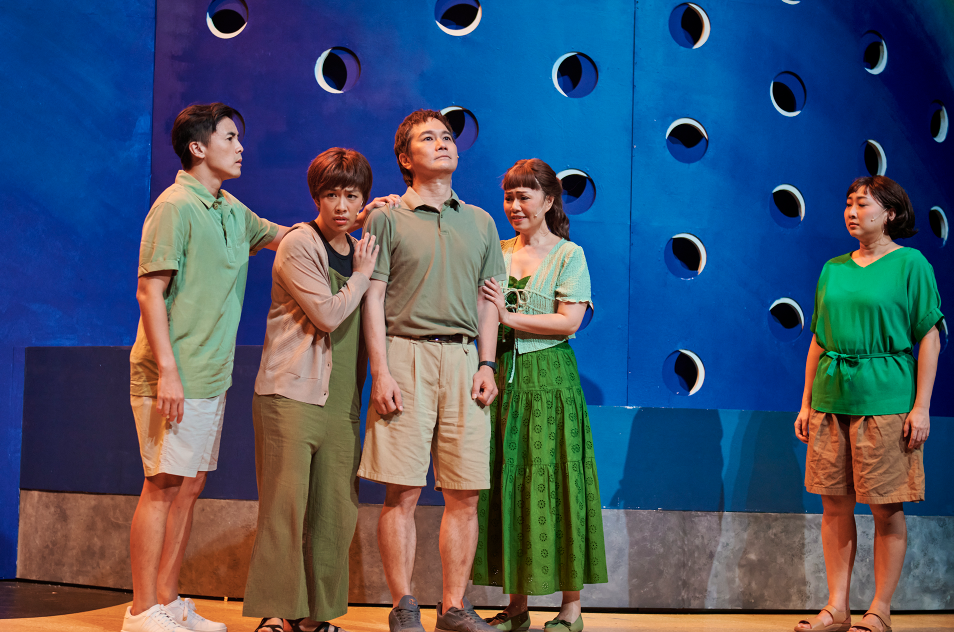
Director Kuo Jian Hong and choreographer Seong Hui Xuan go above and beyond, staging the production on a grand scale, with numbers that unfold like full-fledged music videos. Szu-Feng Chen’s ingenious rotating set, the recurring chalet, offers multiple perspectives, from its double doors to its familiar-looking living room, complete with spiral staircase, to a striking wall painted with eclipse motifs that doubles as a climbable surface. This versatility allows the staging to remain dynamic across the decades.
Kuo makes ensemble numbers feel expansive, starting with the exuberant opening 我们是最好的朋友, where the cast in beachwear, bathed in an orange sunset glow, deliver Seong Hui Xuan’s enthusiastic choreography with infectious energy. Genevieve Peck’s lighting design complements the show beautifully, shifting from atmospheric moonlight for tender ballads to dramatic flourishes for ambitious set-pieces. One standout is 未知的精采, where Joanna Dong dazzles as she inhabits multiple “movie star” personas, from descending a staircase during a faux red-carpet moment, to navigating a storm on the rotating set, and collecting a cascade of awards in quick succession.

Each number is as much a feast for the ears as for the eyes. Songs are smartly matched to performers, who give themselves over completely to the emotional core of each piece. The cast’s stamina in carrying all these emotionally and vocally-demanding numbers, with only a brief intermission between Acts 2 and 3, is impressive. Individually, each lead shines: Ric Liu grounds the group as optimistic chairperson YQ; Chriz Tong imbues Jia Xuan with capability and vulnerability; Joanna Dong is magnetic as Yu Ning, charting a journey from weepy girlfriend to celebrated television star; Project Superstar alumni Derrick Hoh, in a rare stage appearance, nails the swagger and charm of playboy Zhi Hao; and Jean Seizure, while better known as a singer of English songs, anchors the story as narrator Connie, commanding in both presence and Mandarin delivery.
What elevates the production further is the cast’s chemistry. Their interactions feel authentic, convincing us of their bond across the decades. Watching Joanna Dong and Derrick Hoh’s magnetic love-hate arc unfold, flunked A levels, diverging careers, countless lovers, yet an undeniable pull back towards each other is captivating, especially through songs like 人质 and their reconciliation in Better Me. Meanwhile, the inverse to that is Ric Liu and Chriz Tong’s bittersweet journey from youthful couple (会幸福吗) to separation, highlighted in solo turns 不为谁而作的歌 and 我要的幸福, adds emotional heft. Even Jean Seizure, often playing support to the other four, gets luminous moments in 空白格 and 我知道你很難過. Together, they immediately establish a bond as CCA-mates, and over time, you grow to love and care for them and their journeys together, every line of dialogue filling in the years and passage of time not shown on stage.

The ensemble cast also makes their mark. Vanessa Kee delivers a stunning rendition of 女人何苦为难女人, while Hang Qian Chou and Isabella Chiam shine in multiple roles, bringing clarity and individuality to each unique part with their voice and physicality. No matter who’s on stage, the sheer emotional punch of these songs always resonates, often leaving the audience applauding mid-scene or tearing up from the emotional weight of a single lyric. On the design front, MAX.TAN’s costumes subtly yet effectively track the decades, reflecting both changing eras and evolving personalities. The visual progression enhances the sense of realism and nostalgia.
Ultimately, Partial Eclipse of the Heart is a rare gem, finding romance in our island city, and platforming the importance of friendships that endure across decades. It captures the cycles of life like phases of the moon, from moments of shadow, to sudden bursts of brilliance, and the quiet glow of connection that never fades. Nostalgic yet radiant, ambitious yet heartfelt, it shines as one of Practice’s most affecting musicals to date. Like an eclipse, it’s fleeting yet unforgettable, a moment of darkness that makes the light burn even brighter, and a fitting celebration for both the company and Singapore.
Photo Credit: Tuckys Photography, Courtesy of The Theatre Practice
Partial Eclipse Of The Heart runs from 21st August to 7th September 2025, with tickets now available on BookMyShow. Additional information and discounts can be found at practice.org.sg.
Production Credits
| Story Kuo Jian Hong, Jonathan Lim Playwright Jonathan Lim Script Editor Ng Mun Poh Director Kuo Jian Hong Associate Director Ang Xiao Ting Cast Joanna Dong, Derrick Hoh, Ric Liu, Jean Seizure, Chriz Tong, Isabella Chiam, Hang Qian Chou, Vanessa Kee, Marcus Elliot Cheong, Seah Janice, Noah Tay, Zhuang Youchen, Liang Yuyan, Low Shinyu Arranger August Lum Music Director Joanne Ho Band Joanne Ho, Daniel Chai, Brandon Wong, Joelle He, Ryan Sim, Rizal Sanip Choreographer Seong Hui Xuan Additional Original Music Composer Julian Wong Additional Original Music Lyricist Xiaohan Set Designer Szu-Feng Chen Associate Set Designer Lee Bee Bee Lighting Designer Genevieve Peck Sound Designer Shah Tahir Sound Engineer Sandra Tay Costume Designer MAX.TAN Hair Designer Ashley Lim Make-Up Designer Bobbie Ng (The Make Up Room) Props Designer Rainie C. Script Translators Ng Mun Poh, Zoea Tania |
 Bakchormeeboy
One thought on “★★★★★ Theatre Review: Partial Eclipse Of The Heart《逆光》by The Theatre Practice”