
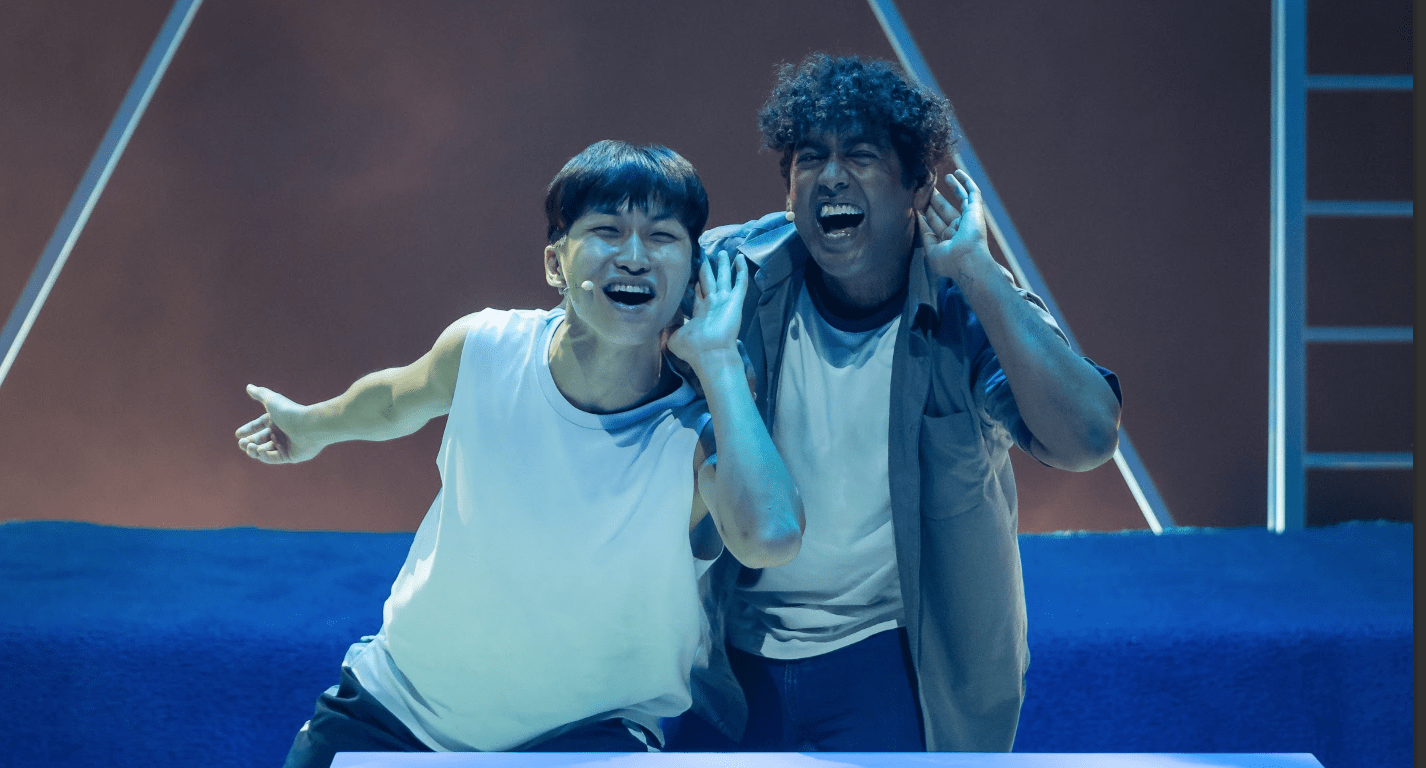
This original play by Gateway Arts takes on the urgent theme of toxic masculinity and men’s silence around their emotions, but faces uneven execution.
In a country where men find it difficult to talk about their feelings, Gateway Arts’ new play Third Man Syndrome tackles the urgent and deeply relevant subject of how toxic masculinity silences men and prevents them from confronting their emotions. Written by Terrance Tan and directed by Ian Loy, Third Man Syndrome also puts suicide at the heart of the story, and clearly has noble intent and an interesting premise in bringing to life a literal mindscape. Unfortunately, despite moments of promise, the production falters in execution and ends up feeling more juvenile than profound.
The play opens with teenage Albert (Krish Natarajan) grappling with the sudden suicide of his best friend Erwin (Clement Yeo), as he reads an eulogy at his wake. What follows is a descent into Albert’s subconscious, a dreamscape of memories, surreal encounters, and desperate attempts to piece together answers. Rather unusual and unique to the play is how it chooses to focus on Albert over Erwin. Where other plays might try to resolve the mystery of Erwin’s death, something that the play initially seems to be working towards, it eventually reveals its true intents of putting the spotlight the effects of suicide on loved ones, left searching for closure that may never come, which the play captures by showing Albert’s replaying of memories, his guilt, and his grasping for meaning.

The production design supports this ambition with symbolic set pieces segmented into colour-coded areas: Albert’s neon yellow study notes completely highlighted, Erwin’s love for carnations in a pink-hued section, or the red bedroom, the site of Edwin’s final moments before his fatal fall. The clutter and proximity of the set represents Albert’s own confused state of mind from the grief. Multimedia touches like glitching screens and interactive tests add intrigue, suggesting the possibilities of blending form and theme. The countdown device, starting at 37 minutes, adds suspense as it ticks down to represent each floor Erwin passed on his way to his death. But its potential soon dissipates, as the high number feels less urgent and more stretched out as time goes by, and the scenes almost repetitive as Albert submits one wrong ‘answer’ after another, only to be greeted by failure from the screens.
The dream sequences themselves are emblematic of the play’s excess. Early on, Albert literally loses his pants, wets the bed, and panics through a surreal exam designed to expose the “truth” of Erwin’s death. These scenes are striking at first, and the imagery lingers, but the repetition blunts their impact, as though the play didn’t quite trust the audience to grasp the point, slipping into didacticism. Even live music, though well-executed, often lands in the most on-the-nose way. Musician Vick Low, with face obscured by a giant carnation mask, repeatedly underscores scenes with cello strains that swell at precisely the emotional beats you’d expect. Rather than heightening the moment, it relies on telling us how to feel instead of letting the emotions emerge naturally.

Where Third Man Syndrome struggles most, however, is in tone. A play dealing with suicide demands emotional precision, yet its overall solemnity is often undercut by far too much comedy. Crude jokes about “boobs” and endless riffs on the word “shit” may reflect teenage banter, but onstage they risk trivialising the gravity of the themes, and mark a tonal mismatch. Flashbacks to the boys’ JC days are played straight with all the clichés of a teen drama, complete with Linkin Park puns and the dreams they have, sacrificing the dreamworld logic that initially held promise. An imaginary Hoobastank concert, a clumsy aging-up video montage played for laughs, and a would-be cathartic moment where Albert is urged to scream out his emotions, all flatten what could have been genuine and moving. Rather than creating contrast, these tonal shifts leave the audience unsure how to respond. This is a play that feels very much written for a teenage audience, and should market itself as such, instead of landing for an adult one.
In that sense, what should anchor the play emotionally, the relationship between Albert and Erwin, is almost always on shaky ground. We are told they are close, but rarely shown why beyond schoolwork and casual banter. Yet perhaps this distance itself unintentionally reflects reality: men, even close friends, are often unable to express care or vulnerability without deflecting with humour about being gay. If this was intentional, it’s a sharp observation, but it risks coming across as thinly drawn on stage.

Krish Natarajan’s performance anchors the piece with conviction in flashes, particularly in a vivid monologue recalling Erwin’s gymnastic brilliance, or in a breakdown where real vulnerability finally surfaces. A late, genuinely shocking reveal of what’s happening outside the dream is a highlight, showcasing what this team can achieve with bold stagecraft. And the play’s finale drives the play’s message home, even if unintentionally so. With the house lights up, the audience is invited to speak to Albert directly. Instead, there’s a long, awkward silence, with the eventual clumsy response. This hesitance inadvertently reflects the very truth the play sought to highlight: we are still deeply uncomfortable talking about our feelings with each other, even when literally invited to.
Third Man Syndrome is clearly a play written with the right intent. Its themes of survivor’s guilt, grief, and the silence around men’s emotions matter deeply. While its uneven execution blunts its impact, the ambition and creativity behind it are undeniable. With tighter editing, greater trust in silence and ambiguity, and a braver embrace of subtlety, Terrance Tan and Ian Loy could shape something truly resonant. This attempt may stumble, but it points toward a team with the courage and imagination to keep growing. If anything, a younger audience might find this resonant, opening up the all-important conversation on feeling safe about being more honest with our feelings, and with each other.
Photo Credit: Gateway Arts
Third Man Syndrome plays from 28th August to 7th September 2025 at Gateway Theatre Black Box. Tickets available here
Production Credits
| Playwright Terrance Tan Director Ian Loy Cast Krish Natarajan, Clement Yeo Musician/Sound Designer Vick Low Lighting & Multimedia Designer Genevieve Peck |
 Bakchormeeboy