
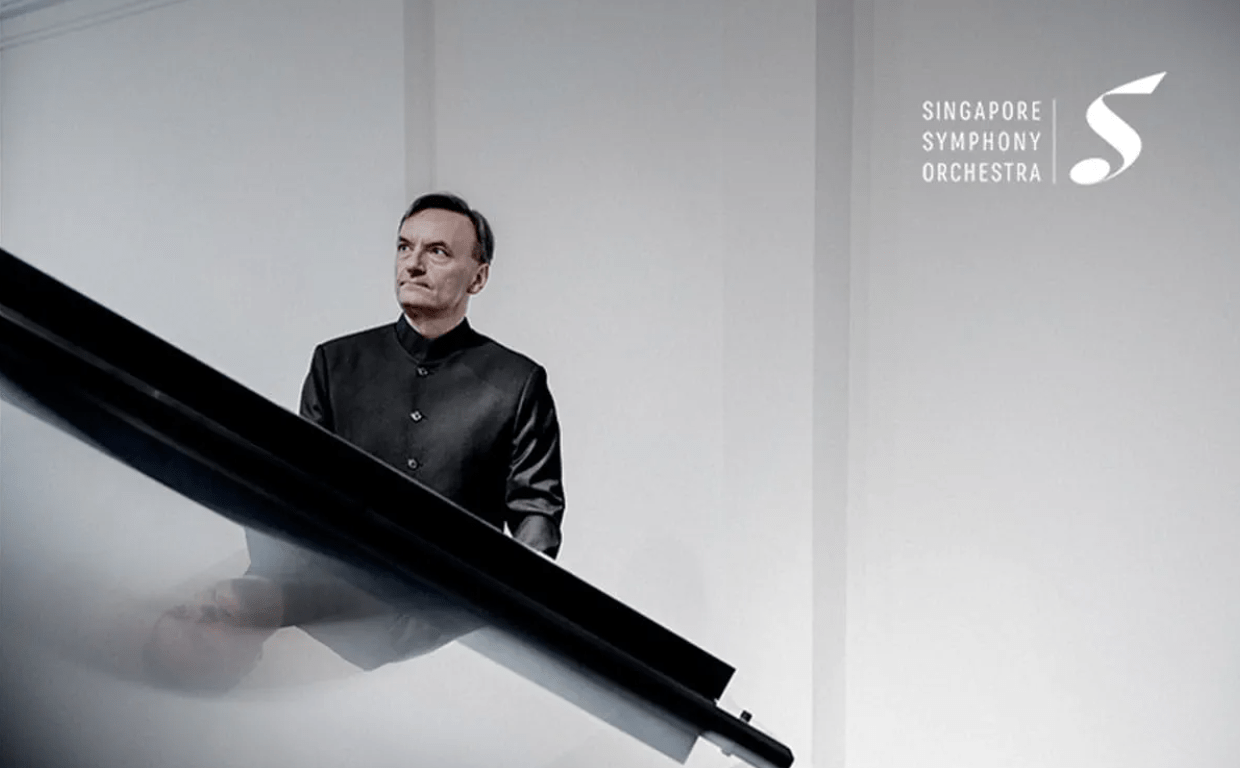
This week, the Singapore Symphony Orchestra brings together two musicians from different generations and traditions: British pianist-composer Sir Stephen Hough and Singaporean organist Isaac Lee, for an evening of reflection, colour, and grandeur. Their works share the stage in a programme that bridges centuries, from Saint-Saëns’s Organ Symphony to Hough’s own The World of Yesterday, which receives its Asian premiere at this Friday’s concert, all under the baton of SSO Associate Conductor Rodolfo Barráez.
“It’s my first time meeting and playing with Maestro Rodolfo Barráez,” says Isaac Lee, fresh from rehearsal at the Esplanade Concert Hall. “He has a great sense of the music, and it’s very encouraging for us. He leads so naturally, so it’s quite easy to follow.”

Performing Saint-Saëns’s Organ Symphony presents both technical and acoustic challenges. “The organ isn’t really a soloist in this symphony—it’s part of the orchestra. You have to gauge the balance very carefully. The Esplanade can be tricky because of the canopy. The sound tends to fly over the musicians’ heads, so we’re actually in the worst spot to judge balance. I’m really thankful to have people out in the hall giving real-time feedback. Anywhere away from the stage, and the sound really blossoms once you’re out in the hall.”
For Lee, experience is everything. “Organists really learn to ‘play the room.’ The acoustics become like another stop on the organ—you’re constantly adjusting for how wet or dry the sound is.” He knows the Esplanade organ intimately. “It’s built by Klais, a very reputable German firm. Singapore has several Klais instruments—the one in Victoria Concert Hall is also by Klais, from 1887, and there’s one in the Petronas Concert Hall in KL. This organ works exceptionally well; it’s versatile for both solo repertoire and orchestral accompaniment.”
Returning to play with the SSO is deeply personal for Lee. “It’s always wonderful to be back. I love our orchestra. I remember being 14, in secondary two, and asking for SSO subscription tickets for my birthday. My parents thought it was a strange request,” he says with a smile. “But to see the SSO now, so established and internationally recognised—it’s incredibly satisfying. Watching the orchestra grow from strength to strength has been inspiring.”
Saint-Saëns, Lee notes, had an unmatched understanding of the organ. “Liszt considered him the finest organist of their time, and this symphony was dedicated to Liszt’s memory. Saint-Saëns wrote very sensitively for the instrument. The fast, dazzling passages go to the pianists, but when it comes to grandeur, he lets the organ shine.”

That grandeur, however, hasn’t always helped the organ’s public image. “Yes, it happens to be in churches, but it’s far more than that. Even in Saint-Saëns’s time, people were playing operatic arias in church! The organ has always straddled sacred and secular worlds. When applying for funding, it’s sometimes dismissed as ‘church music,’ which is a shame, because the organ’s repertoire is vast and beautiful.”
Advocacy, then, is personal. “The SSO has done a fantastic job giving the organ a platform. The SSO Organ Series still sells out. When I curated programmes, I tried to balance three elements: educational, entertaining, and edifying. You attract audiences with the familiar, but also introduce them to new repertoire. People just need to attend a recital; the instrument must be experienced live. CDs don’t capture the full magnitude, the way sound fills and moves in a hall.”
Lee is quick to praise collaborators, including violinist Chloe Chua and composer Cheng Jin Koh. “Working with Chloe was a dream. The organ’s pitch is fixed, but she could adjust her intonation so the sound blossomed. I really enjoy that chamber side of music-making, sometimes even more than solo playing. There’s so much repartee between musicians.”
He also draws on his extensive studies and historical practice experience. “I love informed practices. The more you learn about Baroque music, the more you realise it’s actually very free; tempo, ornamentation, they all have flexibility. That approach informs how I play modern repertoire too. There’s nothing like playing a historical instrument. Playing a violin from a Stradivarius or Guarneri, or an organ from 1515, is like communing with history. The instrument teaches you how to shape sound, touch, and phrasing.”
Balancing performance, study, and teaching, especially at Juilliard, can be demanding. “The music profession is gruelling. But it’s also what we love, so it doesn’t feel like work. Teaching or performing always leaves me refreshed and inspired. It’s about knowing yourself and what you do best. Not everyone needs to be a soloist. Some excel at accompaniment, and that’s perfectly fine. Versatility is key today. You can’t just play your principal instrument well. You have to teach, collaborate, communicate. Musicians wear many hats: performer, entertainer, entrepreneur, teacher.”
And if not an organist? He laughs. “I love the violin. It’s punishing, but in another life, I’d love to learn it properly. I did it for MEP. After secondary school MEP, we had to take up an Asian instrument in junior college, so sadly I had to put aside the violin during those years.”
Looking ahead, Lee hopes to do more teaching. “Playing is fulfilling, but sharing that joy, helping someone realise they can create that joy themselves, that’s extremely meaningful to me,” he says. “That joy has to be honed early on; I remember growing up in Saint Andrew’s Cathedral and had the chance to observe the organist after service, running up just to hear her play the postlude. It was all part of learning and learning to love the instrument.”

For Sir Stephen Hough, The World of Yesterday was born in the quiet of lockdown. “It began in my studio, during the early months of the pandemic. I got an email from a film director in Los Angeles asking if I would like to write a film score for a movie about an ageing Austrian baroness who commissions a young American composer to complete the sketches her sister left before dying by suicide. It was an intriguing concept, and I decided to take it on.”
“I began with a theme for the American composer, with wide open skies, a touch of Americana, interwar white-note simplicity. Then came a theme for the baroness, lusher, Viennese, with a little waltz. That waltz became the second movement with some variations; later, it all merges in the finale, the white notes turning to black in the climactic chords,” he adds.
The movie never happened, though the sketches remained, and Hough decided to turn them into a full-scale piano concerto, almost like life imitating art. “In 2021, when so many concerts were cancelled, it was wonderful to be asked to write something. We had endless Zoom calls with the producer and director in Los Angeles. Even as I wrote, I knew I would eventually turn this into a concert work. Everything in it was written with care. I like music that has both head and heart, and I wanted it to be romantic yet tightly constructed.”
He describes the opening with architectural precision: “It begins in C major, with a theme in the violins and flutes, the wide open skies, perhaps a touch of Copland, because the film was set in the 1930s. Underneath, the harp and clarinet have this rising chain of thirds, which later becomes the waltz of the second movement. Everything grows from those opening bars. For me, music must be architecture as well as decoration.”
Performing the piece in Singapore adds another dimension. “It’s very possible to construct a sense of nostalgia about this country, because it’s obviously a very young country, but with many historical roots and connections with many different cultures. I’ve always found that fascinating about here. As a British person, I see familiar things, like how Victoria Concert Hall is named after the Queen of England. But I also see the many influences that make Singapore what it is: huge Chinese influences, among other Asian influences, and now in the 21st century, it’s one of the most international places in the world. Yet it integrates beautifully. In a way, I think that nostalgia has a very healthy history here. Maybe I can live that in the concert when I play on Friday.”
Hough sees all his creative pursuits, piano, composition, writing, as part of the same impulse. “They’re part of the poetic drive. Poetry takes everyday words and makes them mean something more. When I play the piano, when I compose, it’s all coming from this sense of how we transform our lives from the mundane. Life can be magical, full of poetry, or very dull. It depends on how we approach it. Even tasting a mango can be a moment of reverence, attention, and gratitude. We are all potential poets.”
Connecting with past traditions, Hough observes, “Saint-Saëns was part of a long line of pianist-composers who wrote for themselves to perform, from Mozart onwards. I feel a connection with that: turning one’s own playing into one’s own compositions.”
But performing one’s own work brings vulnerability. “Certainly more vulnerability, yes. Once a piece is published, it’s like a child sent off to university, it’s in the world. When I return to it, I’m playing music written by a different version of myself. If you play Beethoven, people may dislike your interpretation, but not the music itself. With my work, they can dislike both.”
Social media and engaging younger audiences is a joy, he says. “It’s a great thrill when young people engage. You need to protect your time, but do come to concerts, say hello afterwards, it means a lot. We’re all in this together.”
The concerto’s title, The World of Yesterday, inevitably stirs thoughts of nostalgia. “Nostalgia can be painful, but the longing itself is human. It comes with gratitude, for parents, teachers, those who shaped us. The past is gone, but we can learn, enjoy, and live in the present.”
On misconceptions about classical music, Hough is clear. “Yes, it’s difficult, but that’s why it’s rewarding. Classical music is a lifelong art. You explore, listen, and return to works over time. It’s more like training for the Olympics than playing on a beach. It gives long-term reward, not instant gratification.”
After decades at the piano, what still surprises him? Hough smiles. “I’m always surprised. I’m never bored. I love the sound, the touch, the pedal. I still can’t believe how lucky I am to spend my life with this miraculous instrument. Thank you, Mr. Cristofori, Steinway, and all the other innovators who have developed it and brought it to life.”
For both Stephen Hough and Isaac Lee, music is a lifelong conversation between artist and audience, tradition and imagination, sound and silence. Hough’s The World of Yesterday and Saint-Saëns’s Organ Symphony may seem worlds apart, but in their hands, they become twin meditations on creating, remembering, and listening, with attention, gratitude, and joy.
Photo Credit: Singapore Symphony Orchestra
Stephen Hough Piano Concerto + Saint-Saëns Organ Symphony plays on 7th November 2025 at the Esplanade Concert Hall. Tickets and more information available here
 Bakchormeeboy