
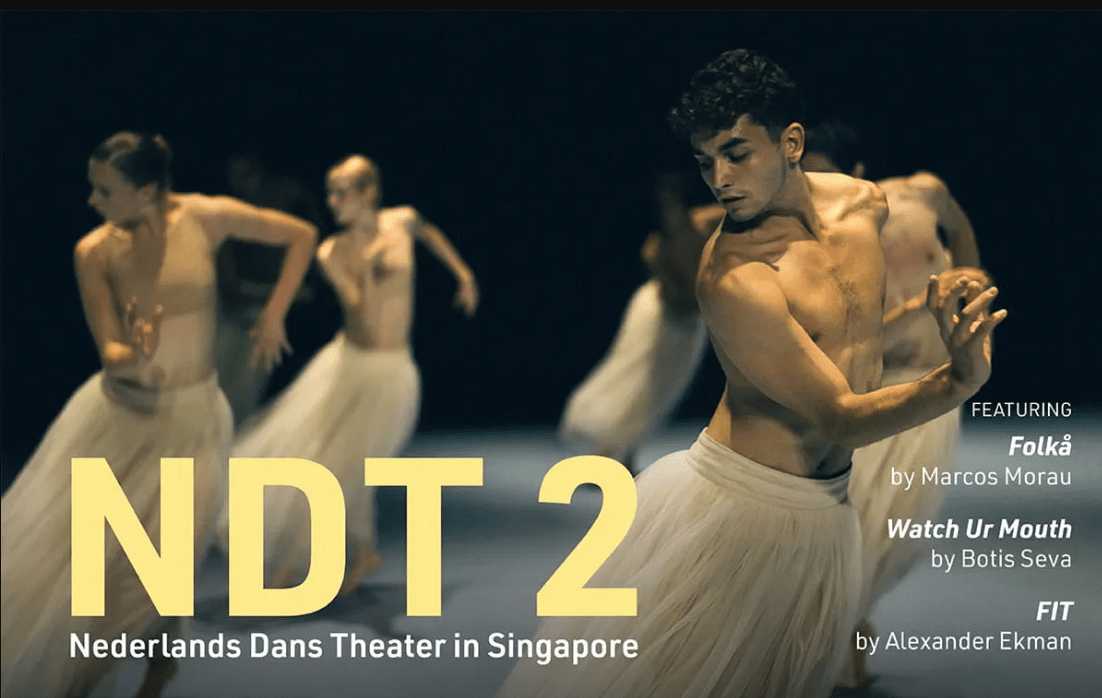
Triptych of dance work from one of the world’s foremost dance companies firmly establishes each choreographer as an auteur, as they comment on community and belonging.
Nederlands Dans Theater (NDT 2), one of the world’s foremost contemporary dance companies, returned to Singapore with a programme that reaffirmed why they occupy such a singular place in the global dance landscape. Whether through their deep choreographic lineage or their embrace of theatrical innovation, NDT has long been a proving ground for artists who stretch the vocabulary of movement into realms raw, poetic, and entirely new. Under the guidance of Artistic Director Emily Molnar, this spirit of bold exploration thrives—now invigorated by a new wave of collaborations and emerging voices.
The evening’s triple bill, comprising Folka, Watch Ur Mouth, and FIT, showcased the remarkable range of NDT 2’s young dancers. Each work approached the question of belonging from a different angle, inviting us into communities that nurture, entrap, comfort, provoke, or dissolve entirely. Together they offered an uncommonly rich portrait of the universal tension between individuality and the collective. The result was a night of exceptional dance: visceral, reflective, and impossible to forget.
Folka

Marcos Morau’s Folka opened the programme with a world that felt both ancient and otherworldly, as if the dancers had emerged from some primeval dusk to enact a ceremony older than language. Their silhouettes, heads first, skirts pooling in darkness, immediately set the tone for a ritualistic journey rooted in folklore yet sharpened by contemporary urgency. Morau crafts a community that moves not as individuals but as parts of a shifting organism, each gesture absorbed and echoed by the group until personal agency melts into collective rhythm.
Tom Visser’s lighting acted almost as a living partner, defining pathways, intensifying crescendos, and marking thresholds between visibility and mystery. Pools of pale light resembled moonbeams that the dancers chased, worshipped, or recoiled from. When a single concentrated beam descended, their bodies quickened as though summoned by a higher force, a visual metaphor for the lure of belief, of belonging, of surrender.
The choreographic textures were rich and uncanny: bodies trembling like incantations, rolling in waves, spiralling into pirouettes that seemed to tether them to unseen cosmic cycles. Choral vocals and drum-heavy sound design gave the work a sense of communal invocation—somber yet celebratory, sacred yet visceral. There were moments where they resembled witches, vampires, or woodland spirits, not theatrically but archetypically, drawing from myths that feel universal across cultures.
Despite its darkness, the work radiated care. The dancers constantly wove in and out of one another, supporting, circling, and enveloping one another in movements that suggested both safety and entrapment. It felt like a portrait of communities that sustain us while also binding us—religion, tradition, inheritance, ritual. The result was deeply hypnotic, especially in the final image where tiny points of light pierced the black backdrop like dawn through trees, the dancers flickering away with pirouettes in and out as night gave up its hold.
By the time the last whisper faded, Folka had completely transported the audience into its nocturnal realm. It was a powerful beginning: eerie, immersive, and beautifully executed.
Watch Ur Mouth

Where Folka delved into communal mysticism, Botis Seva’s Watch Ur Mouth hurled us into the chaos of contemporary life; its noise, pressures, self-doubt, and the battles we fight inside our minds. Botis Seva’s choreography blends hip-hop, contemporary dance, and spoken word into a deeply personal reckoning with criticism and resilience. What unfolds is not a narrative so much as a psychological landscape, pulsing with urgency.
The dancers began in sharp military formations, their bodies snapping into salutes, drills, and regimented patterns that suggested a war being waged, but not one with weapons. Instead it is a war of words, and of self-perception. Seva uses the language of combat metaphorically, revealing how quickly we armour ourselves in the face of external judgment. Yet within these formations, cracks appeared. Dancers slid out of sync, splintered into solo protests, or collapsed into frantic exertion, one even panting as he moves across the stage, running in place and progressing ever so slightly, as if trying to outrun his own thoughts.
Visser’s lighting again performed a critical role, carving the stage into fractured zones that felt like emotional pressure points. Shadows swallowed bodies whole; tight beams isolated moments of vulnerability; sudden blackouts mirrored the overwhelming flash of intrusive thoughts. Seva’s spatial composition was remarkable: clusters of dancers forming, dissolving, and reforming as though shaped by the shifting winds of anxiety and support.
What grounded the work was its tenderness. Amidst the tumultuous physicality, snippets of Seva’s voice, part prayer, part confession, emerged like beacons. You sensed the presence of loved ones, of people who lift us up, anchoring the work in deep emotional truth. Hip-hop here becomes not just a stylistic choice but a form of defence, pride, and reclamation, and a way of asserting identity in the face of erasure.
The piece ends without easy resolution, yet with unmistakable strength. It reminds us that survival in a loud world is not just a matter of endurance but of connection. Of all the works, Watch Ur Mouth felt the most raw, the most present, and the most soul-baring, reminding us of how deep our words can cut, and how we must learn to grow a thicker skin against it.
FIT

After the intensity of the first two works, Alexander Ekman’s FIT bursts onto the stage like a sunbeam: playful, irreverent, and full of theatrical charm. The dancers appeared in bright yellow tulle skirts, each one a quirky character in a world that seemed both tropical and surreal. From the tongue-in-cheek opening announcement, welcoming us to ‘the best work we’ve ever seen’, and then quickly retracting that statement, Ekman made it clear we were entering a universe where humour and philosophy dance hand in hand.
At its core, FIT explores the paradox of fitting in: the yearning to stand out while craving the safety of the crowd. The dancers flocked, scattered, regrouped, and imitated one another with comedic precision, constantly negotiating the shifting rules of their miniature society. When the lone figure in blue appears, the dynamic became even more intriguing—was she the instigator of this groupthink or merely a reflection? Ekman leaves space for ambiguity, turning mimicry into a witty commentary on trend-chasing, whether it’s putting on a leather jacket, or even the absurd act of sticking her head into a bin, wondering if she’s hit rock-bottom.
The music, ranging from jazz to electronic textures, added a buoyant unpredictability that kept the piece in perpetual motion. The fog machine hovering innocently upstage added a surreal flourish, just enough strangeness to unsettle the otherwise light-hearted environment. And unlike the previous two pieces, FIT embraced a bright, exposed lighting palette, inviting us to witness every hesitation, every rivalry, every flash of insecurity across the entire stage.
As the work progressed, competitiveness seeped into the group dynamic. Dancers tried to outdo one another, each attempting to claim a moment of brilliance, only to be swallowed back into the collective, or be rendered exhausted – perhaps they are displaying faux friendship, perhaps they are in genuine admiration of each other. When the tulle skirts were finally discarded, everyone seems momentarily identical, temporary relief as they all find togetherness, equals at last.
Yet before long, the cycle of imitation and reinvention begins anew, repeating the first scene once again. The message was clear: individuality is fleeting, conformity is persistent, and the dance between the two is endlessly looping. Filled with wit and humanity, FIT was a buoyant finale that gently poked fun at our universal desire to belong. It was a joy to watch the dancers revel in such physical and theatrical freedom.
In bringing together these three works, NDT 2 offers a profound reflection on belonging—how we lean into communities, how we push against them, and how we constantly renegotiate our place within them. Whether through the mystical communion of Folka, the internal battles of Watch Ur Mouth, or the playful social satire of FIT, the company showcased an astonishing breadth of artistry and emotional depth.
NDT 2’s young dancers proved themselves extraordinarily versatile, navigating vastly different choreographic worlds with breathtaking precision, imagination, and heart. Their collaborators: choreographers, designers, and musicians, created worlds that felt fully realised, cohesive, and deeply resonant. The thunderous applause that followed each piece were both appreciative, and suggested something more – being grateful. Nights like this reaffirm why NDT remains at the forefront of contemporary dance worldwide, and why any opportunity to witness their work feels like a gift.
Photo credit: Rahi Razvani
Nederlands Dans Theater (NDT 2) in Singapore plays from 29th to 30th November 2025 at the Esplanade Theatre. Tickets available here
Production Credits
| Folka Choreographer Marcos Morau Staged by Shay Partush Music Composition / sound design by Juan Cristobal Saavedra, contains compositions: Condividiamo La Luna & Whisper: Kim Sutherland. The London Bulgarian Choir led by Dessislava Stefanova: Mor’f Elenku, trad.; Izgreyala Yasna Zvezda, trad. Arrangement by Dessislava Stefanova; Razbolyal Se E Mlad Stoyan by Kiril Todorov. Light design Tom Visser Decor Marcos Morau Costumes Silvia Delagneau NDT rehearsal director Ander Zabala Watch Ur Mouth Choreographer Botis Seva Assistants to the Choreographer Jordan Douglas, Victoria Shulungu Music New Composition by Torben Sylvest with use of Bunny Sigler: Shake Your Booty; Sony Music, Warner-Tamerlane Publishing Corp (Bmi), Warner Chappell Music Holland B.V. Vocal Performances by Magero, The Seva Family Light Design Tom Visser Decor & Costumes Botis Seva NDT Rehearsal Director Lydia Bustinduy FIT Choreographer Alexander Ekman Staged by Eve-Marie Dalcourt Music No, Nicolas Jaar, published by Mattitude Music / Beggars Music Take Five, The Dave Brubeck quartet, ©Valentine Music Ltd Serious drug (instrumental), Wildcookie, written and produced by Freddie Cruger, 2011 Tru Thoughts Ltd, Full Thought Publishing Light Design Alexander Ekman, Lisette van der Linden Set Design Alexander Ekman Costumes Alexander Ekman, Yolanda Klompstra Text Alexander Ekman Collaborating Artist Julia Eichten Collaborating Artist/ Dramaturgy Carina Nildalen NDT Rehearsal Director Lydia Bustinduy, Ander Zabala |
 Bakchormeeboy