
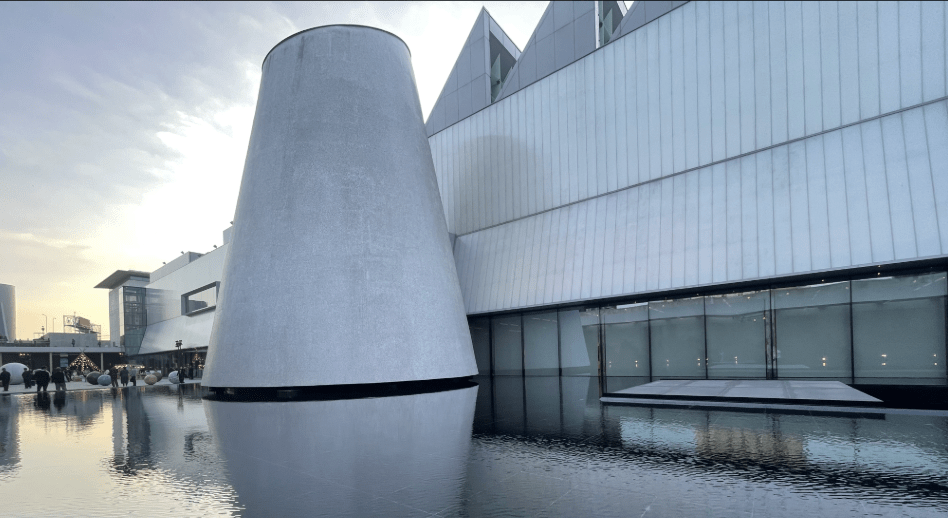
BANGKOK, THAILAND – There is something a little daunting about reaching Dib Bangkok’s location for the first time. Down a narrow, nondescript alleyway, the GrabBike we’re on slows, hesitates, and seems to take a moment to register what lies ahead before riding off. A large, gated building emerges, its blackened exterior giving little away, with only a narrow opening through which to enter the premises itself.

But step behind the wall, and it is like entering a different realm altogether. The city’s noise collapses almost instantly, replaced by the acoustics of water, air, and open space. The architecture, designed by Kulapat Yantrasast of WHY Architecture in collaboration with A49, is breathtakingly beautiful, brutalist in its concrete language, yet carefully calibrated to feel porous rather than imposing. The building does not dominate the body; it guides it.
This choreography of movement is intentional. Dib Bangkok is not encountered all at once; it reveals itself gradually. From compressed entrances to expansive courtyards, from shadowed thresholds to luminous interiors, the architecture establishes a rhythm of contraction and release. It prepares visitors for a different mode of attention: one rooted in slowness, reflection, and presence.

That emphasis on slowing down was articulated clearly during the opening address by Purat “Chang” Osathanugrah, Dib Bangkok’s founding chairman. Standing before an audience of artists, curators, collectors, and cultural leaders, Chang spoke candidly about what it means to open a museum in a city defined by sensory excess.
“We look where we are in the city of Bangkok — there’s hustle and bustle, there’s sights and sounds and smells. If I’m quiet, I can hear an ambulance and the tuk-tuks,” he said. “The energy, the pure energy of it, it’s eclectic, it’s chaos, it’s beautiful. But putting this museum here, what we also wanted to do is provide something else, something that people can slow down with, enjoy these fruits of creativity.”

Dib Bangkok did not begin as an institutional master plan. It began as a dream — one inherited, unfinished, and deeply personal. Chang introduced himself not only as chairman, but as “a very proud son of a dreamer,” referring to his late father, Petch Osathanugrah. “We’ve inherited not just the collection,” Chang explained, “but we inherited a dream.”
When his father passed away, that dream was fragmentary. “I only knew about three pieces, what he wanted to have inside,” Chang recalled. “There was no team, just one administrative staff, but no team whatsoever.”

What followed over nearly three years was not simply construction, but an extended process of questioning, questions Chang once imagined discussing with his father, but now had to answer himself: “How can a museum transform a city? What role can it play? And most importantly, how will our generation living and breathing today be remembered?”
These questions form the conceptual spine of Dib’s inaugural exhibition, (In)visible Presence, which unfolds less as a showcase than as a meditation on memory, absence, and continuity. As Chang noted poignantly, “our founding father is no longer with us, but his art as a legacy speaks from beyond.”

Kulapat Yantrasast of WHY Architecture has described the project as an attempt to reflect Bangkok’s evolving role as an international art destination while fostering dialogue across communities. In practice, the building behaves less like a monument and more like a vessel, one that holds art, people, and time with equal care.
The outdoor spaces then act as a threshold, neither fully inside nor outside, preparing the body for the shift in perception that follows. Several permanent installations are integral to this, encapsulating the museum’s aims and thematic shift.

One of the first pieces one encounters is Alicja Kwade’s Pars Pro Toto, composed of planetary stone spheres marked by geological time, expands the conversation outward. From atoms to solar systems, the work reminds us that structures repeat, that human life exists within patterns vastly older and larger than ourselves. The museum becomes not a container for objects, but a temporary alignment within cosmic time, and it is through art that we are able to see both the minute and the colossal up close.

Embedded within this architectural journey is Straight Up (1988/2025), James Turrell’s first major permanent structure in Thailand. A foundational figure in the Light and Space movement, Turrell has spent decades using architecture to sharpen awareness of perception itself. On the lower level, a rare camera obscura projects the image of the sky directly onto the stone floor: light inverted, slowed, and rendered tactile.

On the upper level, a precisely cut aperture frames the open sky, collapsing distance and scale. Turrell has described such works as invitations “to go inside to greet the light,” reminding viewers that “you are looking at you looking.” Within a Thai Buddhist context, where the sky symbolizes transcendence and enlightenment, the work resonates deeply. By disciplining attention, Straight Up becomes less an artwork than a ritual. Activated by a lighting program at sunrise and sunset, the upper chamber transforms daily into a time-based event. Reservations are required, reinforcing the work’s contemplative, almost ceremonial nature.

Nearby, Sho Shibuya’s Sunrise from a Small Window explodes across Dib’s exterior walls. What began as a private ritual, where Shibuya painted each morning’s sunrise over the front page of the New York Times, becomes amplified and monumental here. Headlines dissolve beneath washes of colour. Crisis yields, if not to optimism, then to persistence. The sun rises anyway. There is a quiet dialogue here between Shibuya and Turrell: one frames the sky; the other paints it daily. Both insist on attention as an ethical act.

And just around the corner, Paloma Varga Weisz’s Bumpman on a Tree Trunk sits slightly apart, gazing upward with serene self-acceptance. His body is awkward, misshapen, undeniably other, yet utterly at peace. “Take a seat next to him,” the work seems to suggest, “and try to see from his perspective.” In a museum so invested in questions of visibility and belonging, Bumpman becomes an unexpectedly tender ambassador for visitors to spend a moment taking it all in.

All these ideas culminated on opening night with (In)visible Presence, a site-specific performance directed by Dujdao Vadhanapakorn. Female dancers clad in chainmail-like silver garments, armour that obscured their vision, moved tentatively through the museum’s external grounds. They felt their way along walls, reached out to one another, climbed Kwade’s spheres, gathered beneath Turrell’s vertical tower, and rested beside Bumpman.

They seemed to be learning how to see, not with eyes alone, but with the body, with intuition. Eventually, they crossed the water and disappeared into darkness, leaving behind a charged stillness. The space had been activated. The museum was officially opened, and most importantly, inhabited.

Dr. Miwako Tezuka, Dib’s director and chief curator, later described the museum’s realisation never as an individual achievement, and she opened her remarks by reading aloud a message sent to her by Petch Osathanugrah in 2015 — a poignant reminder that this institution began as a conversation: “I really need some advice and I am willing to keep the conversation going,” he had written.
Reflecting on the years since, Tezuka described the process as one marked by “many, many conversations, questions, doubts, late night drinking, laughing and crying.” The museum, she stressed, was “built upon the community effort that has built the foundation for many decades.”

“Our grand opening exhibition is to thank everyone in the community, those who supported the families, supported the artists, supported the art ecosystem that is fast growing in Thailand.”
She also acknowledged the labor behind the scenes: a small core team of just fifteen, supported by facilities staff, technicians, and security. “This museum,” she said simply, “is going to be a space for art for everybody.”

Housed within a transformed 1980s warehouse in the Rama IV district, Dib Bangkok spans 75,000 square feet and includes eleven gallery spaces, a 15,000-square-foot central courtyard, an outdoor sculpture garden, and a penthouse venue for events. Yet its impact lies not in scale alone, but in sequence. The architectural journey loosely follows a Buddhist conception of awakening. The ground floor remains raw and grounded, exposed concrete, weighty volumes, and industrial textures that anchor the body.
Before the guided tour began proper, visitors were invited to activate an interactive artwork by striking a pristine white wall with a bat. Each impact left a visible scar and triggered a thunderous sound installation that reverberated through the space. The message was unmistakable: presence matters. Action leaves a trace.

The exhibition itself unfolds in thematic movements rather than linear chronology, beginning with The Unseen. The first section of (In)visible Presence is devoted to the deceptively familiar; objects that look monumental, architectural, or authoritative at first glance, only to unravel into fragility upon closer inspection. A warship turns out to be air. A wall reveals itself as clothing. A threshold promises safety but delivers unease. Here, vision misleads before it instructs. These works ask us not just to look, but to recalibrate how we trust what we see.
Many of the artists gathered here inherit the postmodern impulse of the late 1960s, when distinctions between art and life collapsed under political pressure and material experimentation. Aluminum foil, secondhand clothing, kitchenware, metal detectors, and automobiles replace traditional sculptural media. The result is a body of work that feels at once playful and ominous — objects masquerading as something else, carrying within them histories of labor, surveillance, migration, and control. This is the exhibition’s most materially exuberant section, and also its most destabilizing.

Lee Bul’s Willing To Be Vulnerable – Metalized Balloon V3 (2015/2019) is the first piece viewers see upon entry to the space, and is emblematic. From afar, it reads unmistakably as a military vessel — sleek, imposing, authoritative. Only when the viewer approaches does the illusion collapse: the ship is a balloon, its structure held upright by air, its metallic sheen nothing more than aluminum foil laminated onto nylon fabric. Vulnerability is literalized. Power becomes breath-dependent. In Lee’s hands, militarism is revealed as performance — inflated, reflective, and fundamentally precarious.

That tension between scale and substance recurs in Jean-Luc Moulène’s Pleasure Dome (2013), a work composed of miniature red stones that nonetheless asserts a quiet gravitational pull. Moulène’s practice often probes systems of value, spanning the economic, geological, and political, and here, monumentality is compressed into something handheld, almost devotional. The dome is not built upward but inward, asking viewers to recalibrate their sense of importance, and invites them to take a closer look.

Arte povera emerges as a crucial lineage throughout this section, most powerfully through Jannis Kounellis’s Untitled (1998). Four steel panels, each pair the exact dimensions of a double bed, anchor the installation. Between i-beams, secondhand clothing is rolled and compressed between lead sheets, resembling luggage crammed for departure. Kounellis, who migrated from Greece to Italy in 1956, began his career painting on bedsheets because he could not afford canvas. That history of necessity persists here. Rusted fingerprints, dark stains, and worn fabric carry the trace of human contact. These are not neutral materials; they remember being touched.

Passing through Hugh Hayden’s Untitled Threshold (After Victor Horta After Charleston) (2019) makes that memory bodily. A functioning metal detector, framed like a Gothic archway, emits alarms in response to everyday objects — keys, phones, accessories — rendering the act of passage fraught with suspicion. Referencing both Belgian architect Victor Horta and the 2015 racially motivated church shooting in Charleston, the work gives form to invisible systems of control: policing, fear, religion, belief. The alarm does not reassure; it amplifies anxiety. Safety here is performative, conditional, and deeply unstable.

Subodh Gupta’s Incubate (2010), installed in a chapel-like space of its own, offers a more ambivalent vision. Stainless-steel lunch tins, the ubiquitous dabbas of India, are stacked into egg-like forms beneath glittering crystal chandeliers. Gupta entangles symbols of Western opulence with objects of daily labor, evoking family, nourishment, and collective systems of care. Massed together, the vessels feel charged with potential, as if something might yet hatch from within them.

Surasi Kusolwong’s Emotional Machine (VW) (2000–2001/2025) completes the section by dismantling the museum’s authority altogether. An upside-down Volkswagen Beetle, rocking gently like a houseboat, becomes a space to enter, sit, and inhabit. Visitors remove their shoes, lounge on cushions, interact with vending machines and monitors. Kusolwong invites us not to observe but to dwell, to generate our own memories inside the work. The museum becomes less a site of reverence than of lived experience — provisional, intimate, and strangely tender.

Together, these works establish The Unseen as a realm of misdirection and revelation. What appears solid is hollow. What looks powerful is fragile. Meaning, like breath, must be sustained, and encourages us to take a second look, a closer glance, and more time to meditate and ponder on how there is almost always more than meets the eye.

If The Unseen challenges perception, The Unsaid turns inward. This second floor becomes quieter and more introspective, incorporating preserved elements of the original structure, including an old Thai-Chinese window grille that operates like a mnemonic device, signalling memory and transition.
The Unsaid then gathers works that speak through silence, memory, and delay — art that resists immediate legibility and instead unfolds through duration, repetition, and trace. The winding layout encourages a loss of temporal orientation; viewers drift rather than progress, encountering fragments of lives remembered, recorded, or imagined.

Hiroshi Sugimoto’s Tri-City Drive-In, San Bernardino (1993) compresses an entire film into a single white rectangle. By setting his exposure time to the length of the movie playing, Sugimoto drains narrative of motion and sound, leaving only luminous absence. The drive-in, once a site of communal leisure, appears abandoned, its blank screen becoming a surface for projection. What remains is not the story that was told, but the space it once occupied in collective memory.

Rebecca Horn’s The Lover’s Bed (1990) offers one of the section’s most affecting moments. Mechanical butterflies perch atop an iron hospital bed, their wings fluttering softly. The work recalls Horn’s confinement during illness in the 1960s, when imagination became a means of escape. Butterflies, for Horn, symbolizs transformation and alchemy. Here, they animate the bed, an object of vulnerability, turning it into a site of psychic flight, an attempt to break free from what she called “the little prison” of the mind.

Apichatpong Weerasethakul’s film Emerald deepens this dreamlike register. Neither linear nor explanatory, the film drifts through time and place with the logic of memory rather than narrative. Like much of Apichatpong’s work, it exists in a liminal zone between documentary and reverie, inviting viewers to inhabit uncertainty as a mode of perception.

Light itself becomes a carrier of memory in Miya Ando’s White Gold Light Mist (2015). Using reflective pigments and resin on aluminum, Ando creates the illusion of light emanating from within the surface. As viewers move, the work shifts between sunrise and sunset, its chromatic haze refusing to settle. Time here is not measured but felt.

Photography returns in Vanishing Bangkok, Surat Osathanugrah’s quietly devastating documentation of a city in transition. Taken at the turn of the millennium, the images capture neighbourhoods on the brink of disappearance. They are not nostalgic so much as attentive, a form of witnessing that becomes foundational to Dib Bangkok itself.

That sensory layering intensifies in Jinjoon Lee’s Daejeon, Summer of 2023 (2023). Sumi ink spun onto plaster disks becomes a visual diary, later translated by AI into sound. One screen zooms hypnotically into the spinning record; another shows a street outside the gallery where the work first appeared. The installation suspends us between geographies, between human memory and machine interpretation, between past experience and present replay.

Loss, grief, and endurance surface with particular force in Jessie Homer French’s paintings. The Loved Ones (2016), Night Swim (2015), and Wildland Fire (2013) hold moments of beauty alongside devastation. French began painting graveyards after the death of her daughter; fire entered her work through witnessing prescribed burns. “It was so beautiful,” she recalls, a statement that encapsulates her ability to hold contradiction without resolution.

Light becomes one of the section’s primary carriers of meaning. In Pae White’s Module#1390 NCS-Color S0530-G20Y (sea foam green) (2014), illumination is not simply projected but embodied. Constructed from copper, epoxy filler, glass, wire, and a halogen illuminant, the work emits a muted, almost aquatic glow that resists spectacle. The colour: precise, coded, industrial, nevertheless feels atmospheric, as if light itself were being held in suspension. Rather than directing attention outward, the piece draws the viewer into a heightened awareness of perception itself, a reminder that light is both information and sensation, something that registers in the body before it resolves in thought.

Housed in its own room, Somboon Hormtientong’s The Unheard Voice (1995) literalizes silence through ritual. Temple columns, wrapped like bodies and blessed by monks, rest quietly, bearing scars of past lives.

Nearby, Jakapan Vilasineekul’s Dialogue Between the Tongue-Tied and the Dumb (1995) assembles domestic objects into a stalled conversation; speech implied but withheld.

Memory, as both material and compulsion, finds one of its most affecting expressions in Louise Bourgeois’s Nothing to Remember (2004–2006). Comprising twenty-two folios arranged along an unusually long plinth, the work unfolds like a slow descent into the artist’s interior world. Etchings and mixed media markings spill across musical staff paper, populated by Bourgeois’s familiar spirals and cells, forms that oscillate between containment and release. The title is characteristically ironic.

Created in the artist’s nineties, the series reads as an acknowledgment of memory’s slipperiness, even as Bourgeois obsessively returns to it. The repetition becomes hypnotic, even unsettling, as though the viewer is being drawn into the same recursive thought patterns. Walking the length of the plinth feels less like viewing discrete works than accompanying the artist through an extended psychological passage; intimate, humourous, and quietly destabilising.

Navin Rawanchaikul’s There Is No Voice (1994) brings the section to a hushed crescendo. Over a thousand photographs of elderly Chiang Mai residents are sealed into discarded medicine bottles and arranged like a stupa. First shown in a library, the work remains a library still; shelves of knowledge preserved in silence, waiting for listeners.

Time, elsewhere, is marked through ritual. In the Dib Bangkok presentation of Sho Shibuya’s ongoing series Sunrise from a Small Window (2020–), the daily newspaper becomes a site of meditation. Each morning since April 2020, Shibuya has painted the sunrise over the front page of that day’s news, partially obscuring headlines with gradients of colour that reflect the sky outside his window.
Selected works are grouped according to dates of personal, political, and cultural significance — from global crises and elections to moments of private loss, including the passing of Dib Bangkok’s founder, Petch Osathanugrah. The effect is cumulative. Color overtakes information, but never fully erases it, creating a tension between the immediacy of news and the cyclical promise of renewal. History, Shibuya suggests, is lived one morning at a time.

That insistence on presence is extended in Present (2025), an interactive work realized with Nomena, Tokyo. Visitors are invited to take a die-cut postcard, stamp it with the current date using a timecard machine, and hold it up to the sky. The gesture is simple, almost disarmingly so, yet it reframes the museum visit as a temporal marker, a conscious acknowledgment of “here and now.” In a section preoccupied with memory and loss, Present offers neither resolution nor consolation, only attentiveness.

Other works in The Unsaid address silence more directly, as something structured and imposed. Finnegan Shannon’s Do you want us here or not (Dib) (2025) confronts the viewer with a blunt institutional question. Part of an ongoing series examining disability, access, and power, the painted plywood seating invites participation while simultaneously exposing the conditional nature of welcome. The work’s directness cuts through the surrounding atmosphere of reverie, reminding us that silence is not always poetic, it can be enforced, systemic, and exclusionary. In this context, rest itself becomes political.

History’s weight presses most heavily in Anselm Kiefer’s Der verlorene Buchstabe (2019). Composed of metal, lead, photographs, resin, and sunflowers emerging from the remnants of an original Heidelberg letterpress, the work draws on Jewish Kabbalistic thought, specifically the belief in a lost, invisible letter of the Torah that will one day reappear to repair the world. The printing press, once a symbol of enlightenment and communication, carries its own burdened history, its production diverted during World War II to manufacture Nazi war machines. From this ruin, sunflowers bloom, a recurring motif in Kiefer’s practice, emblematic of endurance and regeneration. For an artist who grew up amid the rubble of postwar Germany, destruction is never final. Memory is not something to be resolved, but something to be carried: heavy, unresolved, and necessary.

In The Unsaid, Dib Bangkok makes a compelling case for silence as a form of knowledge. Rather than declaring meaning, these works linger, gathering memory through fragments of light, breath, residue, and repetition. Documentary formats are invoked only to be stretched beyond their evidentiary limits: photographs become speculative archives, sound emerges from absence, and time folds back on itself.

What unfolds is not a single narrative but a constellation of lived experiences, suspended between personal testimony and collective history. By refusing spectacle and foregrounding trace, delay, and disappearance, this section reframes remembrance as an active practice, one that demands patience, attentiveness, and a willingness to dwell in the spaces where language falters and meaning slowly accumulates.

The final section on level three centers on Montien Boonma, a pioneer of Thai contemporary art whose work insists on being felt as much as seen. If the previous sections explore illusion and memory, The Unknown confronts what lies beyond comprehension: illness, impermanence, breath, and transcendence.

The third floor opens into luminous white-cube galleries flooded with natural light from skylights and capped by a striking sawtooth roof. Here, the architecture lifts, both physically and psychologically, creating a sense of openness, clarity, and suspension. Housing Boonma’s work here seems to bring the entire exhibition ful circle, where we note how Boonma’s practice was shaped by arte povera’s embrace of everyday materials, but evolved into something profoundly spiritual.

Works like Lotus Sound (1992/1999–2000) arrange five hundred terracotta bells around a gilded lotus. Inspired by temple bells at Doi Suthep, the work draws attention to silence to the hollow spaces where sound might resonate beyond perception.

In Prayer of Abihsot (1994/2025), Boonma transformed personal crisis into ritual transmission. Unable to leave his wife’s hospital bedside, he sent his presence into a gallery via video and photocopied question marks — symbols of the unknowable, repeated endlessly like prayer. In this recreation, his son performs the gestures, extending the work across generations.

Arokayasala: Temple of the Mind (1996) engages the body directly. Aluminum lungs, coated in herbal pastes, release scent into the space, foregrounding breath as a site of healing. In Inside-Outside Pots (1991), bowls drawn obsessively on paper become meditations on emptiness, reflecting the Buddhist concept of sunyata. “I gazed into the bowl,” Boonma wrote, “or the bowl gazed back at me.”

The section concludes with Red Breath (1996) and photographic portraits by Manit Sriwanichpoom, images that anchor Boonma’s metaphysical inquiry in lived presence. Together, these works offer not answers, but sanctuary: spaces to breathe, to look upward, and to accept the unknown as a condition of being alive.

As we made our way back out, the food and drink from on-site restaurant and bar Watthu-Dib still flowing, live music and performances carried on beneath the open sky, and artists, collectors, and cultural figures mingled freely. We walked under the night sky, and recalled one of Chang’s most poignant metaphors from his speech, feeling particularly apt for Dib Bangkok’s ambitions. “At Dib Bangkok, art is an ocean,” he said. “Those experienced swimmers will scuba dive right at the deep end. But for people who might not know how to swim, that can be a little daunting.”

The museum’s task then is to “find the depth of water” where both groups can coexist, where specialists are challenged and newcomers feel welcomed. “So yeah,” he concluded, “let’s all make more swimmers.” This ethos permeates Dib’s opening. It is a museum that resists intimidation, privileging curiosity over authority. It honours the past, ushers in the future, and in Chang’s words, “celebrates the now.”

Dib Bangkok arrives not as a finished statement, but as a promise to provide a space designed for return, for reflection, and for risk. In a city defined by motion, it offers pause. In a region hungry for dialogue, it offers depth. And perhaps most importantly, it asks us to do what contemporary art has always demanded at its best: to slow down, to look again, and to learn how to see with eyes unseen.
Dib Bangkok is located at 111 Soi Sukhumvit 40, Phra Khanong, Khlong Toei, Bangkok 10110 Thailand. Invisible Presence runs till 3rd August 2026. More information on Dib Bangkok available here
 Bakchormeeboy