
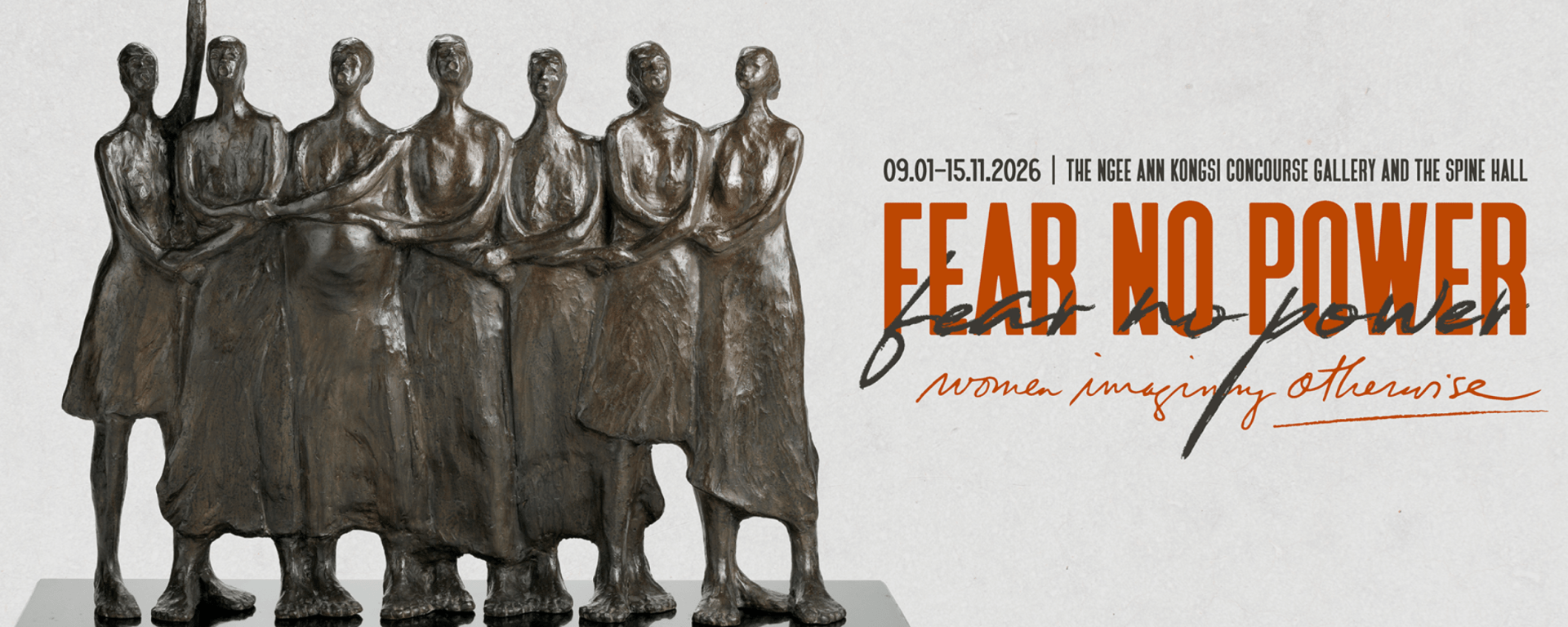

There is an intriguing double meaning embedded in the title of National Gallery Singapore’s latest exhibition. Fear No Power: Women Imagining Otherwise is not only an act of defiance against entrenched systems of authority; it is also a quiet injunction directed inward. To fear no power is to recognise one’s own capacity to act, imagine, and effect change. Across five artistic practices, the exhibition foregrounds how imagination and art can gather people together, allow singular experiences to resonate beyond the self, and over time, reshape how the world is understood.
This expansive framing is the result of a carefully constructed curatorial process led by curators Qinyi Lim and Joleen Loh, developed through more than three years of sustained research, archival study, and close engagement with the artists’ lives and networks. Rather than positioning the exhibition as a straightforward feminist statement, the curators trace how each artist arrived at her own understanding of power, often in isolation, often without institutional support, and how those individual convictions gradually generated wider social, political, and communal impact. What emerges is a celebration not only of collective resistance, but of the power of the singular voice: one person imagining otherwise, and in doing so, creating ripples that extend far beyond herself.

Outside the gallery, before one even crosses the threshold, Dolorosa Sinaga’s We Will Fight (2004/2025) leans into view, not monumental, but immediately arresting. A group of women tilt toward one another, their bodies angled as if resisting a force just beyond sight. The sculpture does not shout. It catches the eye, then lingers in the mind. As Sinaga has said, she is less interested in anatomical correctness than in gesture, how stillness can suggest motion, how form can hold life. Here, the anguish of communities displaced by government-led clearances in Indonesia is palpable, but so is something else: resolve. This modest yet forceful encounter sets the tone for the exhibition as a whole. Power, we are told from the outset, does not need to be loud to be felt.
Inside, Fear No Power unfolds as a carefully choreographed journey through the lives and practices of five women artists working across Southeast Asia from the 1960s to the present: Amanda Heng (Singapore), Dolorosa Sinaga (Indonesia), Imelda Cajipe Endaya (Philippines), Nirmala Dutt (Malaysia), and Phaptawan Suwannakudt (Thailand). Presented by the National Gallery Singapore, this is its first exhibition to bring these figures together in a focused, comparative framework. It is not a survey, nor an attempt to impose a false unity under the banner of feminism. Instead, it asks viewers to delay easy categorisation and begin where these artists themselves began: with lived experience.

The first interior space belongs to Phaptawan Suwannakudt, whose newly commissioned The Sun’s Spell (2025–2026) fills a small alcove like a sacred chamber. Drawing on more than five decades of practice, the multi-panel mural is conceived as a palimpsest, layering memory, text, iconography, and fragments of earlier works. Temple mural painting, Phaptawan’s first visual language, was inherited from her father, the respected master mural painter Paiboon Suwannakudt. When he died in 1982, she was only 22, yet she became the first woman to helm a Thai temple mural workshop, sustaining it for 15 years.
The Sun’s Spell carries this lineage forward while quietly unsettling it. Gold leaf glints among lotus and gingko motifs; scaffolding appears alongside children and celestial forms; sketches and preparatory drawings coexist with finished passages. The space is broken into segments, there is height, a balcony-like vantage, intimate corners that invite proximity, mirroring the way memory itself works. The title refers to her birth name, meaning “image of the sun,” given by her father at sunset over the Chao Phraya River. “It transcends gender,” she reflects, “and does not dictate the path I would follow. Nevertheless, it was clear that I was to be destined to become an artist.” Standing here, it becomes clear that this alcove encapsulates the exhibition’s core proposition: personal history is not separate from artistic language or social meaning, it is the very ground from which they grow.
Phaptawan herself puts it best: “I’m so happy. This is an exhibition where I feel my practice is being seen for the first time, rather than being put in a box. That’s how I felt throughout.” It is a sentiment that resonates across the exhibition.

From this intimate beginning, the first section, Where the Body Thinks, Worlds Open, unfurls in olive-green tones, a palette that feels deliberately organic. This is a space of beginnings: bodies, identities, and inner lives taking shape in relation to the world. Here, the personal is not treated as anecdotal or private, but as a way of thinking, an epistemology rooted in embodiment.
Imelda Cajipe Endaya’s early etchings Ritwal (Ritual) and Ikapitong Buwan (Seventh Month) (1974) are among the most striking works in this section. Created when she was newly married and pregnant with her first child, they are rare meditations on motherhood at a time when such subjects were largely absent from art discourse. The maternal nude is neither idealised nor sentimental; instead, it registers constant exchange, vulnerability, and transformation. Mothers, in Endaya’s practice, would later come to embody not only nurturance but political consciousness, a theme forged amid the turbulence of the Marcos regime.

This tension between interior life and external upheaval continues in Endaya’s paintings from the early 1980s, such as Tanong ni Neneng (A Little Girl Questions) and Buhay ay Vodavil Komiks (Life is a Vaudeville Comic Book). Windows open onto psychological landscapes where women hover between home and the outside world, buffeted by images of soldiers, spaceships, and mass media. Even her playful abstractions from 1975, Neon and Tugtog ng Banda’y Halu-halo, carry ambivalence. “Almost always I was burdened with guilt at doing abstracts,” she later admitted, making these moments of joy feel hard-won rather than escapist.

Nearby sits Phaptawan’s My Mother Was a Nun (1998) sits nearby, honouring her mother’s curtailed spiritual aspirations within Thai Buddhist hierarchies. Reworking the three-tier cosmology of temple murals, the painting quietly exposes gendered exclusions embedded in tradition, where women were disallowed from ascending to the same level of authority or spirituality as men were.

Across the room, Nirmala Dutt’s works resist easy consumption altogether. In Self-Portrait (1999), her steady gaze confronts the viewer against a blood-red ground, accompanied by the urgent plea: “When are you all going to say enough! and stop it.” Dutt, who rejected labels throughout her life, political, feminist, or otherwise, understood art as a means of ethical engagement. Her stark, hard-edged Woman series abstracts the female torso into silhouettes that refuse eroticisation, challenging Euro-American traditions of the woman as muse. For Dutt, the bamboo growing in the heart before one paints is not serene; it is painful, tormenting, and transformative.
Amanda Heng’s early installations and performances extend the critique into the domestic sphere. She and Her Dishcover (1991) transforms household objects into tools of self-reflection, while S/he (1993) stages a visceral negotiation of language, identity, and patriarchy in Singapore’s shifting cultural landscape. “This performance was about making a place for myself,” Heng asserted, and that insistence reverberates throughout the exhibition.

The transition into the second section, Refusal and Hope, is marked by a shift to bright orange walls. The mood sharpens. These are works forged in moments of urgency, Cold War anxieties, authoritarian regimes, environmental destruction, yet they never relinquish hope. Refusal here is not nihilistic; it is generative.
Dolorosa Sinaga’s Solidarity (2000/2025) and title work Fear No Power (2003) anchor this space. In Fear No Power, a gagged woman stands before a wall, hands clasped to her chest, honouring women political prisoners silenced under Indonesia’s New Order regime. Created after Sinaga’s political awakening in the 1990s, the work transforms historical trauma into a gesture of courage. Solidarity, made in response to the May 1998 Tragedy, shows women of different backgrounds forming a united front. Barefoot, pregnant, resolute, they embody a belief that collective presence itself can be a form of resistance.

Nirmala Dutt’s Anti-Nuclear Piece (Commemoration of Hiroshima Day) (1988) expands this critique onto the global stage. Reagan and Gorbachev perch atop a globe like wayang kulit puppets, encircled by rakshasas. Dutt’s use of Southeast Asian visual traditions underscores her conviction that social criticism is not solely a Western inheritance. Nearby, Friends in Need (1986) casts Reagan and Thatcher as villains flanking images of war casualties, collapsing myth and contemporary geopolitics into a single moral theatre.

Imelda Cajipe Endaya’s protest works opposing the Bataan Nuclear Power Plant place Filipino women at the centre of sociopolitical struggle, while Amanda Heng’s Home Service (2003), presented here with its original aprons, flyers, and video documentation, reframes domestic labour as a site of dialogue, dignity, and exchange. These are “small” acts of resistance, perhaps, but they accumulate force through persistence.

The final section, Imagining Otherwise, shifts once more, this time into ochre tones and raw plywood. The materials feel unfinished, provisional, open. This is a space about forming rather than concluding, about what happens when art extends beyond objects into relationships. Photographs, archives, and ephemera document collectives such as KASIBULAN, Womanifesto, People’s Veranda of Garuda, and Women in the Arts Singapore. These initiatives were not peripheral to the artists’ practices; they were central to how these women lived and worked.

Imelda Cajipe Endaya’s Conversations on the Spoliarium and Women’s Work dismantles masculinist art histories by collaging canonical masterpieces with the overlooked labour of women artists. Sinaga’s People’s Veranda of Garuda emerges as a site of radical hospitality, her home a place where meals, conversations, and political awakenings intertwined. Amanda Heng’s founding of WITAS and Phaptawan’s co-founding of Womanifesto reveal networks built on friendship, care, and non-hierarchical exchange. These were worlds made differently, sustained through teaching, writing, organising, and listening.

What Fear No Power ultimately asks of its visitors is attention. This is not an exhibition to simply breeze through. The wall texts, archival materials, catalogues, and programmes are not supplementary; together, they form a coherent narrative that deepens with time. Each work stands on its own, yet gains resonance through proximity to others. The exhibition’s flow, with its pauses, returns, and visual rhythms, mirrors the artists’ own journeys: from self to society, from refusal to connection.

You leave with an expanded sense of what it might mean. Not only political power, but inner strength; not only resistance, but responsibility; not only visibility, but care. In bringing these five women together without forcing them into sameness, Fear No Power allows their practices to be seen fully, complex, and on their own terms.
Photos Courtesy of National Gallery Singapore
Fear No Power: Women Imagining Otherwise runs from 9th January to 15th November 2026 at National Gallery Singapore. More information available here
 Bakchormeeboy