
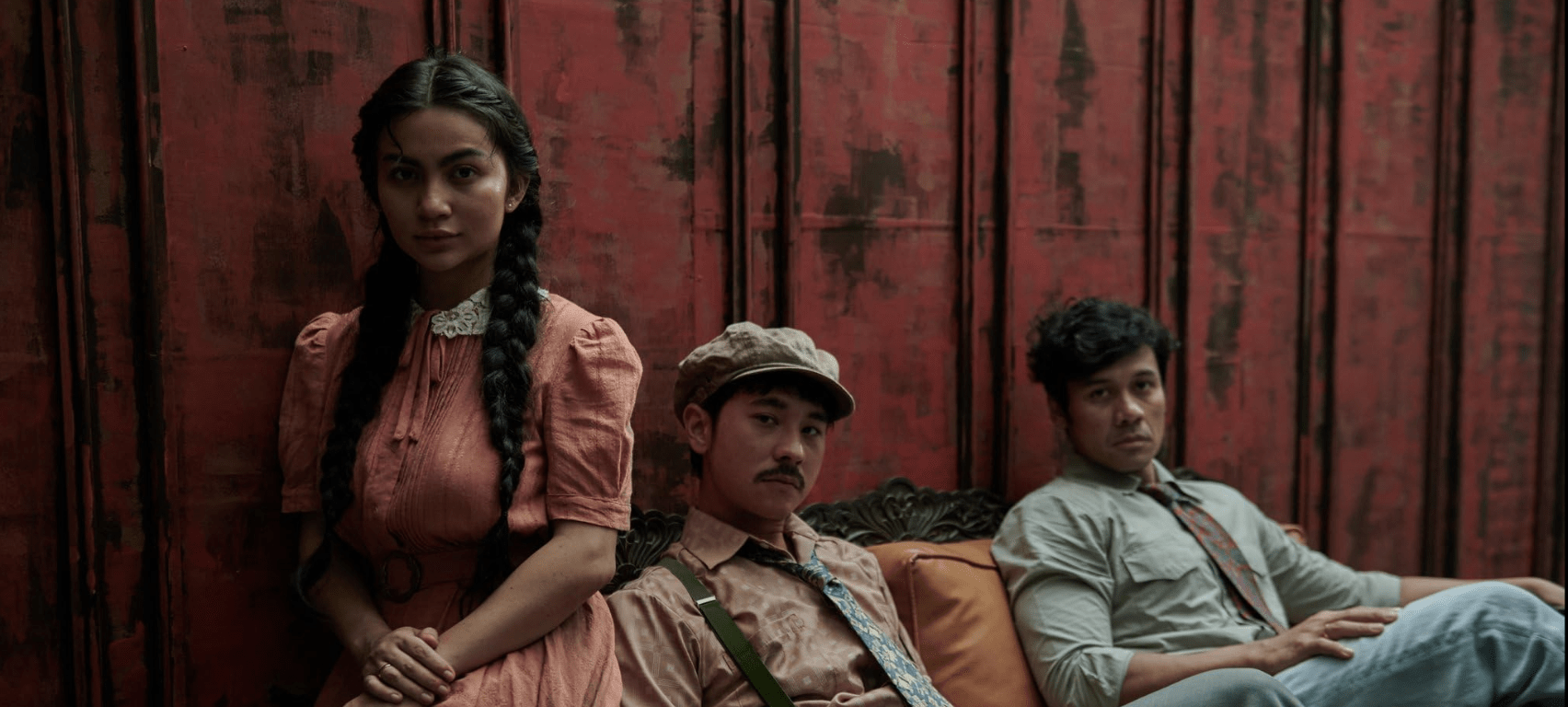
In Indonesian director Mouly Surya’s latest film, This City Is a Battlefield reminds us that revolution is never a clean or heroic act. Set in Jakarta in 1946, in the uneasy year following Indonesia’s declaration of independence, the film plunges into a city caught between collapsing empires and fragile new ideals. Amid the charged streets and covert operations, Isa, a former freedom fighter turned schoolteacher, navigates the quiet wreckage of war: trauma, fear, and a sense of masculinity fractured by violence. As tensions rise within his guerrilla cell, personal loyalties begin to clash with political conviction, drawing Isa, his wife Fatimah, and the fiery young revolutionary Hazil into an increasingly intimate and dangerous spiral.
Adapted from Mochtar Lubis’ 1952 novel Jalan Tak Ada Ujung, the film blends the urgency of a war drama with noir-inflected intimacy, allowing private doubts to carry as much weight as gunfire. While its action sequences pulse with revolutionary fervour, its most devastating moments unfold in silence — in glances withheld, desires unspoken, and moral lines slowly eroded. Following the film’s international premiere as the closing title of the International Film Festival Rotterdam and its release in Indonesia, we spoke with director Mouly, and cast members Chicco Jerikho, Ariel Tatum, and Jerome Kurnia about inhabiting these conflicted figures, the emotional cost of portraying a formative yet painful chapter of Indonesian history, and what it means to revisit a past that still resonates deeply today. Read the interview in full below:

Bakchormeeboy: This is your first historical epic. What felt most new or challenging about stepping into 1946 Jakarta?
Mouly Surya: To find my perspective of an era I didn’t live in took some courage. The word “historical” is very weighty and brings so much pressure, because many believe a good period piece is one that gets historical accuracy down to the smallest detail. With this film, I realized it wasn’t just a choice — it was a creative choice with a very high price tag. That’s when we decided that instead of aiming for accuracy (which wasn’t why I wanted to make the film anyway), we were aiming for believability and genre-bending.
Bakchormeeboy: This period is often left out of Indonesian history. What made you want to bring it to the screen now?
Mouly Surya: I’ve always been curious about the history between Indonesia and the Dutch. Almost a century later, we still see traces of it — in our language, culture, and cities. My late father and uncle used to slip Dutch words into conversation, and I’d meet Dutch people in the Netherlands with very Indonesian names. It was a complicated relationship. It was colonization — but was there love? I think there was. A toxic love, perhaps, but love nonetheless.
Discovering Indonesia’s history was a long journey. I was raised during the New Order era, under a 33-year dictatorship. I memorized dates, heroes’ names, and events. Then I became a filmmaker and started seeing the world, comparing Indonesia with other countries. Everything in the modern world can be traced back to World War II. We see so many films about that war that it has become its own genre. Whenever I watched them, I always tried to place my country’s history alongside those narratives. Both the Allied Forces and the Japanese — the heroes and villains of World War II — were our colonizers. Indonesia is one of the less popular victims, and that perspective still resonates today.

Bakchormeeboy: The film blends noir with a war-era drama. Why did this mix of genres feel right for the story?
Mouly Surya: The film found its tone somewhere close to an American classic. There is romance, there is war, a flamboyant hero — Casablanca was an influence. But there’s also troubled masculinity and questions around gender roles, which were usually absent from films of that era. It’s not as heavy-handed as in Marlina the Murderer in Four Acts; I wanted this film to find its own way. I couldn’t see it working in any other genre mix.
Bakchormeeboy: Isa’s trauma and impotence are central themes. How did you balance the personal and political sides of his character?
Mouly Surya: I’ve never seen them as separate. Whatever happens personally to Isa is what’s happening politically to the country, and to him as part of its resurgence. It never crossed my mind to “balance” the two, because for me, they are inseparable.

Bakchormeeboy: What research or discoveries shaped how you rebuilt the atmosphere of post-independence Jakarta?
Mouly Surya: We searched for references of 1940s Jakarta while trying to find the right balance. There’s a certain tone and style associated with this era in Indonesian cinema, and I knew that wasn’t what I wanted. About a decade ago, I visited Amsterdam for the first time, and it made a deep impression on me. Jakarta has canals built by the Dutch, and seeing Amsterdam helped me finally understand what they were trying to recreate.
The canals, Dutch buildings, and narrow alleyways became anchors for our locations. Many of the main characters come from what would be considered the upper class at the time — educated, fluent in Dutch. I wanted the tone and color to reflect how they were culturally colonized, speaking and dressing like the Dutch while trying to break away from them.
Bakchormeeboy: Where did you stay faithful to Mochtar Lubis’ novel, and where did you feel you needed to reinterpret or modernize it?
Mouly Surya: What I was most loyal to was the anger I felt in the book — anger and pessimism toward the country, the government, and heroism itself. This was my first adaptation, and it took time to find my own film within the novel. Early drafts included sequences that were questioned by our French co-producer, Isabelle Glachant. My only answer was, “It was in the book,” which obviously wasn’t good enough.
The book was written in the 1950s, and I wanted to marry its essence with my perspective and today’s world. I consciously reconstructed Isa and Fatimah. Isa in the book is a coward who is impotent. For the film, I gave him combat experience, exaggerated his flamboyance, cast Chicco Jerikho — arguably one of the most masculine actors in Indonesia — and treated impotence as a spectrum rather than a final state.
As for Fatimah, in the book she’s a housewife who sleeps with her husband’s friend. In the film, she’s seductive and soft but never meek. I drew from memories of my mother, aunts, and grandmother — strong women shaped by their time. And during rehearsals, I discovered Ariel Tatum is a proficient piano player. That became the answer to how Isa and Fatimah fell in love: music.

Bakchormeeboy: Your action scenes feel tense and kinetic, but your quiet moments are just as powerful. How did you approach that contrast?
Mouly Surya: Quiet moments come very naturally to me — they’re like a mother tongue in my cinematic language. But having made an American action thriller gave me confidence with action scenes. This was the most creatively intense shoot I’ve ever done. Every shot was carefully thought through. The script and camera movement were my anchors in approaching that contrast.
Bakchormeeboy: How does This City Is a Battlefield fit or evolve your identity as a filmmaker, coming after Marlina and Trigger Warning?
Mouly Surya: I always try to do something different with each film. I have a special love for historical fiction, even though it’s not very popular. The storytelling here is the most complex I’ve done, and I’m very proud of it. Marlina was more comfortable for me; Trigger Warning was completely outside my comfort zone. This City Is a Battlefield sits somewhere in between — and that’s the growth I need as a filmmaker. Indonesia is still a small industry. It’s easy to become complacent, and that’s a dangerous place for an artist.

Bakchormeeboy: Did you feel a responsibility in portraying a time that still carries emotional weight for Indonesians today?
Mouly Surya: I have my perspective, my vision, and I’m telling a story. There’s always responsibility in filmmaking, but I don’t put pressure on myself to make a documentary.
Bakchormeeboy: What reactions or conversations from Indonesian audiences have surprised you or meant the most to you so far?
Mouly Surya: I expected the film to have a niche audience, but I didn’t expect the uproar over certain fully clothed sex scenes. It was hilarious. The scene was supposed to be uncomfortable — it’s a failed, disappointing moment of intimacy. I love it when audiences unpack the film’s subtleties. One comment I remember fondly asked me to forgive the country for not being able to understand the film yet.

Mouly Surya’s meticulous approach to history, genre, and character laid the foundation for a story that balances the personal and the political. But a director’s vision only becomes fully alive when interpreted by the actors inhabiting the world she has created. In the following conversation, Chicco Jerikho, Ariel Tatum, and Jerome Kurnia reflect on how they approached trauma, desire, and loyalty in the city still reeling from war.
Bakchormeeboy: Isa, Hazil, and Fatimah are all navigating trauma, desire, and loyalty in a city still reeling from war. How did you approach these emotional worlds?
Chicco Jerikho (Isa): The most difficult challenge was bringing Isa to life authentically. I started by reading Mochtar Lubis’ book, then Mouly’s script. I had many discussions with her and watched archival footage online. From there, I relied heavily on imagination.
Jerome Kurnia (Hazil): The history is the background noise, but the real heavy lifting was the emotions. Navigating Hazil’s desperation with his father or the tension with Fatimah was way more intense than the setting itself. It’s about finding that specific frequency of pain that feels real even in a period piece.
Ariel Tatum (Fatimah): I was living in a modern world without ever being a married woman like Fatimah. That made the historical setting so challenging, even as I engaged with her emotional struggles. Workshops, conversations, and research helped me prepare to tell this story responsibly.

Bakchormeeboy: Isa and Hazil represent two very different forms of masculinity under pressure. How did you express that contrast in your performances?
Chicco Jerikho (Isa): Isa is introverted but also strong. Inside, he’s quite fragile. I played this by minimalizing my gestures and putting emphasis on gaze and expression.
Jerome Kurnia (Hazil): What hooked me was his total chaos. He is basically lost in every possible direction… He wants to be a legend but he is really just a kid who does not know left from right. That raw messiness is what made him human to me.

Bakchormeeboy: Your character’s choices are shaped by a complex mix of emotions and needs. How did you connect with their experience?
Ariel Tatum (Fatimah): I understand her dilemma. Wanting to love and be loved is human, but at the same time, certain things have to happen in order to survive.
Jerome Kurnia (Hazil): Navigating Hazil’s tension with Fatimah was way more intense than the historical setting itself. It’s about finding that specific frequency of pain that feels real even in a period piece.
Chicco Jerikho (Isa): History is a mere setting. The challenge was living as someone from that era — a father, teacher, war hero, in a time where everything is uncertain and unsafe.

Bakchormeeboy: How did working with Mouly Surya influence your performances?
Jerome Kurnia (Hazil): Mouly offers freedom with terms and conditions. You feel autonomy in how you play the character, but she has meticulously carved a path. It keeps the performance fresh and spontaneous.
Chicco Jerikho (Isa): She prefers conveying sadness, anger, and doubt through a look, through very little movement, and very little dialogue. It’s a challenge but rewarding.
Ariel Tatum (Fatimah): Often, we didn’t have to verbally describe things to understand each other. That level of trust was something I never experienced with other directors before.

Bakchormeeboy: The story deals with a painful and rarely discussed moment in Indonesian history. How did that affect your sense of responsibility?
Chicco Jerikho (Isa): This story comes from one of Indonesia’s greatest writers and was reinterpreted by Mouly. At a glance, it’s massive, but at its heart, it’s about a father fighting for his family.
Ariel Tatum (Fatimah): I struggled so much in the beginning, but after months of preparation, workshops, late-night talks, reading, it made me feel ready to tell this story to the world.
Jerome Kurnia (Hazil): I read the original book to get a sense of the atmosphere, but the script was my real compass. There is a weight to telling a story about this specific part of our history. My main job was to protect Hazil’s truth.
Bakchormeeboy: What conversations or reactions from Indonesian audiences have shaped your understanding of the film’s impact?
Chicco Jerikho (Isa): People say it’s not just a war story. It’s a story of inner wars; a war within a household, a war within the mind, but also a war experienced by Indonesians at that time.”
Ariel Tatum (Fatimah): A lot of Indonesians still have no idea that this happened after independence. It’s a history so rarely discussed — very important for us to reflect on in the modern era.
Jerome Kurnia (Hazil): Locals see the echoes of the past still playing out today, while outsiders are shocked by how brutal it is. But the pain of realizing you are not who you thought you were is universal. Some wounds never really stop bleeding.
More information about This City Is A Battlefield available here
The 36th SGIFF ran from 26th November to 7th December 2025. More information available via their website here
 Bakchormeeboy