
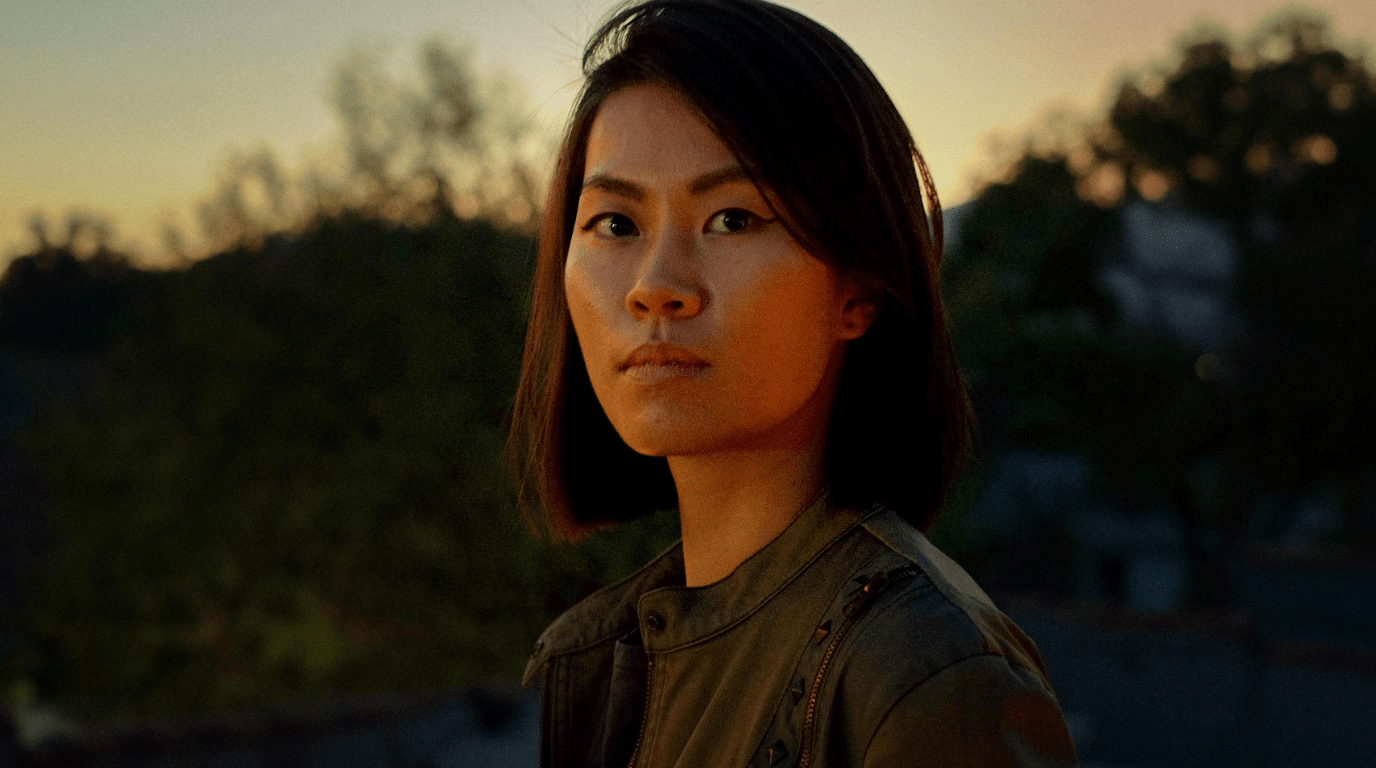

Amoeba’s title is one of the strangest choices in local cinema, considering an ‘amoeba’ doesn’t immediately bring to mind Singapore, teenage girls, or anything local. But perhaps that’s exactly the point. “Most of us know amoebas from biology lessons, and it’s kind of weird, kind of gross,” says filmmaker Tan Siyou. “It’s not a fluffy cloud or Hello Kitty, and I deliberately chose it as a metaphor because it isn’t very approachable, and really captured my feelings growing up as a teenager in Singapore being this strange amorphous blob figuring out who I was and who I wanted to be.”
And in all honesty, there was never any other option for Tan, to the extent she thinks the obsession made her a little delusional. And despite constant pushback from various people in her life, she stood by it, and the idea made its way into the film’s visual identity. “When I started making this film, there were just four elements I had in mind: the title, a ghost, a girls’ school, and a gang,” says Tan. “I’m glad to say they all made it in.”

Based in New York, Tan has slowly been building up a portfolio for herself over the years with both commercial work and short films, before finally releasing Amoeba as her debut feature. The film, about a group of four students forming a gang to resist authoritarian rules at their all-girls school, premiered at the 2025 Toronto International Film Festival, before touring the international festival circuit, including a triumphant sold-out Asian premiere at the 36th Singapore International Film Festival (SGIFF) in December. Now, Tan has returned to Singapore for a short homecoming as Amoeba receives a wider release from Anticipate Pictures here, and reflects on the film’s origins, her upbringing in Singapore, and the persistence of teenage angst on our sunny island.
When you look at the pristine white uniforms the leads of Amoeba don, most Singaporeans would immediately think of a certain girls school director Tan has taken inspiration from. “Of course, I didn’t set out to make a film about a specific school,” says Tan, as she continues to keep the identity of her ‘Confucian’, all girls alma mater under wraps and declines to formally confirm it. “If you recognise it in the film, then it’s more of an Easter egg for those who know. But really, this is not a film that’s passing commentary on that particular school, but the Singapore education system, and how there are often such strict rules, and strict rules and immense academic pressure.”

Amoeba then goes beyond a film about memory, but a quintessentially reflective Singaporean film that questions and considers ideas of rewarding obedience and discipline, both in school and the greater systems of power. Of course, the film itself was highly inspired by her own experiences back in secondary school, and the trials and tribulations faced along the way. “Back in Sec 1, I suddenly found myself very constrained by the stuffiness of the school and its rules, because there were so many that I didn’t agree with or just didn’t make sense to me,” says Tan, who recalls rules as wild as how teachers would place a 50 cent coin against student watches to measure if it was too big, or police the colour of students’ bras against their white uniform.
“A lot of friends told me to just ‘忍’ – to endure; why make noise and make life so difficult? I tried that for a while, but it was really such an isolating experience where I felt like the only one who couldn’t stand what was going on and found it all so absurd,” she continues. “When I went up to upper sec, I got placed in a class of ‘losers’, the sporty class with terrible grades where some teachers would literally tell us we would grow up to be burdens on society. But it was there that I found my people, and met three other ‘misfits’ who became my best friends.”

Tan remembers the mischief she and her ‘gang’ would get up to in class, and felt an incredible sense of togetherness that got her through secondary school. “So my first real heartbreak happened after graduation, where we all went to different schools. We still stayed in touch, and still are, but something shifted after no longer being together 24/7,” says Tan. “The film was originally going to be a love letter to that, and started off very autobiographical and personal.”
But something about just didn’t feel right for Tan, and during the pandemic, Tan took the time to reflect, and situate the story within the context of the larger world and systems instead, rewriting it to give it more distance and telling a different story instead. “I started to think about our definitions of success, where we were brought up on this sleepy fishing village turned bustling metropolis story. Somehow along the way, each successive generation of children became imbued with the idea that your path to success was through education and good grades, where you are already aiming for this before your brain even fully develops and you’re just aiming to get the highest marks possible to reach the most ‘renowned’ schools. That was the story I wanted to tell, to examine these forces and system that shaped young Singaporeans, and question which decisions were really made by us, or by our parents.”

As a teenager, Tan strongly resisted this narrative, deliberately doing the bare minimum to get by and pass her exams, and run away to do her own thing. Looking back, Tan thought about how society itself seemed to forget about the importance of intimacy and friendship, when so much of it revolved around ranking and competition. “There is so much classification going on all the time, like how you’re separated by ability level to school, to class, and the people you meet and are surrounded by are really pre-determined for you based on your intelligence, and you really wonder how much absolute choice you actually have in anything at all,” says Tan.
“I think rebellion then becomes a natural reaction to all these feelings of fear and uncertainty, this pure act of expression of selfhood and identity, as a means to question and disagree with the status quo. It’s necessary to break from conformity and ask questions about whether you belong in the ‘official narrative’, and find the bravery to test the boundaries and figure out who you are, something that’s difficult to do alone, but easier to do when you find friends to step out of the box together with.”
Teenage rebellion for Tan then, is not about thoughtless destruction or vandalism or causing harm, but an outlet for the often nebulous teenager as they seek freedom from structures, and agency to discover who they are for themselves. “One day when you grow up, you don’t want to wake up and think ‘oh man, what have I actually done for myself and not my parents this entire time?'” says Tan. “That would be terrifying, because you’d have an identity crisis. So I think such rebellion should be encouraged. It’s something so instinctive, and really feeds the wellspring of being a teen – to claw your way out of this mould your parents have shaped for you, and you break it by doing the polar opposite as a way to see how far you can go without losing yourself.”

And then there is the ghost. “I was haunted by a ghost in my bedroom as a teenager,” she says matter-of-factly. “The first time it appeared, I was terrified, and remembering that experience still sends chills down my spine. So of course I told my friends, and they gave me so much advice – tell the ghost ‘stop disturbing me!’, use this Catholic chant or this Buddhist sutra, and all kinds of strange tactics. Firstly, it made me realise how important my friends were and how they wholeheartedly believed me, and secondly, the ghost made me question reality. I never saw it, but I felt it, and I became aware of all these undercurrents of emotions that may be invisible, but are very real, as long as we can feel it. So when you see the ghost in the film, I hope I managed to capture that same feeling, and maybe it’s a way of exploring themes of suppression, of the things that shape our desires and anxieties.”
That tension between conformity and selfhood didn’t end with secondary school. It followed Tan into junior college, where things became even harder. By extension, Tan has never felt fully at home in Singapore, her anxieties bubbling to the surface despite loving her family, the food, and the people she surrounds herself with. “The thought of staying on in Singapore and going to university and finding something very stereotypical and stable was suffocating and stifling for me. During my JC years, I honestly thought the world would be better off if I just disappeared,” says Tan.

Film was what saved Tan, and propelled her into the future. “What changed for me was when I started watching movies, all kinds. In Amoeba, there’s a character who’s a bit more ‘atas’ and exposes the girls to new things like film, and it was kind of like that for me,” she adds. “I started to see the possibility of studying overseas, and latched onto the idea, eventually convincing my begrudging parents to let me do it, on the condition I study economics and still put myself on a ‘stable’ path. I think they also recognised that there would come a point they could no longer ‘control’ me and let me make decisions for myself.”
Now, Tan is a proud alumna of Berlinale’s Talents Tokyo, Busan’s Asian Film Academy and Universal’s Director Initiative, and studied film and art at Wesleyan University, before going on to a directing fellowship at the American Film Institute. “I honestly wasn’t expecting to end up staying overseas this whole time, but during my first few years, studying econometrics really was just killing me, and I ended up taking time off school after getting into a film programme, and kept at it till I ended up where I am now,” she says.

“The sense of alienation hasn’t left though, it’s still there, but in a different form now,” muses Tan. “Singapore is so small and insignificant in the grand scheme of things, where people overseas really have no idea what and where Singapore is. I jump for joy when someone says ‘yes! I’ve been to Singapore!’…then my heart sinks when they say ‘for a two hour layover at Changi Airport’.”
“When someone asks me what Singapore is like, I end up feeling very perplexed. I think about all the education system has taught me, and how I’d just be regurgitating the national narrative again if I said all that. All these facts are cherry picked, and I start to wonder how to even start telling these people about the concept of Singapore being not part of China, and instead a relatively well-off country that’s not in poverty that’s part of SOUTHeast Asia, where people are bilingual and well-educated. It’s honestly a lot for someone to take in and process, and I had to constantly explain things over and over again.”

Through all this, Tan began to grapple with her identity as a Singaporean abroad, and it was only with this distance did she begin to really define herself – unlearning certain facts, refusing to put on an accent, to accept that often the Singaporean identity was indeed full of contradictions and confusion, and all that, lumped with her experience in the system, has shaped her into who she is.
“A large part of the loneliness came from how it felt like I didn’t belong anywhere. Sure, I went to Starbucks and sent in letters and typed up ideas just like the countless other people chasing their dreams were, but I thought about how back home, I still hesitate to call myself a ‘filmmaker’ because people still think it’s not a serious career path, and don’t understand how someone can just become an artist as a life choice,” adds Tan. “So I’m caught between people who I grew up with who don’t understand my decisions, and the place where I’m based where people don’t know where I come from, and I had to keep asking myself – was it worth it? To sacrifice time with family, with friends, and still face all these questions and constant uncertainty, constant grinding and working to pay the bills to make films.”
“I think being a filmmaker hinges on being a bit delusional,” says Tan. “I really am a bundle of contradictions, because while I don’t like how Singapore likes to put everyone into a narrow box and definition of success, I think that it’s been hard to find people I’m as close to as my friend group in Singapore. For the Western world, you watch all these films about growing up and there’s so much that revolves around sexual awakenings and discovering who you are, but in Singapore, well, we really just keep studying to pass our exams. Westerners have never been through the ‘oppression’ of a system like Singapore, and maybe Singaporeans really understand what it’s like to trauma bond with each other. It made me nostalgic for the past, and I kept returning to our halcyon days, these friends who helped me figure out who I was, where we were in our own worlds, and I just wanted to hold onto that feeling as long as I possibly could. Maybe this film was a way of immortalising that, and keeping that feeling eternal.”

To that end, the film doesn’t necessarily follow a fixed plot, but rather, tries to mimic the teenage mindscape, deliberately chaotic but tinged with a clear emotional lodging and structure. “There’s something so absurd about being a teenager isn’t there? Sometimes you think of everything that’s expected of you and you just go, ‘wah, siao ah’,” says Tan. “I hope the film conveys the strangeness of it all, how unpredictable each day can be, and how it resists adult logic. The film helped me investigate a lot of these, and really come to terms with all these systems of powers that shaped the intimacies of our lives and our relationships with ourselves and each other. The political always feels so foreign and far away, but it has all these very real impacts on our daily lives. And the more aware we become of these mechanisms, the more self-actualised we become to see the world as it is, how we live in the world and how it affects us. And by doing so, we can resist that, resist when things get hard and overwhelming, by seeking out that feeling of youth and reckless abandon again, remembering a time you felt pure joy and exhilaration.”
Starring Ranice Tay, Nicole Lee, Lim Shi-An and Genevieve Tan, Tan muses on how she initially wanted to cast actual teenagers instead of professional actors. “I really did want to cast actual teens in the show, under 20s, but it was limited because sometimes these things I wanted to convey only become apparent when you’re older on hindsight, coupled with how they themselves also had stress about their own school work and parental pressure, and it struck me how they were still going through the same things we did,” she says. “Around the world, there were so many young people who received the film very well, and there were so many young people at the SGIFF screening, when I expected it to be primarily older millennials.”

“It’s crazy how ossified the system is, where even the current generation of teenagers still experience similar things my generation did. I think about how now our education system is being exported to other countries and how that’ll affect them; good for producing grades, but where is the emotional aspect, how do we handle the resulting traumas and scars as busy working adults? It takes years and time and space to investigate all these little things, to allow ourselves to smell the roses and take time for ourselves instead of forcing efficiency and productivity all the time. I think today’s youth at least, are more aware of that,” she adds. “I don’t think my film is a dangerous one, despite being R21. It doesn’t provoke, but raises questions, and I think it’s valuable for people to feel seen, heard, and know that they’re not alone in their struggles.”
As for how her own friend group has reacted to the film, Tan is happy to say that all of them loved it. “One of them is now based in the USA and she brought a lot of friends to a screening, and she told me she just felt so seen, because no other film quite captures the Singapore experience, this modern yet conservative place. Another friend saw it at SGIFF, and she said it was like being in that classroom again, and with all these other old schoolmates, it was the first time they’d seen a film together since secondary school,” says Tan. “I cannot overstate how important cinema has been to me, and continues to be. It invites collective joy and reflection, to sit here with strangers in the dark, feel things together, and as an introvert, I emerge feeling socially charged.”
“To me, this is a love letter to my friends and family, and the only way I know how to write one. I hope people of all generations come and see it – for the youth, because it relates to them, and older folks, who might understand the youth better through it. Seeing a Singaporean film, to see these landscapes, these people who speak like me onscreen, it can show that your experiences are important enough to be made into a movie onscreen and shown to the world. It’s a powerful feeling that validates our existence and identity, that beyond a country that constantly imports our culture from overseas, we learn to embrace our Singlish, our food, our own culture, and just own it. I like to think it’s empowering in its own way, and I hope people come to understand that our formative years really do shape who we are, and to see into it like a mirror – to see your life up there, and know that it’s ok for it to be a little chaotic and make mistakes, even in a society that demands excellence and perfection, and that it’s ok to mess up sometimes and not to know everything.”
Amoeba opens in Singapore cinemas on 26th March 2026. Ahead of the release, special screenings with post-show question-and-answer sessions with Tan and the cast will be held on 21st and 28th March, with tickets available at anticipatepictures.com/amoeba
 Bakchormeeboy