
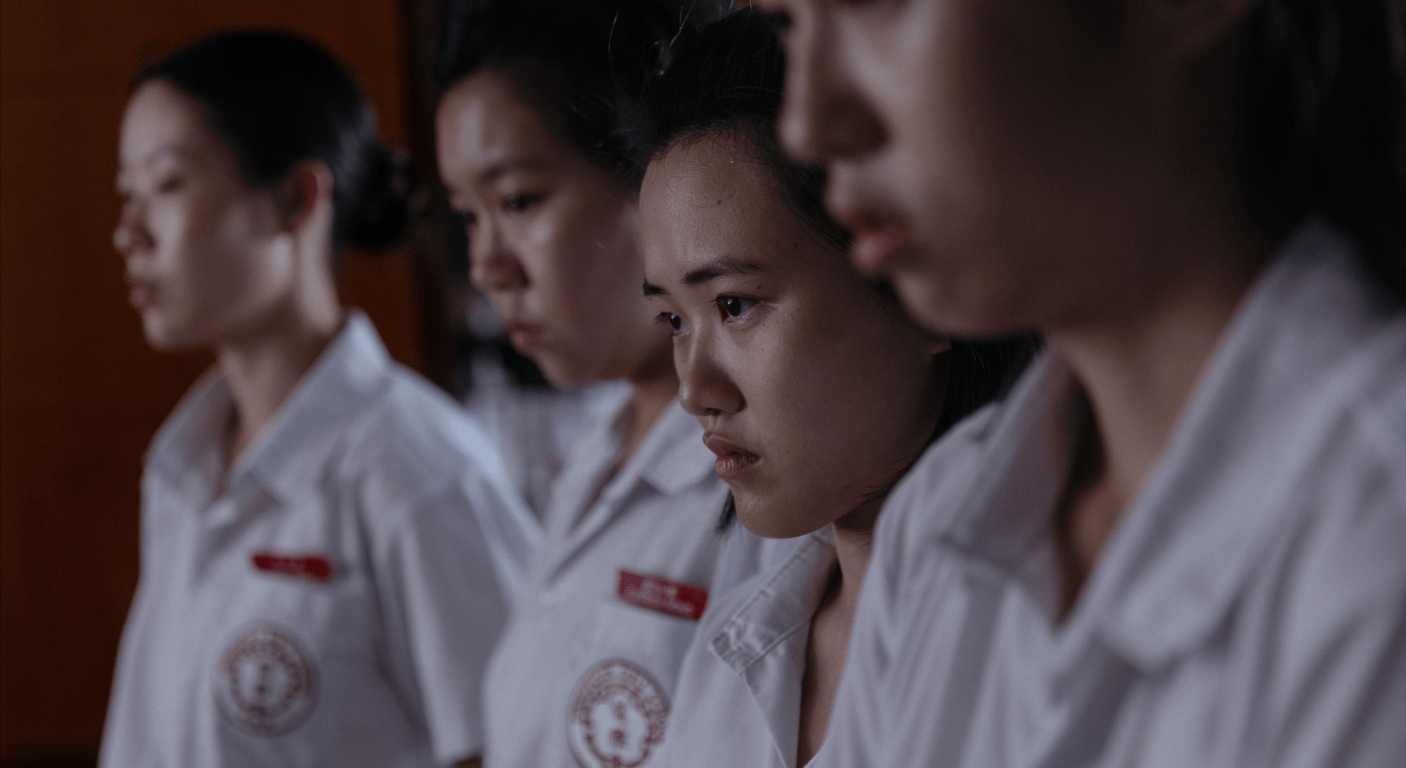

Girls just wanna have fun in this sincere, all-too-relatable portrait of confusing, rebellious teenage girlhood in restrictive Singapore.
After its sold-out Singapore premiere at the 2026 Singapore International Film Festival, Tan Siyou’s debut feature Amoeba has continued to make the rounds across festivals, and now returns home for a series of screenings at indie cinema Filmhouse. The response has been more than warm, to say the least, with almost every screening seeing a full house or close to it; a testament not just to strong word of mouth or its growing list of accolades, but to how deeply the film resonates as one of the freshest, most honest cinematic takes on what it means to grow up in Singapore.
If there’s one word to describe Amoeba, it’s ‘uncanny’. Its opening scene, shot in grainy black and white on a handheld camcorder, immediately disorients, watching our protagonist lying on a bed as someone off-camera insists they don’t sense anything. It feels like an out-of-body experience, positioning us as something unseen, something hovering. We become the ghost in the room, gazing down at these teenage girls, and in doing so, the film quietly implicates us in its memory, drawing us back into our own pasts, into that strange, confusing emotional landscape of adolescence.

The film unfolds less like a conventional narrative and more like fragmented memory, drifting through snapshots across the final year in the lives of four secondary 4 girls at the fictional Confucius Girls Secondary School, a setting so precise in its details that it feels unmistakably Singaporean. The pristine white uniforms, the elite, values-driven Chinese education, the quiet hierarchies and suffocating expectations all ground the film in a reality that is instantly recognisable. At its centre is Choo Xin Yu (Ranice Tay), who re-enters the school system and finds herself immediately at odds with its rigidity, eventually forming an unlikely bond with three fellow misfits: ace swimmer Vanessa (Nicole Lee), privileged Sofia (Lim Shi-An), and rough-edged jokester Gina (Genevieve Tan).
From there, Amoeba builds not through plot but through sensation: fleeting, emotionally volatile fragments that accumulate into something deeply familiar. It can feel frustrating in how it drifts, hinting at tensions it never fully resolves, but that is precisely its power. Growing up here is not a clean arc but a series of contradictions – joy and repression, intimacy and isolation, absurdity and control – and the film understands this instinctively, capturing the texture of a time where everything feels significant yet impossible to hold onto.

That specificity extends to the film’s meticulous rendering of school life, where humour and absurdity cut through an otherwise oppressive environment. One of its earliest moments, the morning assembly, perfectly encapsulates this: students locked at sediya position, barely suppressing fidgeting, as prefects painstakingly raise the flag in near silence, almost slow-motion, before the entire school breaks into the school song (in Chinese, of course). We laugh because it is deeply familiar, all too real.
Tan leans further into this through the school’s rules, many of which border on the surreal in their rigidity; watch faces measured against a 50-cent coin, hemlines checked with rulers, bra colours inspected under white uniforms. Students interrupt conversations mid-sentence to greet passing teachers before resuming as if nothing happened, while Confucian analects line classroom boards as moral instruction. These details accumulate into something both hyper-specific and universally felt, illustrating how control becomes normalised, how structure quietly shapes behaviour, how the pristine uniform itself becomes a symbol of restraint. And against this, the girls push back, not necessarily through grand acts of rebellion, but through small, messy, deeply human moments of defiance.

The girls’ friendship forms the emotional core of the film, a pseudo-gang bound by rituals, shared secrecy, in-jokes, and a desperate desire for belonging that forges their camaraderies. It begins almost accidentally, Choo being “sabo-ed” into a leadership role and delivering a sarcastic campaign speech that earns her punishment from her teacher Adeline (Jo Tan) but admiration from her future friends, and grows through a series of seemingly inconsequential acts that become everything. They wander into muddy construction sites, unbothered by the state of their once-pristine shoes, hiding when teachers approach. They rope in Sofia’s driver, Uncle Phoon (Jack Kao) to teach them how to be “gangsters” after watching online videos. They stage a surreal moral education skit about Singapore’s founding, dressed as fish, veering into satire as teachers look on with discomfort. They run from punishment when they realise teachers are in meetings, accidentally destroy school property.
None of it is particularly serious, and yet all of it is. The film captures that fragile space where play blurs into consequence, where rebellion feels both exhilarating and dangerous, where each act of defiance strengthens their bond even as external pressures, from punishments, parental expectations, and the looming weight of O Levels, threaten to pull them apart. What emerges is a deeply felt understanding that these “stupid” moments are not trivial at all, but formative, the kinds of memories that linger long after everything else fades.

There is also something striking about how out of time the film feels, existing somewhere between the present and the 2000s in a way that suggests how little has changed. The anxieties, the hierarchies, the small rebellions persist, and that continuity feels both comforting and quietly unsettling. The dialogue, blending scripted and improvised elements, feels startlingly natural, with plenty of Singlish slipping in and out, awkward jokes, half-formed thoughts. Whether it’s mixing up biological terms like fission and fusion, referencing The Matrix, or loudly, unabashedly throwing up middle fingers and expletives, there is an intimacy in the way the girls speak that feels entirely unperformed. Even in quieter moments, like conversations at a wake, the cadence is unmistakably Singaporean, slightly repetitive, slightly awkward, deeply familiar.
Layered into this is the film’s exploration of girlhood in all its confusion: intimacy that borders on the queer, admiration that lingers without definition, emotions that are felt more than understood. In one quietly charged scene, Vanessa helps Choo film the ghost in her home, and what begins as playful curiosity shifting into something more tender before being abruptly interrupted. The film never resolves this tension, and it doesn’t need to; like adolescence itself, it exists in ambiguity.

The ghost, too, fits seamlessly into this world, not as a conventional horror device, but as a presence that embodies what remains unspoken. It represents suppression, emotional undercurrents, the invisible forces that shape desire and anxiety. Similarly, the gang’s unity is revealed to be fragile, caught between sincerity and performance. Their oath of loyalty feels absolute until it is inevitably broken, and in a quietly devastating late scene centred on an oral examination, we see how each girl begins to diverge, some choosing to conform, others to resist, revealing the fractures that come with growing up. It is here that the film’s emotional core sharpens: adolescence is not just about finding yourself, but about losing the version of togetherness you once believed would last forever.
Amoeba resists neat resolution because adolescence itself offers none. Instead, Tan Siyou crafts something deeply personal and tactile, a film that feels lived-in rather than constructed, drifting with a loose, wandering energy while remaining grounded in its cultural specificity. The presence of familiar theatre actors: Julius Foo and Ng Mun Poh as Choo’s parents, Janice Koh as Sofia’s mother, Jo Tan and Zelda Tatiana Ng as teachers, Doreen Toh as the principal, further anchors the film, while a new generation of young performers emerges with striking confidence. But what lingers most is not any single performance or moment, but the feeling the film leaves behind. The final image, of the girls looking into the camcorder one last time, lands with quiet devastation, capturing what Tan referred to as the ‘first heartbreak’ of separation, of knowing that something once so immediate has already become memory.
It is cathartic, even healing, whether you were the rebellious one or the one who longed to be. There is nostalgia here for millennials, immediacy for younger audiences (unfortunate that it is rated R21), and a shared recognition that transcends both. The film understands that what stays with us are not the moments of obedience, but the reckless, fleeting, deeply human ones. And in capturing that, Amoeba becomes something more than just a coming-of-age story: it becomes a mirror, a memory, and, in its own quiet way, a release. A must-watch film of the Singapore canon and a stellar debut feature, and a movie that entertains, that heals, that makes you feel and think about how everything that came before has formed the person you are today.
Amoeba plays at Filmhouse. Tickets available here
 Bakchormeeboy