
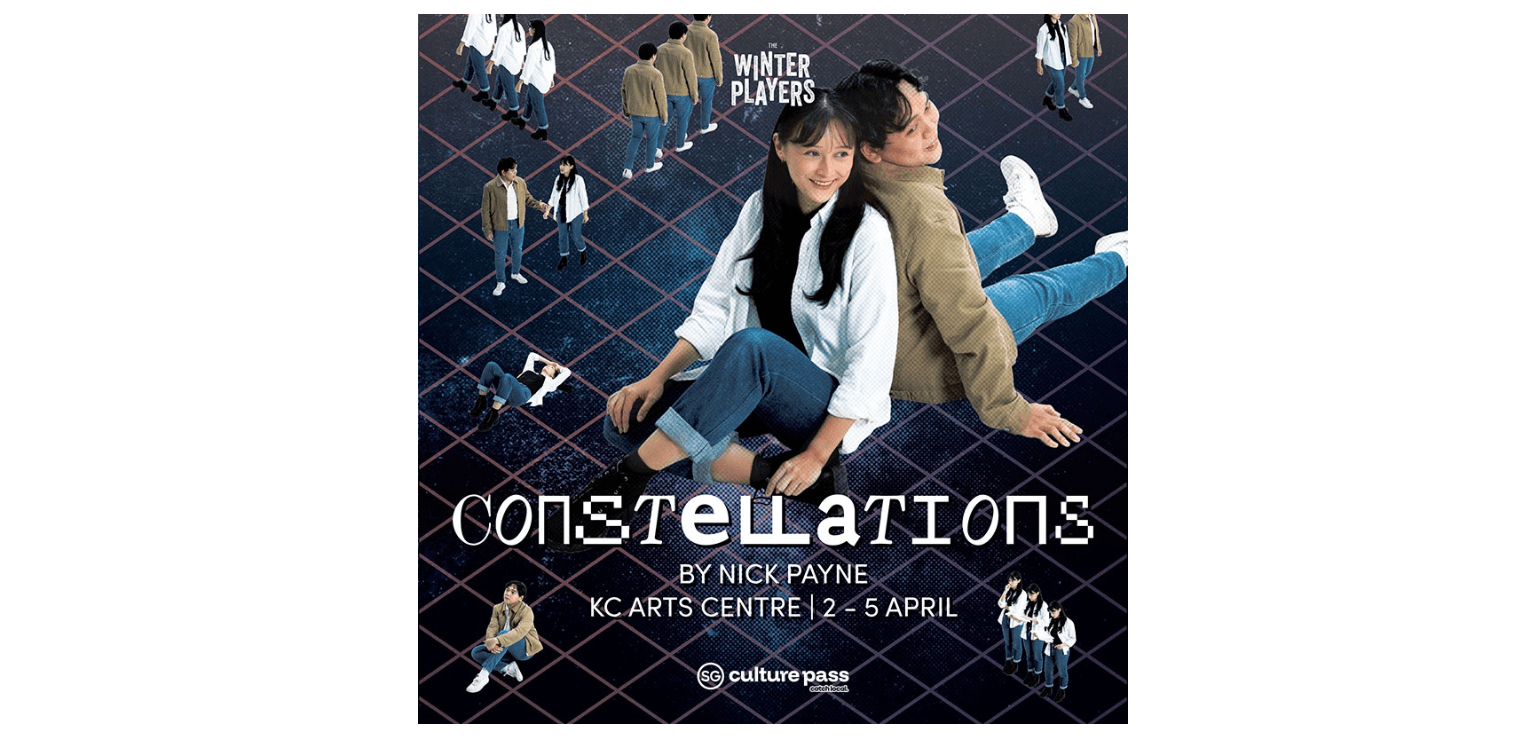
Across the multiverse, there are highs and lows, but when the stars align, it strikes all the right notes.
“Multiverse” may no longer be a novel concept in pop culture, but in Constellations, it becomes something far more intimate than spectacle. Staged by independent theatre company The Winter Players at the KC Arts Centre, this quietly ambitious production distils the vastness of parallel universes into the fragile, shifting dynamics of a single relationship and its ups and downs. Playwright Nick Payne’s modern classic asks a deceptively simple question: in how many universes can two people fall in love, and stay there?
Our story follows Marianne (Juliana Kassim Chan), a physicist, and Roland (Marwyn Ho), a beekeeper, whose chance meeting at a barbecue splinters into countless possibilities. In some versions, their first interaction crashes and burns; in others, circumstances keep them apart. But across this kaleidoscope of repeated moments, with lines revisited, choices altered, outcomes reshuffled, we begin to see the versions where something clicks. What emerges is not a linear romance, but a mosaic of attempts that weaves together awkward, tender, painful, and sometimes quietly triumphant moments.

Co-directed by Marwyn Ho and Michaela Leong, the production moves with the rhythm of someone rapidly flicking through television channels, as scenes reset, dialogue loops, and emotional tones shift in rapid succession. It’s a demanding structure, requiring both actors to pivot instantly between wildly different emotional states. At its best, this creates a kind of hypnotic flow, drawing the audience into something almost philosophical: a recognition that every moment is contingent, every outcome precarious. At times, however, the device overstays its welcome. The repetition occasionally feels indulgent, and there are moments where transitions between emotional beats aren’t fully landed, with certain lines feeling performed and even a little hollow, rather than lived.

Yet what anchors the production across every universe is the chemistry between its two leads. Marwyn and Juliana resist the temptation to romanticise their characters, instead leaning into the awkwardness and unevenness of connection. Their relationship is not built on grand declarations, but on stumbles, recoveries, and quiet negotiations of vulnerability. Each kiss, each rupture, each fleeting moment of violence lands with a shared audience reaction, a collective recognition that these two are bound to collide, again and again.

When the performance clicks, it truly soars. There are sequences where timing, tone, and emotional precision align perfectly: a hesitant decision over whether Roland should stay the night; a proposal that fails, resets, and fails again, until, finally, it doesn’t. Like a theatrical fusion of Groundhog Day and Everything Everywhere All at Once, the play finds momentum in repetition, inviting the audience to keep rooting for a version of events that gets it right. And when it does, the payoff from all that buildup is almost euphoric.

Juliana shines most in Marianne’s moments of emotional unravelling, shedding the character’s intellectual detachment to reveal something raw and deeply human, as her character’s body breaks down. Marwyn, meanwhile, brings a grounded sincerity to Roland, balancing gentle humour with emotional openness. In his most affecting scenes, he lays himself bare, voice breaking, tears flowing, only to pivot moments later into an entirely different emotional register, a testament to the play’s relentless demands.

The production’s design elements elevate its conceptual ambition. Set designers Studio Vagabond (Reyn & Tong) create a striking visual metaphor with furniture suspended overhead, with objects from the characters’ lives floating like constants in an otherwise unstable universe. Maximilian Leong’s multimedia work is particularly evocative, layering cosmic imagery of exploding stars and swirling nebulae with glimpses of the natural world, reminding us of both our insignificance and our persistence. Lighting designer Andrew Wijaya integrates illumination into these floating elements and bathes the set in a wash to heighten the mood, while Elliott Tan’s restrained score and Usaid Abdul Rashid’s sound design subtly underscore the emotional peaks without overwhelming them.

Constellations is, by nature, an unusual and sometimes distancing theatrical experience. Its structure resists easy emotional immersion, and its insistence on impermanence can feel, at times, alienating. But as the performance unfolds, something shifts. We begin to invest not in a single outcome, but in the persistence of trying in the hope that somewhere, in some universe, things work out.

And so when, in its final moments, Marianne and Roland find each other once more, saying a shy hello before dancing together with an ease and lightness we have not quite seen before, the effect is almost overwhelming. After a cascade of missed chances, fractured timelines, and emotional false starts, this seemingly simple act of love feels earned. It doesn’t promise forever, nor does it resolve the uncertainty that defines their relationship. But it offers something gentler, and perhaps more reassuring: that even in a universe of infinite variables, connection can still be found and felt when the stars align just right.
Photo credits: Emily Aurelia (@luminemily) and Alexander Vincent Lewi (@filmcentlewi)
Constellations plays from 2nd to 5th April 2026 at the KC Arts Centre. Tickets available from BookMyShow
Production Credits
| Playwright Nick Payne Co-Directors Marwyn Ho, Michaela Leong Cast/Co-Producers Marwyn Ho, Juliana Kassim Chan Production Manager Tan Yin Qi Stage Manager Bree De Souza Sound Designer/Music Composer Elliott Tan Sound Designer/Sound Engineer/Sound Operator Usaid Abdul Rashid Multimedia Designer Maximilian Leong Lighting Designer Andrew Wijaya Set Designers Studio Vagabond (Reyn & Tong) Dramaturg Stephen Rowland Intimacy Coordinator Namrata Juneja Marketing/PR Manager/Co-FOH Manager Corliss Tay Co-FOH Manager Iman Md Falmi |
 Bakchormeeboy