
From neon-lit sea creatures to haunted Singapore legends, RWS is turning Halloween into a showcase of local stories, design and creative craft.
There is a lot of work that goes into making something scary. The scream itself is easy enough. The difficult part is everything that comes before it: the story, the characters, the costumes, the lighting, the sound, the sets, the makeup, the food, the performers, and, perhaps most importantly, figuring out how to turn a story into something people can physically walk into.
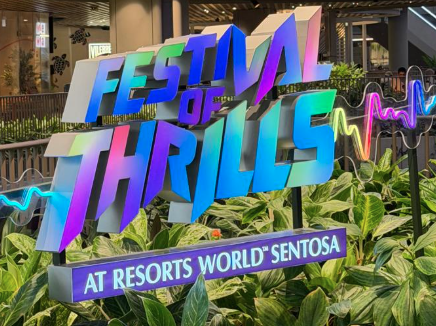
At Resorts World Sentosa, Halloween has become something of a creative industry in miniature. This year marks the 14th edition of Universal Studios Singapore Halloween Horror Nights, part of a Halloween programme that has grown far beyond the haunted houses themselves. From Singapore Oceanarium to Adventure Cove Waterpark and WEAVE, the Festival of Thrills brings together visual art, performance, design, culinary creativity, technology and local storytelling across the resort.
It is easy to arrive for the scares. Look a little closer, though, and there is an awful lot being made behind them.

At Singapore Oceanarium, the creative process begins somewhere far removed from haunted houses. For Into the Glowcean, artist Megan Foo has created traditional glass neon works depicting marine species including the Japanese swellshark, green moray eel and humpback anglerfish.
There is something particularly apt about using an old-fashioned, painstaking medium to represent creatures from one of the least understood environments on Earth. The neon tubes trace the animals in glowing lines, pulling them out of the darkness much as bioluminescent creatures might reveal themselves in the deep sea. The result is less a conventional aquarium display than an encounter between marine biology, craft and installation art.

It is also a reminder that “Halloween” does not necessarily have to mean ghosts and gore. Sometimes it is simply the transformation of a familiar environment into something strange.
That idea continues after dark with Deep Blue Beats, the Oceanarium’s first-ever Silent Disco. Guests move through selected zones wearing wireless headphones, with DJs performing among drifting sea jellies, prehistoric marine predator replicas and the ninth-century Omani dhow Jewel of Muscat. For a few hours, the Oceanarium becomes an unexpected performance space.

At Adventure Cove Waterpark, the creative challenge is different: how do you take stories that belong to Singapore’s cultural imagination and turn them into something families can participate in?
Legend Keepers: Tales of Singapore Awaken does exactly that. A strange board game becomes the starting point for a treasure hunt through five legends inspired by Kusu Island, Bukit Merah, Sisters’ Islands, Radin Mas Ayu and Temasek. Families follow The Keeper, solve puzzles and collect clues while trying to restore the lost memories of an Ocean Spirit. It is essentially folklore translated into an interactive game.

And after sunset, that same environment gets another rewrite. For participating Saturdays, Pool Party Panic transforms Bluwater Bay into a neon-lit murder mystery. Five suspects, five crime scenes and five confessions send guests around the waterpark looking for evidence, with live Game Masters and performers adding to the investigation.
The interesting part is not simply that Singapore legends have been used as Halloween material. It is the act of translating them and taking familiar stories with local roots and finding new formats for an audience that may be more accustomed to consuming entertainment through screens, games and theme parks.

At WEAVE, the visual language changes again. Motorsport takes over from folklore, with a full-scale race car, interactive experiences and displays exploring the engineering and craftsmanship behind elite racing.
At the Lenovo Gaming Zone, visitors can test themselves on racing simulators, while an AI photobooth turns them into race-car drivers. And at Adrenaline Bar, the idea becomes a social experience, with live music, racing challenges, games and Heineken.

It may look like entertainment designed to fill a few hours. Behind it, however, is an entire ecosystem of people working across creative and technical disciplines: designers, fabricators, performers, technicians, food and beverage teams, makeup artists, photographers, marketers and the many other roles required to turn an idea into a physical experience.
That is perhaps the less visible side of a season like this. The finished product may be a haunted house or a neon installation. The process behind it is much closer to a production.

At Universal Studios Singapore, Halloween becomes more theatrical. Trick or Thrills gives younger visitors a lighter version of the season, with Kuromi dancing through the park, Minions bringing their usual chaos and Sesame Street characters appearing in Halloween costumes — Cookie Monster as a jester, The Count as a king.
It is easy to look at a costumed character and see only the final product. But costume is part of the storytelling. A familiar character needs to remain recognisable while still belonging to a different world for the occasion. The same is true of the park’s stage shows, music, choreography, sets and photo opportunities.

Even the food gets a design treatment. The Magical Halloween Odyssey, for example, turns a flaky croissant into a small piece of edible theatre, with berry diplomat cream, toasted marshmallows, an edible pumpkin topper and edible sparkle. The Toxic Apple Elixir takes another route, combining apple purée, mint, chia seeds, lime and nata de coco.
And at Halloween Horror Nights, local flavours get an even more explicit makeover, from the Kampung Lemak Chicken Burger to the Kopi Guni Afterlife Shake, combining kopi-gao, kaya, cendol and red agar jelly. The culinary side of Halloween is easy to overlook because it is, quite literally, consumed.
But it is another form of creative translation: taking familiar local flavours and giving them a visual and conceptual language suited to the season.

Then comes the main event. Universal Studios Singapore Halloween Horror Nights 14 returns across 18 select nights from 25 September to 1 November.
Fourteen editions is enough time for Halloween Horror Nights to have developed its own vocabulary; haunted houses, scare zones, live shows, original characters and increasingly elaborate worlds — while continuing to find ways to make the stories feel rooted in their setting.

This year, that local identity comes through most prominently in Ponti-Ana, the Scream Queen of the Undead. Her story begins in The Raveyard, where she has been buried with a sacred nail driven into the back of her neck. Awakened by the pounding bass and crowds above, she returns with the ghostly Fatimah Rockers.
She then takes centre stage in Nail the Beat, alongside HamiKuma, the zombie teddy bear making his first appearance at Universal Studios Singapore.

The haunted houses take four very different approaches. Singapore’s Most Haunted: On Air plays with the idea of a haunted broadcast. Karang Guni: The Cursed Collection draws from a familiar Singapore figure and turns the ordinary into something sinister. Made in Hell: XL Robotics pushes into technological horror, while Chatterbox Charlie’s Vaudeville Horrors heads somewhere more theatrical and grotesque.
Around them, The Raveyard and Necropolis: The Serpent’s Crossroads function as fully realised worlds rather than simply spaces between houses, while Scaremony, Nail the Beat and Club PanDEMONium bring performance and music into the mix.

This is where the scale of the operation becomes apparent. A haunted house is not simply a room dressed to look frightening. It is a combination of set construction, lighting, sound, character design, choreography, performance, makeup and storytelling, all calibrated to work as one experience — and then repeated night after night for thousands of visitors.
The audience sees the finished illusion. For the people making it, there is a lot of craft in getting there.

That may be the most interesting thing about Festival of Thrills. The season is marketed around adrenaline, but its execution depends on a much broader collection of creative disciplines.
There are artists working in neon. Designers building environments. Performers inhabiting characters. Makeup artists transforming faces. Costume teams creating recognisable new versions of familiar figures. Chefs and pastry teams reworking local flavours. Technicians handling lighting, sound and special effects. Writers and creative teams finding new ways to tell old stories.

And then there are the people whose work is largely invisible to visitors: the crews who build, operate, reset and maintain these experiences every day. It takes a small army to make a fantasy feel effortless.
Perhaps that is why the Festival of Thrills feels bigger than a seasonal marketing exercise. Across the resort, the same basic idea keeps appearing in different forms: take something familiar, change the context and invite people to experience it differently.

A marine creature becomes a neon artwork and a Singapore legend becomes an interactive mystery. A race car becomes the inspiration for a new kind of playground., while beloved children’s characters dress up for Halloween. And a 14-year-old Halloween event becomes an elaborate world of its own.
The screams may be what visitors remember, and certainly, with the emotions that come with them, a certainty. But look behind them, and there is something else worth appreciating: the sheer amount of creative work required to make people believe, even for a few minutes, that the world has changed.
Resorts World Sentosa’s Festival of Thrills runs from 1st September to 1st November 2026 at Resorts World Sentosa. More information available here

