
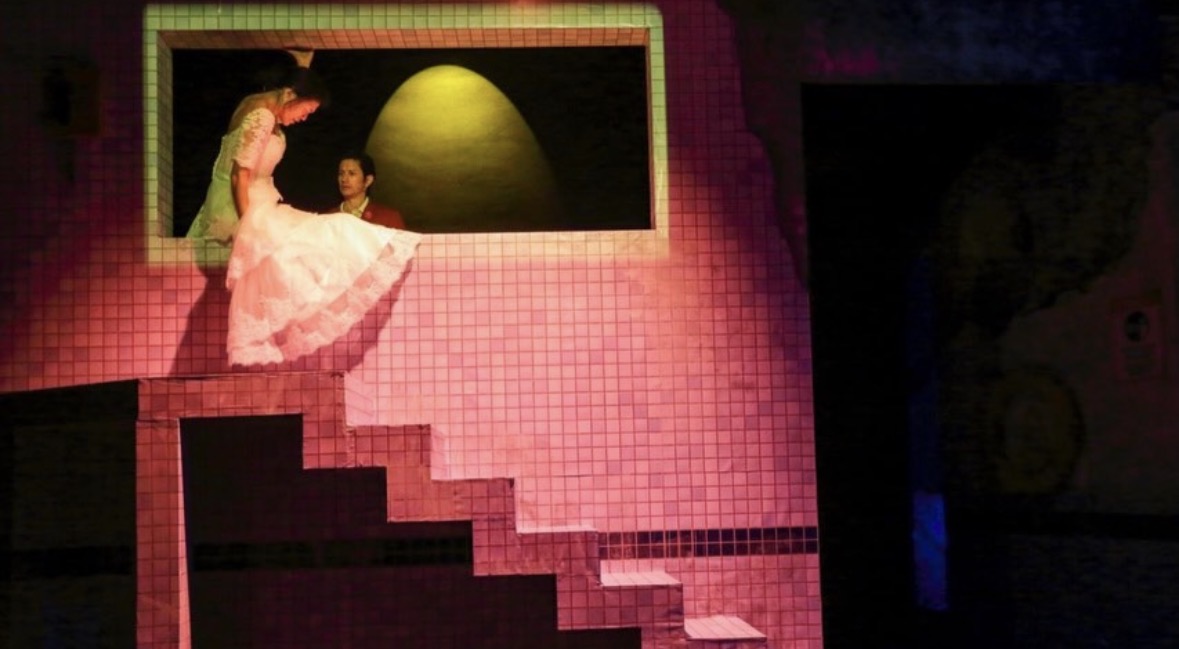
Sarah Ruhl’s retelling of the Orpheus and Eurydice myth comes alive under Ghafir Akbar’s inventive and imaginative staging, and the cast’s deeply sincere performances.
Duration: 90 minutes
For more than two thousand years, the story of Orpheus and Eurydice has endured as one of Greek mythology’s great stories of love and loss. Orpheus, the gifted musician, travels into the Underworld to retrieve his wife Eurydice after her death, and is granted one chance to bring her back to the world of the living, provided he does not look back at her until they have escaped. He does. She is lost again. It is a story that has been retold countless times, but Sarah Ruhl’s Eurydice, first premiered in 2003, asks what happens when that familiar myth is no longer told through the eyes of the man who makes the journey, but through those of the woman who has been left behind.
Ruhl’s Eurydice dies on her wedding day and enters an eccentric Underworld where she encounters her dead father, who is desperately trying to communicate with her. There, memory, language and identity begin to unravel. Orpheus remains above, writing letters and eventually attempting the journey himself, while Eurydice must navigate a realm governed by strange rules, seductive threats and the River of Forgetfulness. Ruhl retains the myth’s central tragedy but makes Eurydice’s inner life the story: her relationship with her father, her love for Orpheus, her struggle to remember and, ultimately, her own choices about whom to follow and what to leave behind.
In Ghafir Akbar’s production, staged at The Studio at JCPAC, he chooses to embrace that unusual mixture of the ancient and the contemporary. Rather than presenting the Underworld as a cavernous realm of darkness, he locates it in an abstracted swimming-pool world, where the familiar and the fantastical constantly overlap. The effect is established immediately. The production opens with Vinna Law and Tinesh Janaki Raman as Eurydice and Orpheus lying on beach towels in swimsuits, as though they have wandered into an old-fashioned seaside holiday. Their early scenes have an appealingly youthful quality: two young people teasing each other, talking about music and moving towards a future that neither has any reason to believe will be interrupted.

That beginning is important because the production takes its time allowing us to believe in Eurydice and Orpheus as a couple. Their chemistry grows rather than arriving fully formed. Orpheus makes a song for Eurydice; he ties a piece of string around her fourth finger, deliberately choosing her ring finger, and she realises what he is asking. Their exchange of “yeses” is almost childlike in its simplicity, but Law and Raman play it with such sincerity that it becomes genuinely touching. These are not grand declarations designed to announce a great mythological romance. They are small gestures between two people who are happy to have found each other.
That sincerity becomes the emotional foundation of the production. When Orpheus later writes letters, searches for Eurydice and attempts to reach her through music, we understand why he refuses to let her go. Raman gives Orpheus a persistent tenderness without overplaying his grief, allowing his character’s determination to emerge through repetition: another letter, another song, another attempt to cross a boundary that should be impossible to cross.
Law, meanwhile, gives Eurydice a rather compelling trajectory. Her journey is not simply from happiness to grief; it is from knowing herself to losing the very things that make her recognisable to herself. One of the most affecting moments comes when she attempts to play hopscotch and finds that she can no longer remember how. The terror is understated, and there is no dramatic announcement that her memory is disappearing. Instead, it slips away in tiny increments, and Law makes those moments feel all the more painful because they are so ordinary.
Ruhl’s decision to make Eurydice’s father such a central figure is one of the play’s most emotionally-charged departures from the traditional myth. The original story is primarily remembered as Orpheus’s descent for his wife; Ruhl creates a second emotional axis by giving Eurydice a father who is waiting for her in the Underworld. The play was, significantly, written for Ruhl’s own father.

Terence Swampillai captures the tenderness of that relationship beautifully. Early on, he reads the words his character has written to Eurydice for her wedding day, offering the sort of practical, affectionate advice a father might give his daughter before she begins a new life. It is not simply exposition. These words establishes a parent who has been thinking about his daughter even after death, and who wants to continue caring for her despite being unable to stand beside her physically. When he later encounters Eurydice in the Underworld and she does not recognise him, the emotional reversal is devastating: he knows exactly who she is, while she has lost the knowledge of who he is.
Swampillai plays that asymmetry with restraint. His diction gives Ruhl’s language room to breathe, and his performance becomes particularly affecting once the Father takes on the role of a porter in the Underworld and begins patiently trying to restore his daughter’s language and memories. He teaches her words. He creates a space for her. He waits. His care is practical and almost humble, which makes it more moving when he constructs a room for her out of rope and light.
The room is one of the production’s clearest demonstrations of how little theatre actually needs to show us. There is no fully built house. Instead, the Father creates a place through string, movement and illumination, and suddenly we understand that Eurydice has somewhere to rest. The image also resonates with the play’s larger concern with fragile forms of connection. Ruhl has spoken about the string imagery as a way of thinking about care: Orpheus has no grand material gift, only a piece of string; the Father cannot build his daughter a conventional home, so he makes one from what he has.

That principle runs through Ghafir’s staging. The Studio is used with remarkable efficiency, with Melissa Teoh’s set design and Joanne Ooi’s props providing just enough physical detail to trigger the audience’s imagination. The faded swimming-pool environment gives the production an old, slightly uncanny atmosphere, while Ee Chee Wei’s lighting continually redraws the boundaries of the space. Two rows of lights evoke the institutional glow of an old swimming pool; elsewhere, blue light suggests water, height or an entirely different realm. The lighting does not merely illuminate the action but helps establish the shifting emotional temperature of the otherwise murky Underworld.
One of the most impressive sequences occurs when Eurydice is led into what appears to be a high-rise apartment. There is no elaborate building towering above the audience, but through staging, light and performance, the production persuades us that the characters are dangerously high up. When Eurydice attempts to make her way down, the possibility of a fall becomes physically imaginable. The production repeatedly achieves this kind of transformation: a limited physical environment becomes whatever the scene requires.
The transition into the Underworld is similarly imaginative. An elevator-like doorway opens, and Eurydice stands beneath an umbrella as water falls around her. She appears soaked, disoriented and newly separated from the world she knew. The image is simple, but it establishes the Underworld as something closer to a dream than a conventional location. Ruhl herself describes the Underworld as a place that should resemble Alice in Wonderland more than traditional Hades, and Ghafir’s production clearly understands that invitation to be strange, playful and slightly unnerving.

Gavin Yap seems to have the most fun with that strangeness. As the Lord of the Underworld and the other forms the character takes, he moves between charm, absurdity and menace with considerable ease. At one point, he appears on a tiny tricycle, an image that immediately recalls and references the unnerving playfulness of Saw’s Jigsaw. Yet the comedy never entirely removes the danger. Yap can be ridiculous one moment and deeply unsettling the next, which is precisely what the role requires. The Lord of the Underworld is not a conventional devil so much as an unpredictable force who enjoys games, and Yap understands how much more threatening that can be.
The Stones, played by Jo Kukathas, Anne James and Sukania Venugopal, occupy a particularly interesting place within Ruhl’s theatrical world. They function as the play’s Greek chorus, a direct connection to the conventions of ancient Greek theatre. Ruhl has said that she was interested in the idea of the stones from the original myth, the stones that weep at Orpheus’s music, and turned them into a chorus that could establish the rules of the Underworld while also providing comic relief.
That dual function is evident here. Each Stone has a blue chair, and together they observe, comment, instruct and occasionally interfere. Their presence helps immerse the audience in the logic of this strange realm: they tell us what is permitted, what is forbidden and what happens to those who break the rules. Yet they also keep the production from becoming too solemn. When the emotional weight threatens to become overwhelming, the Stones can puncture it with their oddness.
They are especially effective when they seem to address not just the characters but the audience itself, urging us to listen to Eurydice and drawing attention to what is happening. That is significant in a play built around the recovery of a woman’s voice. The myth has traditionally given Orpheus the song, the journey and the action; Ruhl gives Eurydice the perspective, while the Stones help frame and witness her story.

Irena Taib’s music and sound design, with Putrina Rafie as assistant music composer, deepen the production’s submerged atmosphere. At times the soundscape has the serene, slightly eerie quality of an aquarium, creating the impression that the characters are suspended underwater. Elsewhere, the sparseness of dripping water becomes almost physical. Sound is particularly important in a production where so much is suggested rather than literally shown: it gives the unseen world a presence of its own.
The same imaginative economy can be seen when Orpheus sends objects into the Underworld. One of the production’s loveliest pieces of stagecraft occurs when he lowers a book down from one side of the stage and, through precise timing and positioning, it appears to arrive with Eurydice on the other. The audience sees the mechanics and yet accepts the illusion. This is theatre at its most satisfying: not hiding the trick, but giving us enough information to participate in it.
There is a similar pleasure in the production’s tonal shifts. A scene can move from tenderness to absurdity without feeling as though it belongs to another play. The Lord of the Underworld can arrive on wheels; the Stones can sit in their blue chairs; Eurydice can try to reconstruct her memories; the Father can build an entire room from string. The absurdity does not weaken the grief. Instead, it makes the grief sharper by reminding us that the characters are still capable of wonder, play and affection.
The emotional centre eventually returns to the familiar, fated myth. Orpheus makes his way into the Underworld and is given the chance to take Eurydice back, on the condition that he walks ahead without looking behind him. Eurydice must decide whether to follow him or remain with her father. It is here that Ruhl’s reworking becomes particularly poignant: Eurydice is no longer simply the woman Orpheus is trying to retrieve. She has a relationship with her father, a relationship with Orpheus and a choice of her own.

Swampillai’s Father encourages her to go, even though doing so means losing his daughter once again. The Stones urge her forward. Eurydice takes those first tentative steps. She sees Orpheus. She calls his name. Of course, he turns. The moment lands because the production does not over-explain it. The audience already knows the myth, but Ruhl’s version makes the emotional stakes different. This is not simply the failure of a man to obey a rule. It is the collision of several kinds of love: romantic love, parental love and the desire to return to a life that can no longer be recovered in quite the same form.
After Eurydice disappears again, the Father dismantles the room he had built for her. The act is devastating precisely because it is so practical. He takes apart the physical evidence of the home he made, removing the ropes that had briefly turned an impossible place into somewhere his daughter could belong. What had been an act of care must now be undone.
When the Father enters the river, the production again avoids literalism. Through light, movement and sound, we understand that he is surrendering his memories and language to the River of Forgetfulness. By the time Eurydice returns, the person who had worked so hard to help her remember is no longer able to do so himself.
The final sequence brings the production’s ideas about memory, love and language together without needing to spell them out. Eurydice writes a letter, enters the river and chooses forgetfulness. Orpheus eventually arrives, only to find that he can no longer read the words she has left behind. The doors open, water falls, and another boundary between the living and the dead disappears.

Throughout the evening, Ghafir Akbar has allowed the Studio to become a beach, a swimming pool, a high-rise apartment, an Underworld and a series of imagined rooms without insisting that the audience see any of them literally. The result is a production that trusts its audience to complete the picture.
The cast and creative team work together particularly well in sustaining that trust. Law gives Eurydice an emotional trajectory that moves from youthful happiness to disorientation and finally to a painful acceptance of what she has lost. Raman brings warmth and persistence to Orpheus. Swampillai gives the Father a quiet, deeply affecting tenderness, while Yap brings an unpredictable theatrical energy to the Lord of the Underworld. Kukathas, James and Venugopal give the Stones their own distinctive rhythm and presence. Taib and Rafie’s soundscape, Teoh and Ooi’s physical world, Ee Chee Wei’s lighting and Theresa Chan’s costumes all contribute to an environment that feels coherent without becoming overdetermined.
Most importantly, Ghafir’s direction understands that Eurydice does not need to compete with the grandeur of Greek mythology by becoming grand itself. Instead, it finds the myth in small things: a piece of string around a finger, a letter from a father, a song remembered imperfectly, a room made for someone who may not stay, a hand that reaches out and a person who turns around. The story may begin in the world of gods, myths and the Underworld, but its deepest concerns are recognisably human. What do we hold on to when someone dies? How do we remember the people who shaped us? What happens when memory itself becomes unreliable? And how much of love survives when the person we love is no longer there to receive it?
Ruhl’s Eurydice has been described as a play about a woman whose voice has been overshadowed by a much more famous mythological hero. Ghafir Akbar’s production gives that voice room to be heard, and surrounds it with a world imaginative enough to make the ancient story feel newly alive. By the end, the audience is left not with the grandeur of a Greek tragedy, but with a collection of intimate images: Eurydice trying to remember, Orpheus refusing to stop searching, a father quietly building a room for his daughter, the Stones watching from their blue chairs, and water falling once again between one world and another. Those images and memories stay.
Photo Credit: Pam Lim
Eurydice plays from 18th to 27th September 2026 at The Studio@JCPAC (Jeffrey Cheah Performing Arts Centre), Sunway Square, Kuala Lumpur. Tickets available here

