
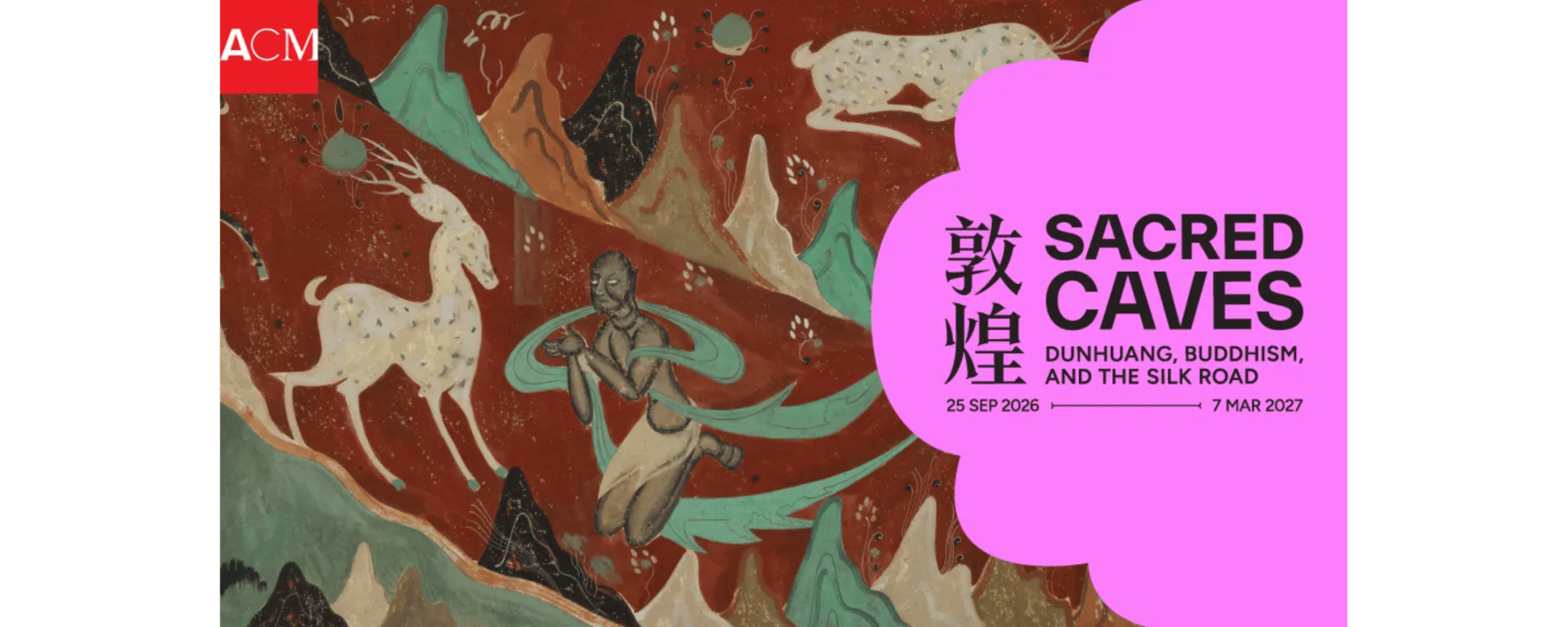
For centuries, travellers crossing the Silk Road passed through Dunhuang carrying goods, stories, beliefs and artistic traditions from across Asia and beyond. Now, some of the most remarkable traces of that exchange are making their way to Singapore, including four life-size reproductions of the famed Mogao Caves.
Opening at the Asian Civilisations Museum (ACM) on 25 September, Sacred Caves: Dunhuang, Buddhism, and the Silk Road brings the ancient city’s art and history to Southeast Asia for the first time. Running until 7 March 2027, the exhibition combines original paintings, sculptures, manuscripts, textiles and devotional objects with immersive cave reproductions, offering visitors a closer look at more than a thousand years of artistic and religious exchange.
Located in northwestern China at the edge of the Gobi Desert, Dunhuang occupied a strategic position where routes between China and Central Asia converged. Merchants, pilgrims, envoys and travellers passed through the city, making it a meeting point for cultures stretching from India and the Middle East to China and Europe.

It was also here that Buddhism flourished, eventually giving rise to the Mogao Caves — a vast complex of cave temples created between the 4th and 14th centuries. “We are honoured to partner with the Dunhuang Academy to bring the extraordinary art and stories of Dunhuang to Singapore,” says Clement Onn, Director of ACM and the Peranakan Museum. “Dunhuang reminds us that cultures have never developed in isolation — people, ideas, beliefs and artistic traditions have always travelled, met and shaped one another.”
More than a thousand years on, he adds, the caves continue to speak to ideas that remain familiar today: “devotion, compassion and connection.”
The centrepiece of the exhibition is perhaps its most immediate one: visitors can step into four life-size reproductions of caves from Mogao. Three of the four caves are restricted or completely closed to the public at Dunhuang, making the reproductions a particularly rare opportunity to experience their interiors in person.

In ACM’s Level 2 Shaw Foyer, Cave 158 presents one of the most striking scenes in the exhibition. Dating to the Tang dynasty’s Tubo period, between 781 and 847, the monumental cave contains the largest reclining Buddha at Mogao.
The scene depicts Shakyamuni, the historical Buddha, entering nirvana. Around him, mourners from different regions grieve his passing, while the bodhisattvas remain composed, understanding his death as the moment of final liberation. Buddhas of the past and future flank the scene, bringing different periods of time together within a single space.

Three more reproductions — Caves 249, 45 and 3 — appear in the Special Exhibitions Gallery. Cave 249 brings together figures from Buddhist and Chinese mythology in an elaborate vision of the cosmos. Cave 45 is known for one of Mogao’s finest Tang dynasty sculptural groups, while Cave 3 is celebrated for the fluid brushwork of its paintings. Altogether, they provide a sense of how varied the Mogao Caves are, both in their imagery and in the stories they tell.

Beyond the cave reproductions, the exhibition follows three themes — City, Devotion and People — to explore the world that surrounded Mogao.
One of the first works visitors encounter is a linmo, or copy, painting based on the ceiling of Cave 407. Its deceptively simple image shows three hares sharing three ears within a circular composition. Similar versions of the motif have appeared across Eurasia, from India to England, acquiring different meanings along the way. At Dunhuang, it reflects Buddhist ideas of rebirth; elsewhere, the three-part image took on Christian associations with the Holy Trinity.

The City section turns to Dunhuang as a place of movement. A Tang dynasty travel pass offers a glimpse into the practicalities of travelling along the Silk Road, while a coin from Sassanid Iran points to the reach of long-distance trade. Paintings and depictions of caravans evoke the travellers who moved through the region and the connections they created.

In the Devotion section, the focus shifts from movement to belief. Patrons commissioned caves, paintings and sculptures as acts of religious devotion, giving visual form to Buddhist teachings. Among the highlights is the Jataka of the Nine-Coloured Deer from Cave 257, which tells a story from one of the Buddha’s past lives and explores compassion, integrity and karmic consequence.

For all its grand stories of empires, religions and trade routes, Sacred Caves is also interested in something much more personal: the people who lived and worked at Dunhuang.
The People section brings together donor portraits of rulers, monks and influential women alongside objects connected to everyday life. A portrait of women from the Cao family, dating to the Five Dynasties period between 947 and 951, offers one glimpse of the individuals who supported and participated in the life of the caves.

Other objects reveal the practical side of Mogao. Visitors can see artists’ tools, a divination diagram and a fragmentary sculpture showing how the caves’ sculptures were constructed. The exhibition also includes what is described as the earliest surviving example of movable type in the world. Together, these objects shift the focus away from the caves as distant monuments and towards the communities that created, used and sustained them.
The story does not end in the medieval period. Sacred Caves also looks at the modern history of studying and conserving Mogao through photographs and records of the site. Among these are images taken by James and Lucy Lo in 1943 and 1944, forming part of an archive of more than 2,500 photographs.

Today, the Dunhuang Academy continues to document, study and conserve the caves through contemporary conservation and digitisation projects. The exhibition therefore becomes a story not only about what has survived, but also about the ongoing work required to preserve it.
As Zhang Yuanlin, Deputy Director of the Dunhuang Academy, puts it, the Mogao Caves are “a testament to the exchanges between different peoples, cultures, and faiths along the Silk Road.” Bringing them to Singapore, he says, offers audiences another way to encounter that history.

The exhibition also moves beyond looking, with several interactive elements designed to make the experience more participatory. A soundscape created by artist Sulwyn Lok features three original compositions inspired by the musical cultures of Dunhuang and the Silk Road. The works bring together instruments including the bansuri and yangqin, both of which travelled along Silk Road routes, alongside the dizi, ruan, cello, saron and bonang.
There is also an interactive digital trail using RFID-enabled paintbrushes. Beginning at the Cave of Colours in ACM’s lobby, visitors can collect different colours as they move through the exhibition. Those colours are then transformed into digital wallpaper and a portrait inspired by the costumes of the Mogao Caves, which visitors can take home.

Outside, a six-metre inflatable apsara provides a rather more playful photo opportunity. From 2 October, visitors can also take part in a stamping trail spanning ACM, the Bank of China and Fullerton Hotel. Collect at least six stamps and you can redeem an apsara blind-box figurine. Three designs feature objects from ACM’s collection, while a secret fourth figure takes inspiration from a familiar Singapore custom.
It is a distinctly contemporary way to encounter a story that has travelled thousands of kilometres and more than a millennium to reach Singapore. But at its heart, however, Sacred Caves is about connection, between places, faiths, artists and generations. The Mogao Caves may have been created in a desert crossroads far from Singapore, but their story is ultimately one of movement: of people meeting, ideas travelling and cultures influencing one another. And for the next several months, a little piece of that Silk Road history can be experienced right here.
Photo Credit: Asian Civilisations Museum
Sacred Caves: Dunhuang, Buddhism, and the Silk Road runs from 25th September 2026 to 7th March 2027 at the Asian Civilisations Museum. Tickets available here

