
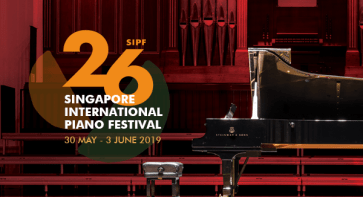
The 26th edition of the Singapore International Piano Festival returns this May and brings together four of the world’s best virtuoso pianists, each performing solo at the Victoria Concert Hall over the four day festival. In the lead-up to the performances, we spoke to veteran British pianist Ronan O’Hora, who has performed in every major country in Europe and the USA, Canada, Australasia and South Africa.
The Head of Keyboard Studies at Guildhall since 1999, O’Hora is known for the exquisite singing quality of his playing and purity of melodic line. Read the interview in full below and find out a little more about what we can expect from him, and his life as a professional pianist:

Bakchormeeboy: What motivated you to become a musician, and what motivates you to continue playing each day?
Ronan: I was drawn to music because somehow I felt I could express deeper feelings, thoughts and impulses through music than I could through any other form of communication. It is the capacity of music to mirror the growth and evolution of our inner life that keeps me as much in need of living with it every day as ever.
Bakchormeeboy: You’ve performed in countless countries and venues around the world. Which has been your most memorable performance thus far, and why?
Ronan: I have been lucky enough to have too many highlights to remember but I can say that any occasion where a performer feels an audience is ready to open themselves to the transformational power of music is memorable and I must say that in recent years a large proportion of those occasions have taken place in Asia where the hunger and curiosity for classical music is so extraordinary.
Bakchormeeboy: You’re a regular judge on competition juries around the world – what would you say most differentiates the younger musicians of today from those in the past?
Ronan: Technical standards today are extraordinary and the vast majority of the young performers in these competitions have serious musical intentions. The aspect that sometimes needs more awareness is that performing music is essentially an act of human communication and this sense of telling a story to a listener has to be central to a performer.
Bakchormeeboy: Is the future of classical music, in your opinion, still bright? If so, why? And if not, what might be lacking?
Ronan: Music is a natural element, like water or oxygen, and we will not silence it, whether we intend to or not! I have no fundamental fear for the future of classical music but it is quite right that some of its practices should evolve, whether it be concert timings and structure, verbal communication or, indeed, helpful technology. Like all successful changes , the more organic and natural the change, the better it will work!
Bakchormeeboy: How do you constantly challenge yourself in your craft and continue to evolve day by day?
Ronan: The most important thing is to bring yourself to the music as you truly are at that moment, rather than as you were the last time you played it, every time you re-encounter a piece. It is not so much trying to change how you will approach the music that is important (although that will certainly happen) but being open to the changes that inevitably happen to us all continuously and meeting the music again as a new person!
Ronan O’Hora plays on 31st May 2019 at the Victoria Concert Hall. Tickets available from SISTIC
The 26th Piano Festival runs from 30th May to 2nd June 2019 at the Victoria Concert Hall. Tickets available here
 Bakchormeeboy