
Letting go means learning to leave things in the past.
In a small island nation like Singapore, land scarcity has always been an issue, leading to landscapes of constant scaffolding and roadworks to tear down older buildings and built heritage to make way for newer, modern spaces. Often, it seems that there is no time for looking back, only the constant banging of bulldozers as we progress faster and further into the future, as the landscape around us changes beyond familiarity and recognition.
Is there any value then, in trying to preserve such spaces for the sake of identity and memory, or should we learn to accept that this is how Singapore is and always will be, and set our bleeding hearts elsewhere?

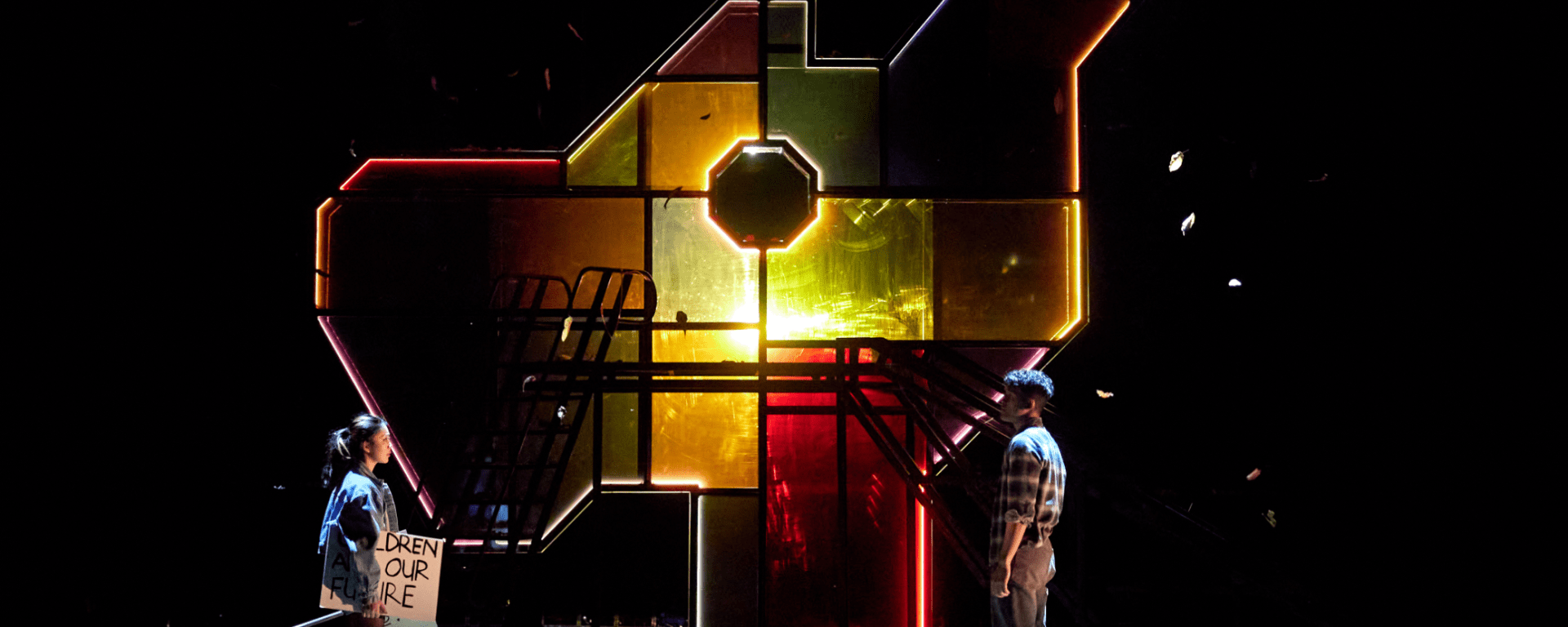
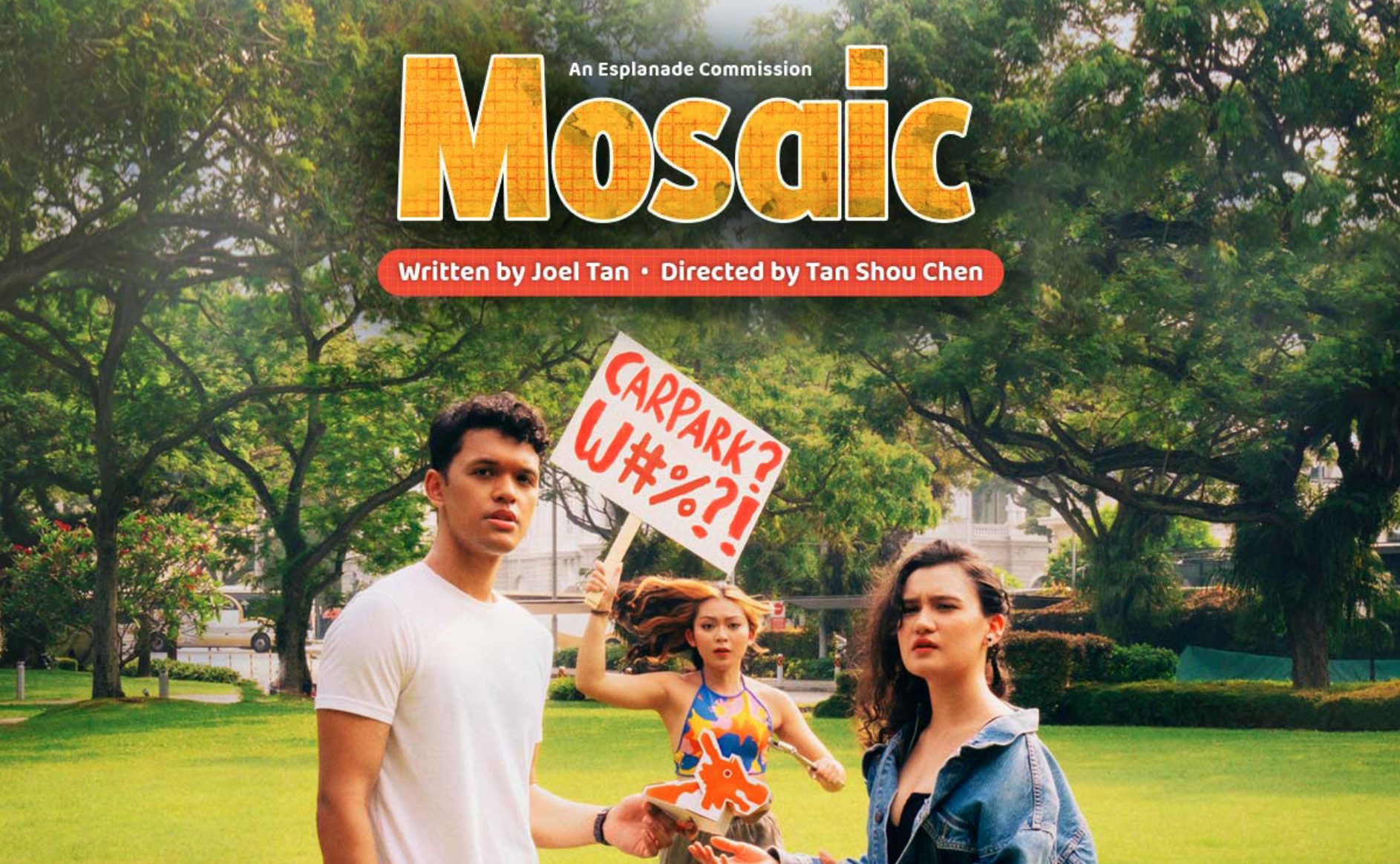
In Joel Tan’s Mosaic, nostalgia is put under trial and interrogated through the lens of four millennials, questioning whether we should be doing everything in our power to remember the past, or let go and move on. Directed by Tan Shou Chen, Mosaic sees Sharon (Coco Wang Ling) and her boyfriend Hanis (Irsyad Dawood) organising a ‘memorialisation’ of an iconic dragon playground at Toa Payoh, before it is due to be demolished the next day to make way for a carpark. Joined by their friend, the free-spirited Wong (Rebecca Ashley Dass) and a stranger, the mysterious and somewhat odd Rongcheng (Andre Chong), over the course of the night, old wounds and fresh feelings emerge that challenge their perceptions of both the past and the present.
Set in 2015, Mosaic brings us back to a pre-COVID era that feels like a lifetime ago, a time before TikTok existed, and perhaps a more hopeful time when we believed that things that happened on the internet had enough meaning to translate into real life. At the heart of the play is Sharon’s event, with none of the 200 people who RSVP-ed on Facebook showing up. It’s context that sets the play’s theme of facing reality in motion, as Sharon obsesses over the lack of numbers, passive-aggressively posting photos in the group to guilt trip the absent invitees, or desperately getting her small, motley crew of attendees to write placards in protest, none of which have any visible effect.

However, it soon becomes clear that all the energy that goes into such an effort, towards a place she has basically no connection to, seems to be a way of venting the other subconscious frustrations she’s in denial of. Even if they don’t realise it, each of these characters is grappling with loss in some form, whether it’s Hanis struggling to accept that Sharon has changed from the time he first met her, Rongcheng learning that a memory from his childhood may have been false, or Wong living completely without abandon, completely in the moment without care for the past or future.
What makes each of these instances painful is how much value they choose to ascribe to their memories and how much it makes up who they are today. Mosaic explores the millennial quarter-life identity crisis, where rapid change has left the generation feeling unmoored and detached from anything permanent, where the rose-tinted lenses of childhood are ripped away, and relationships do not last forever. The harder we hold on to these things, scrambling to find something that doesn’t just disappear, the more one realises how fleeting everything is.

Joel’s writing is keenly observant, echoing the speech patterns of millennials in their prime, and capturing that grating frustration of feeling powerlessness in the face of inevitability. Mosaic is particularly audacious and unflinching in how it calls out millennials for their neuroses, from the almost perverse joy of ‘corrupting’ a good Christian girl, taking shots at transport otaku stereotypes, or the desire to be defined by something other than one’s job. Seemingly unfiltered and filled with expletives, each character is a heady concoction of contradictions and confusion, lashing out or breaking down, with never a dull moment as they try to sort out their own everchanging emotions. As a writer, Joel imbues his characters with such verve and gusto, each one ready with a passionate outburst, all damaged in some quintessentially Singaporean way from their upbringing and environment – you feel for them all, and each one is shaped so precisely, you understand exactly who they are, recognising them from school or your own circle.
Director Tan Shou Chen understands the energy of the play very well, and after some initial build-up, his cast catches every emotional beat and the comic timing of most of the punchlines. Characters enter and exit the set often, but this is well-integrated and non-disruptive, almost as if they are fading in and out each time they walk on or off, the audience noticing them coming in just as the characters onstage are in the midst of talking about them. There is equal weight given to each character, where one can almost imagine their entire backstory just from the way they carry themselves and the way they speak, and good use of levels as they battle it out and chase each other around the playground, an almost darker version of ‘catching’ as they slide down or leap off structures. Visually, it feels as if there is always a fine balance in terms of blocking and positioning, utilising the two-tiered set very well to play with levels, while also affording each cast member equal opportunity to shine, the beats of each major stage of their character development clearly felt.

The young set of actors embody their roles exceptionally well, each one bringing to the stage an angry, agitated energy melded with world-weariness. Coco Wang Ling captures Sharon’s journey well, going from someone doing something for the sake of it, as if chasing clout, to genuinely questioning herself and the value of memory and actions when confronted. Irsyad Dawood brings a faux macho masculinity to Hanis, a slight hint of alcohol-fuelled confidence after a few beers, while also possessing a fragile sense of fear and vulnerability at losing Sharon once and for all.
Meanwhile, Rebecca Ashley Dass is a delight with the completely manic energy she brings to the stage as rocker chick Wong, dressed in fishnet tights and carrying an IDGAF attitude as she literally says the words ‘LOL’ or reads auras, utterly unpredictable as she goes from comforting to flirty to menacing. Finally, Andre Chong is an ideal Rongcheng, as he brings a quiet, aloof energy to his presence, dropping odd, random facts about buses. Half socially awkward, half worldly with how brutally he calls out flaws in both Hanis and Sharon’s bravado, Andre’s performance keeps us guessing, and manages to make us ultimately feel for him when he finally expresses the pent up feelings inside.

And of course, all this is set against TK Hay’s set, which features a massive, multi-hued mosaic-dragon, dwarfing the characters beneath it. Beyond literally representing the playground the characters are at, the dragon seems to at times feel threatening, a set piece that refuses to be ignored as it reminds us of its presence, a massive landmark of memory that refuses to be forgotten and symbolising how difficult it is to move on. During short scene transitions, it lights up to more clearly illuminate its puzzle-like structure, a jigsaw of the mind where every fragment is necessary to get a full picture. On the ground, there is a carpet of dead, brown leaves, crunching quietly as characters walk through them, and signifying the death of a season, the end of an era. Meanwhile, Alberta Wileo’s lighting is subtle but effective, slowly moving the sky from orange evening to purple night, where we feel the passage of time.
Mosaic is more than just a play about lost millennials. In opening the play with Children’s Day song ‘Semoga Bahagia’, it cements the idea that this is a play about what it means to grow up and become an adult, leaving childhood behind, and all the fear that brings with it. For all this talk about conservation and keeping our built heritage, how much of it actually matters if we do not appreciate things when they are around? By the time it becomes too late to save them, we realise how little they mattered to begin with. Sharon’s attempt to save the playground is representative of the want to do something, anything that actually matters and has a lasting impact, and over the course of the play, realising that nothing actually does, ending on a particularly poignant note of acceptance and hope.
With this production of Mosaic, Joel Tan’s play finds new life and a new audience, for the elder millennials looking back, or Gen Z coming of age and figuring out the life they want. Under Tan Shou Chen’s lead, the young but brilliant cast showcases future thespians worth investing in, and a need to carve out new spaces for them to showcase their talents. To move on is not to give up, but to accept that change is inevitable, as the old paves the way for the new. What we lose today may simply be making room for better things to come, and if we hold on too long, then we may end up stuck in the past, rather than embrace the change that is sure to come. As painful as it may be to let go, we do not need the past to hold us down, in our continual journey towards growing up, and becoming newer, better versions of ourselves, always looking forward and not back.
Photo credit: Crispian Chan, courtesy of Esplanade – Theatres on the Bay
Mosaic played from 18th to 20th August 2023 at the Singtel Waterfront Theatre. More information available here
The Studios 2023 runs from July to September 2023 at the Esplanade. Full programme and tickets available here
Production Credits:
| Playwright: Joel Tan Director: Tan Shou Chen Performers: Coco Wang Ling, Irsyad Dawood, Andre Chong, Rebecca Ashley Dass Set Designer: TK Hay Costume Stylist: Yvette Ng Lighting Designer: Alberta Wileo Sound Designer: Jing Ng Sound Engineer: Guo Ningru Producer: Shridar Mani (The Public Space) Production Manager: Cindy Yeong Technical Manager: Kailash Stage Manager: Celestine Wong Assistant Stage Manager: Chong Wee Nee Key Visual Design: Akbar Syadiq |
 Bakchormeeboy
One thought on “★★★★★ Review: Mosaic by Esplanade – Theatres on the Bay (The Studios 2023)”