
Life finds a way.
In the highly urbanised landscape of Singapore, it’s easy to forget that beyond the trees lining the edges of roads and our publicly accessible gardens and parks, our island is also home to full-blown forests on the fringes of the city, lining expressway edges and more ‘ulu’ locations.
Amidst these are the secondary forests, a type of forest that has emerged from a landscape that has been disturbed by human activity, resulting in a strange alien ecosystem that mixes the human, animal and greenery. In Singapore, many of these are filled with the Albizia tree, often one of the tallest trees in the secondary forest and common due to their wind-based seed dispersal and ease of growth.
These trees also end up becoming the main character in artist Robert Zhao Renhui’s newest work, also titled Albizia. Collecting eight years worth of rare footage of unexpected and poignant shots of nature captured by Robert using motion-triggered camera traps, Albizia then arranges and presents these as a singular mixed media installation, in a free-roaming experience for audience members to explore.

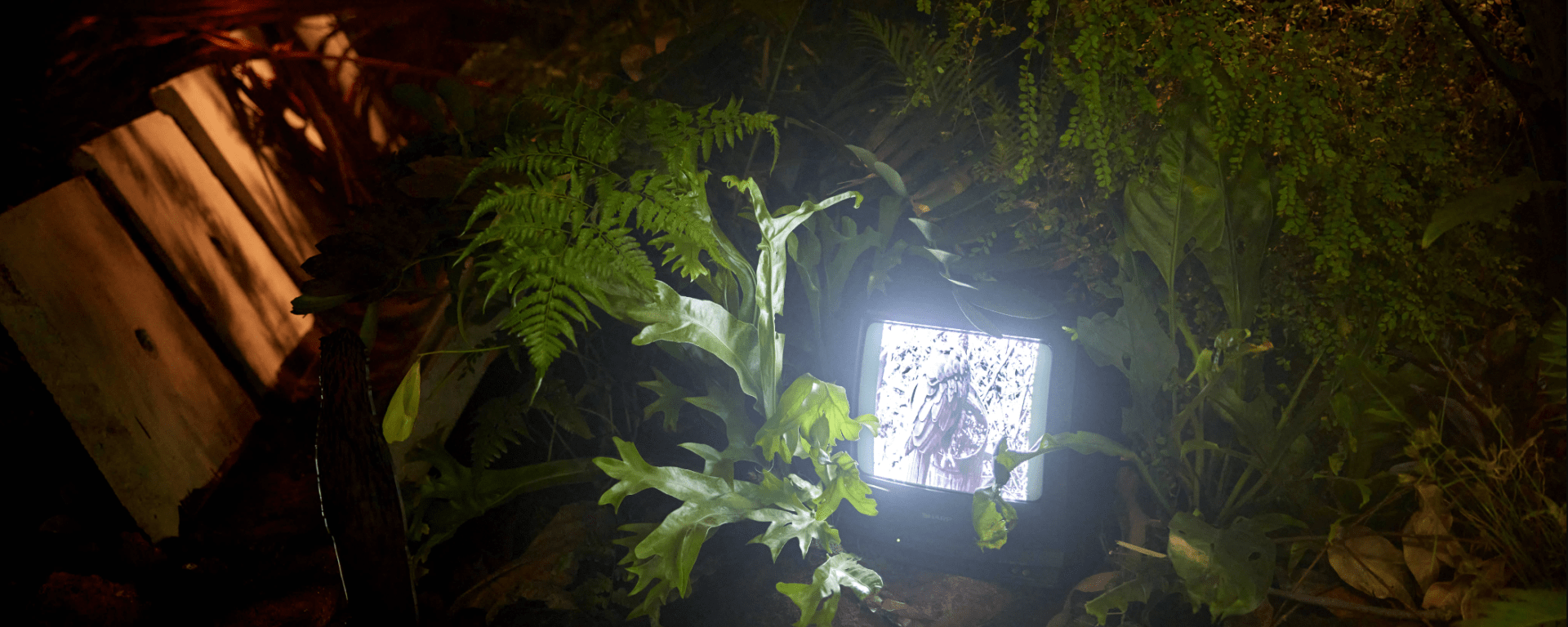
From the moment one enters the Esplanade Theatre Studio, audience members are swathed in darkness, so much that it becomes difficult to navigate, as if away from city lights, under cover of night. As ‘daylight’ slowly arrives, our eyes adjust and we can see how the entire set-up of the installation has been designed to resemble an actual secondary forest, and one cannot help but feel transported to another world.
Designed by Allister Towndrow, various set pieces could practically have been carved straight out of an actual forest, with a plethora of live plants in soil with shoe prints imprinted onto them, trash from plastic bottles to aluminium cans, and even part of a drain with audible running water (all of which, no doubt, took plenty of time and effort to approve setting up). For Robert, nature is not necessarily neat and clean, and with Albizia, he fully intends to showcase the messy side of things, this strange co-existence and hybrid ecosystem where all life seems to thrive. What may seem like a place we need to ‘clean up’ seems to have found a way to adapt and incorporate all the human elements into its environment anyway, an incredible feat and testament to the persistence of nature and survival.

Robert’s artistic sensibilities also play into the set itself, where we see alien elements that wouldn’t even make sense in a forest, including a set of shelves that contain bric-a-brac from archival photos to soil and plant samples in tiny jars, and even a massive display case containing part of an Albizia tree trunk on its side, with moss and fungi growing out its sides, right in the centre of the space. All of this points to a deliberately curated experience within a faux natural world, particularly with the television sets nestled among the plant life, like technological Easter eggs, each displaying distinct footage of nature that changes as the experience goes on.
Most of our attention however, falls towards two large screens in a corner of the space, where the main ‘narrative’ of Albizia takes place, taking us through various scenes within and on the outskirts of the secondary forests. Over the course of an hour, Albizia shows us a montage of fleeting, blink and you’ll miss it moments in nature that range from amusing to disturbing, mysterious to sobering. Planet Earth this is not, and there are few ‘stories’ actually presented to us, only footage for us to observe and form our own interpretations of.

From two lizards engaged in a half-embrace half-wrestle, to a family of wild boar grazing in a field of grass, a massive pandemonium of parrots circling before finally coming to roost in a single tree, shy mousedeer having a walk, or catfish lurking in murky, trash-infested rivers, Albizia makes the animal world fascinating by presenting it in its most natural state. From time to time, we also view footage of human intervention, juxtaposed against these natural moments, where trees are being cut down, or clouds of thick smoke from fogging billow up into the sky.
While there is no specific ‘story’ that holds it all together, what makes Albizia so enthralling is the sheer diversity of life that perpetuates within these natural green spaces. The animals do not care, or at least, are perhaps unaware of the greater implications of all this human activity. So much of the time, we see the animals learning to live with the trash and repurposing the makeshift housing left behind by ‘drain walkers’ into their own habitats. We hear of the uncanny things that go on that we do not bear witness to – forest brothels evidenced by the condoms left behind, and mysterious carvings that suggest an entire community of people living in the forest. Outside the city, there is an entire world unbeknownst to us that is seething with life and activity, and all it takes is to take a step out of our comfort zone to take a chance and potentially, see something spectacular.

All this is captured from how there are interspersed scenes of two explorers (played by Umi Kalthum and Yazid Jalil) walking the forest, alongside their strange encounters. Seen as red silhouettes through thermal imaging videos, such moments verge on the supernatural, presenting the forest as a space where its own kind of magic seems to happen. While nothing outright horrific actually happens, it is heavily suggested that the forest has its own means of protecting its own, and all that dare step into it will end up in its thrall somehow.
All this is accompanied by timely lighting and sound cues (by sound designer/composer George Chua and lighting designer Elizabeth Mak), where select parts of the set are illuminated in accordance with the scenes onscreen, bathed in red light to reference the culling of birds deemed as pests, or more electronic music paired with more surreal moments, helping to further immerse us in the experience. In essence, one experience an entire range of emotions throughout, from being lulled into the natural calm of the forest’s tranquility, to our eyes darting around to the sound of a tiny sound emitted from a smaller screen, leading us to creep closer to find out exactly what we’ve missed out on. The more one explores the space, the more there is to uncover.
Towards the end of the experience, the words ‘for here there is no place that does not see you’, from Rainer Maria Rilke’s poem Archaic Torso of Apollo, are projected onscreen. While we view footage of fireworks bursting above the cityscape, we think of this quote, not as a reminder not for us, but for the forest. To reassure it that as much as it’s surrounded by people who’ve fully become city folk, it continues to exist, silently, but noticed by those who find solace in its shelter, and those who find value and joy in all that it encompasses and provides a home to. For us, rarely stepping into the forest unless absolutely necessary, Albizia is a gateway to more natural encounters in future.
Albizia is not here to convince us of anything, but to show us that nature is all around us, and life finds a way to persist in the face of everything we throw at it. The secondary forests do not need to assert their experience, but Robert Zhao at least, has seen something special in them and a need to platform them through this work. In seeing how they absorb the foreign into its systems, we understand this idea of evolution and change with the times, and that our relationship with the land we live on is undeniable, unbreakable. By inviting us into this makeshift forest landscape, Robert has given us brand new eyes to be aware of just how much diversity and will to live lies just out of sight, and that perhaps we too can learn to notice all that we’ve missed.
Photos by Crispian Chan, courtesy of Esplanade – Theatres on the Bay
Albizia ran from 31st August to 3rd September 2023 at the Esplanade Theatre Studio. More information available here
The Studios 2023 ran from July to September 2023 at the Esplanade. Full programme and more information available here
Production Credits:
| Artist Robert Zhao Renhui Associate Producer James Jordan Tay Dramaturg Joel Tan Sound Designer & Composer George Chua Lighting Designer Elizabeth Mak Set Designer Allister Towndrow Actors Umi Kalthum, Yazid Jalil Landscape Company IT Meng Landscape and Construction Set Construction Q’s Advertising Technical Manager Terence Lau Stage Manager Jasmine Khaliesah Logistics Manager Daniel Tham Assistants to Robert Ge Xiaocong, Hong Shuying, Lewis Choo, Noah Lee Assistant to Set Designer Abdul Alim Bin Ani Assistant to Technical Manager Lee Wai Siang |
 Bakchormeeboy
One thought on “Review: Albizia by Robert Zhao Renhui”