
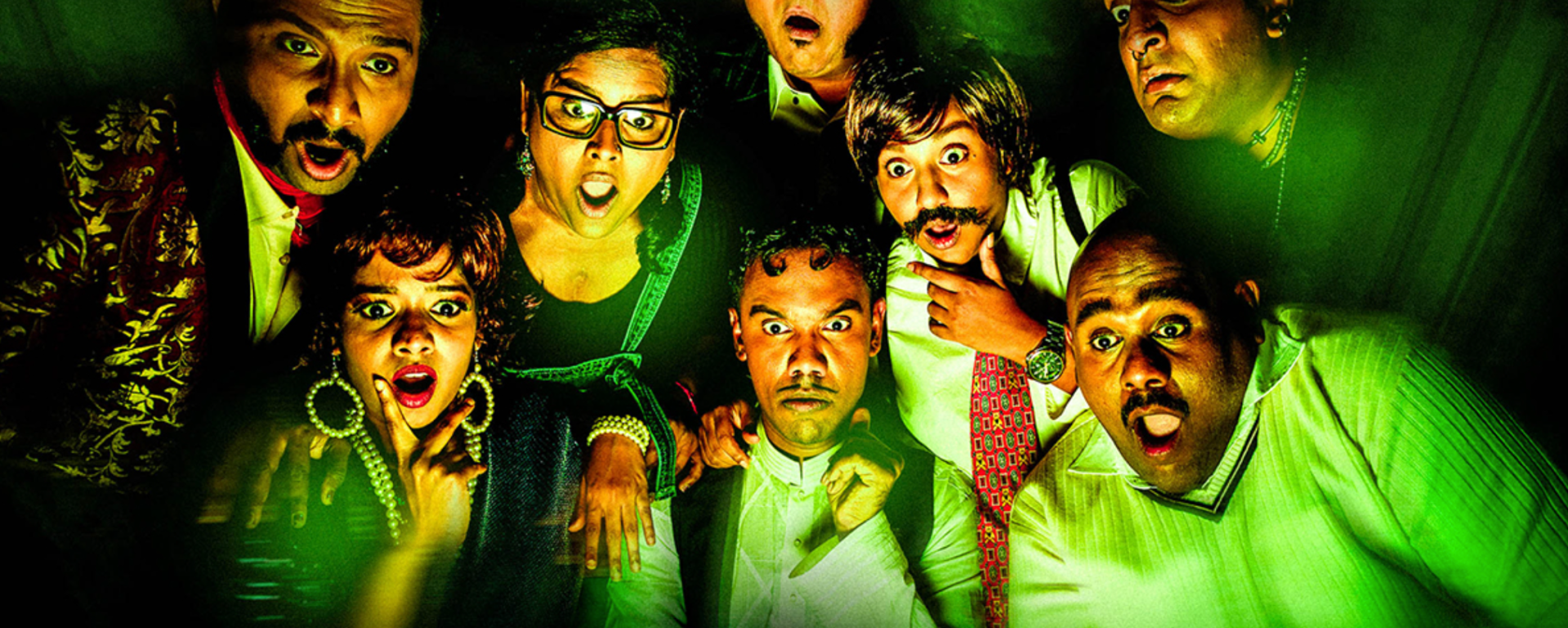

In 2012, Britain’s The Mischief Theatre Company struck gold with a little theatre production – The Play That Goes Wrong. An incredibly clever comedy that sees an amateur drama club putting on a murder mystery play, things quickly go awry as the set falls apart, actors forget cues, and essentially, everything that can possibly go wrong, does.
Riotous and receiving international acclaim, the play quickly went on to hit the West End, go on tour, transfer to Broadway, and has become one of the most well-received theatre comedies in the last decade. Now, Singaporeans will finally get a chance to catch a version of the hit play, as local company Agam Theatre Lab adapts it in Tamil as Twin Murder In The Green Mansion, set to play at the Esplanade Theatre Studio this month as part of the annual Kalaa Utsavam – Indian Festival of Arts.
Speaking to co-directors Subramanian Ganesh (Ganesh) and Karthikeyan Somasundram (Karthik), we found out more about the adaptation process, what audiences can expect from the show, and Agam Theatre Lab’s journey over the years. “”Both myself and Karthik have been in the theatre sector for a long time, and in 2017, before we started Agam, I was involved in this National Library Board project where we were archiving the histories of Tamil theatre,” says Ganesh, who is also producing the show. “We spent about a year collecting documents and material, and ended up with over 3,000 objects from Tamil productions, but we realise that that’s just the tip of the iceberg, considering how Tamil theatre in Singapore has been around since the 1930s. Not to mention, there were so few active practitioners of it, and it led to questions of sustainability as a minority theatre scene.”
“So that’s where we realised there was a gap, and that while artistically, we are all very capable, what was lacking is the management and governance in the business of theatre, leading to so many practitioners leaving the scene because there’s no sustainability,” he continues. “So we decided, we need to do this properly to help ensure the longevity of Tamil theatre, and really focus on the professional aspects. We got out paperwork, got out IPC status, hired full time staff, and were on our way to proving that theatre can be a sustainable industry for those looking to become artists and practitioners.”
“Passion is something that Ganesh and I have had instilled in us from our days in the Ravindran Drama Group, and we owe it to them to developing that fire towards wanting to make sure we bring theatre to the next level, to keep bringing in new audiences, new writers and directors,” says Karthik, who also adapted the script and performs in the play. “We’re here to keep exciting society, while also always remembering our mission of ensuring this isn’t just a hobby, but a profession and industry, where practitioners of the future get this opportunity to say they want to become full-time artists, and achieve it.
“The expectations were very high coming in, but the community was excited about it, considering how they’ve previously seen us onstage, and suddenly, we’re here telling everyone that we’ve started a company of our own,”says Karthik. “Theatre is still niche, both in general and within the Tamil community, but both Ganesh and I saw it as a challenge, where we’re here to entertain and engage everyone. And with the heartening response over the years, it’s been very encouraging to us to keep at it.”
Four years on, and Agam Theatre Lab has not only produced hit shows such as a Tamil adaptation of Animal Farm, but also produced digital material, engaged youths in dialogue and training, started children’s theatre classes, and started their visionary Agam – SIET Theatre & Arts Education Trust Fund Assistance Scheme to assist an annual bursary to deserving students pursuing Theatre or Arts Management courses in local institutions. “Historically, Tamil theatre is done with a lot of passion, where people come together to make something, and when you need funds, you end up knocking on the doors of shopkeepers and members of the community to support it and watch it come to life,” says Ganesh. “Today we want to entertain the masses, but with costumes and set pieces and professional technicians, it all needs money, and people don’t realise it’s getting more expensive to do quality work. So our goal is really to make sure we find people who will become a part of the scene, support the scene, and hopefully see it as an investment.”
“It was definitely a challenge going in, but I believe that we’ve managed to streamline the process, and expand our offerings to explore as much as we could,” he adds. “That’s why we have children’s theatre, to introduce theatre to toddlers for exposure, and when they go to school and making a decision as to what to pursue at the tertiary level, to offer them free training for several months and get them interested. And if they are, that’s where the bursary comes in. When they graduate, we offer them a residency and associate artist programme, where we’ve had students graduating with diplomas and master’s degrees, all in the hopes of coming joining Tamil theatre.”
On working together again for Murder In The Green Mansion, Ganesh and Karthik speak about how they match each other’s vision and energies, and align with their goal of bringing big time theatre to the local Tamil theatre scene, with a production as big as Broadway’s The Lion King as the dream. “When it comes to Tamil theatre, historically it’s always been about producing our own Indian stories, from myths hailing from the Ramayana or Mahabharata, and they’ve already been done well and very extensively. So when we formed Agam, we knew we wanted to bring something different to the stage in order to bring new audience members to the theatre, especially younger audiences who will be entertained and enamoured by our shows,” says Karthik.
“Not all contemporary narratives have to revolve around love and marriage after all,” says Ganesh. “To get audience members in, they have to enjoy themselves or even laugh while watching it, and make them want to come back again. So we wanted to break the formality of typical Tamil theatre, to be able to explore other messages and storylines, and adapt plays that excited us. Why can’t we do a Broadway or West End type show in Tamil? We want our audience members to get excited and be surprised at what Tamil theatre is capable of.”
Which leads directly to the decision to adapt and stage The Play That Goes Wrong. “We always felt that humour is necessary to relax the audience and connect with them, and it creates this safe space to open up and start thinking, and that makes it easier to send the intended message we want to across to them through discussions outside of the theatre,” says Karthik. “At this point, we’ve done political plays and biopics, so it was about time we did a full-on comedy, in line with this festive period. My initial introduction to The Play That Goes Wrong was a video online, where we were just so impressed by how this group finishes staging the play despite all the ‘obstacles’ they face along the way, triumphing despite everything going wrong. It felt like I was there celebrating the victory with them.”
“As theatremakers, we’re given the responsibility not just to entertain audience members, but also give them something to think about, and with this play, I think that beyond laughing and loving when we see people fail, watching them get up after that is where the joy really stems from. Look at someone like Shanti Pereira, where we all ended up coming together as a nation to celebrate her victory after watching her struggle so long to get to this point,” he continues. “So with The Play That Goes Wrong, watching this group succeed is a reminder that at the end of your struggle, you will find victory too. In adapting it, all our characters are now local Singaporeans, and that adds a very distinct flavour to the play unlike its West End counterpart, and it makes sense to do such a play as part of Kalaa Utsavam, celebrating Indian arts.”
In Twin Murder In The Green Mansion, we follow the woefully misguided Chutney Drama Society’s opening night performance of Pachae Bungalaa, Rettae Kolaedaa. An unconscious leading lady, a corpse who can’t play dead, a ruffled detective, and a word-mangling butler (among others) must battle against technical gaffes, forgotten lines, and sabotaging scenery in a quest to arrive all in one piece at the final curtain call. “Beyond seeing actors forget their lines, this is a play that posits what if absolutely everything goes wrong, from the set to the lights to even the surtitles, to the extent that there’s even a line they break the fourth wall and go wow, you guys actually paid for this,” says Ganesh. “The tough part then is really making sure everything is timed perfectly. Some people might not see it as ‘theatre’, but it really is a very arduous process we go through to make sure it all goes well.”
That’s a process that requires everything to fall or ‘go wrong’ exactly on cue so that nobody actually gets hurt, and intentionally create near-misses and good actors to deliberately ‘act badly’. “It’s rare for us to begin work so early, but we’ve gotten the entire cast to start almost two months ago, where they start exploring and devising what we can do, and that they become clear what needs to be done,” says Ganesh. “And then comes phase 2, where we do blocking with the set, and for the first time, we had to hire a tech manager to work alongside us to ensure that everything that goes ‘wrong’ has to be choreographed perfectly. Then everything comes together during the rehearsal process, where our cast and set work in tandem to produce the work.
“For me, I do think the hardest part was getting good actors to act as bad actors, because they’re already so trained to do what’s right. There was a lot of unlearning involved, while also ensuring everyone’s synergy was right and the energy was in sync to be able to work well as an ensemble, and can sense and know exactly where everyone else is at any one point in the play,” says Karthik. “The set really is our ninth actor, and once we get enough practice and get used to the choreography of the scenes, that’s when the magic started happening, where they were getting so comfortable, they no longer felt the awkwardness of making a mistake, and even helping each other make mistakes!”
“It’s really the training together that allows us to work together as a team and feel completely invested in this project, and it becomes a collaborative process where we are able to bring our own ideas and skill sets to the table. Through our rehearsals, we focus on how to approach characters and how to understand comedy and acting and how to actually milk the moment, or prepare for if the audience doesn’t laugh when you expect them to. Essentially, you have to really just be in the moment and stay true to it, reacting to whatever the audience reaction is,” he continues. “It’s also about creating a safe haven for all of us involved, where we can thrash out any issues, unwind together as a company and a family, and attend to each other with our shared synergy. We are not a dictatorship where we just delegate jobs to people, but at the heart of theatre is still this desire to have fun together, and enjoy the process and involving everyone, as much as creating a quality final product.”
Ultimately, Twin Murder In The Green Mansion is set to prove Agam’s staying power and ever-growing relevance in the local theatre scene, and seems set on the right path to furthering their company goals and raising their profile ever higher. “We believe in the importance of longevity, and part of that involves bringing in new groups each time we put up a show, mixing actors of different experience levels but always with that same passion as they train together,” says Ganesh. “As Remy in Ratatouille says, anyone can cook as long as you have the passion for it, and I believe the same applies to theatre too, where we can put up a good production so long as the dedication is there.”
“I sometimes think about how we’ve been questioned before at a forum, where an audience member asked whether Tamil theatre can ever be mainstream,” concludes Ganesh. “But to me, if a bunch of passionate people come and do something together passionately, that’s all you need, without needing to explicitly pander or become popular. Four years on, and we’re still on this journey towards making theatre a firmly sustainable industry, where we’re helping each other out and finding a home beyond home, producing professional theatre together, in a proper environment. We’re honestly happy to see so many different Tamil theatre companies thriving, with fresh perspectives and healthy competition and a good working relationship, allowing everyone to succeed together.”
Twin Murder In The Green Mansion plays at the Esplanade Theatre Studio from 24th to 26th November 2023. Tickets available here
Kalaa Utsavam – Indian Festival of Arts 2023 runs from 17th to 26th November 2023. Full programme and lineup available here
Production Credits:
| Producer: Subramanian Ganesh (Agam) Directors: Subramanian Ganesh, Karthikeyan Somasundram Dramaturg: Sindhura Kalidas Script Adaptation: Karthikeyan Somasundram Cast: Karthikeyan Somasundram, Udaya Soundari, Prasakthi Allagoo ,Nallu Dhinakharan, Shaikh Yasin, Pk, Mano, Indu Company Manager: Joanne Ng Assistant Producer: Wan Sarah Production Manager: Charlinda Pereira Stage Manager: Shivani D/O Thillai Nadarajan Assistant Stage Managers: Audrey Low & Reyn Tan Production Assistant: Emily Francesca Soegijanto Sound Design: Nallu Dhinakharan Publicity Design: JS Sasikumar Techincal Manager: Ian Tan Set Design: Lim Keng San (ON STAGING)) Sets Construction: ON STAGING Pte Ltd Props Manager: Audrey Low Makeup & Costume Design: Norehan Fong Surtitles: Durga Devi Photography: Brandon Video Editor: Praveen Kumar |
 Bakchormeeboy