

When he was still based in Singapore, Shiv Tandan was a rising star in the local theatre scene, having penned the hit play The Good, The Bad and the Sholay back in 2011, when he was still an undergraduate at the National University of Singapore. Since then, he went on to become an associate artist with Checkpoint Theatre, assisting across various projects and productions, received a restaging of The Good, The Bad and the Sholay at the Esplanade in 2015, and seemed poised as a darling of the local theatre scene.
But all that changed when he made the decision to leave Singapore and move to Mumbai, where he’s found a new life as an artist and entrepreneur. “The way I ended up moving wasn’t a clean break, where it took about four years of travelling between the two cities before I finally settled down in Mumbai,” says Shiv. “I had set up a company whose main office was based in Singapore, while still running it in various cities in India. It was basically a tech company trying to build a system that could help matchmake projects and casting to the right artists and actors, and with the size of Bollywood, you literally have hundred of projects going on at any one time.”

Having one foot in each country was hectic, but even more chaotic was getting used to the fast-paced lifestyle in Mumbai, a complete change from Singapore. “I spent most of my life in Singapore and got my sense of punctuality from there, and assumed it would be the same in Mumbai,” says Shiv. “But after sending out emails and calendar invites for the better part of the year, and people still forget, I began to realise that there’s no predictability in a place like Mumbai,” says Shiv.
“It makes me think of how engineers have this Six Sigma rule where there is a limited amount of variance we’re allowed to have, but Mumbai completely ignores that,” he adds. “You could have people showing have 1.5 hours late for a meeting, because even when you plan things to perfection, a festival that was only planned the day before might cause massive traffic that holds you up. It’s taken me some time to adjust to it, but once you accept that this is how things are, somehow it works.”

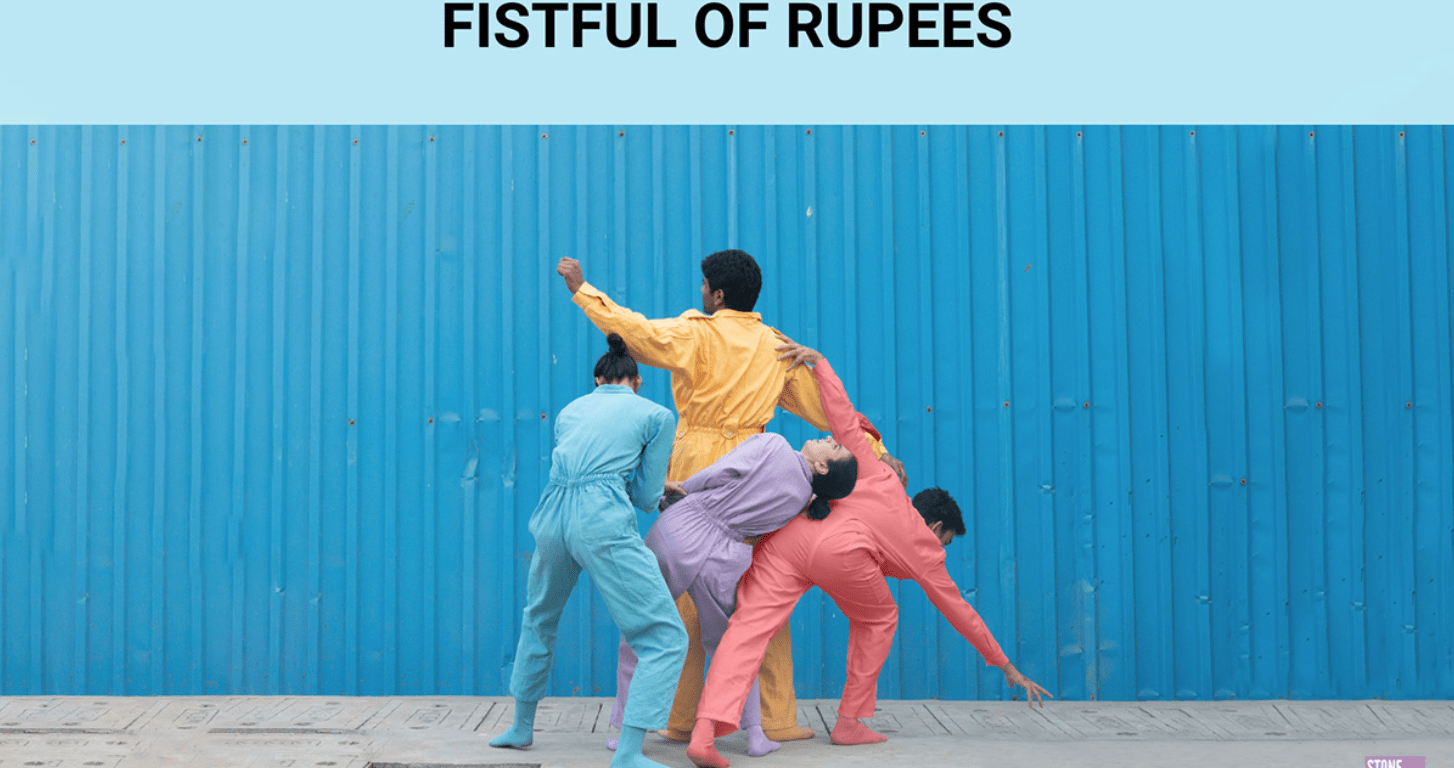
It is all these experiences and more that have become the inspiration for his comic play Fistful of Rupees, which comes to Singapore for the Esplanade’s 2023 edition of their annual Kalaa Utsavam – Indian Festival of Arts. The semi-autobiographical play follows Raghav, who moves from Singapore to Mumbai without much of a plan. Enter culture shock from how much louder and brighter everything feels in the Indian capital, as he learns to adapt to all the changes in his new life.
Interestingly, this isn’t the first time Singaporeans will get a chance to experience Fistful of Rupees live – back in 2017, during the Singapore Writers Festival, Checkpoint Theatre presented a dramatised reading of an early version of the play, completely different from the version being staged this November. “Having lived in Singapore during my formative years from the age of 15 to 24, the sudden move to Mumbai made me feel really out of place,” says Shiv. “One thing I did feel was that everyone else was just like me – coming from a different place looking to start a new life. So as new residents, we were all trying to find our sense of self, and in that initial draft, I focused a lot on the central question of ambition and home and belonging.”

From there, Fistful of Rupees was reworked several times until it expanded beyond the autobiographical, weaving in stories of other Mumbai migrants he spoke to to capture the breadth and diversity of living there. “The kind of stories that interest me most are those that deal with a person’s inner life, and Raghav’s journey in the play is really about trying to find himself in the world while going through all these experiences, and learning to feel more at peace even within the storm,” says Shiv. “Amidst all the comedy, there’s a relatable story that even examines characters like Raghav’s sister, who’s also deciding between remaining in Mumbai or returning to London. Or how we’ve incorporated other stories from the actors themselves, like how one of them was raised by their grandmother and hardly saw her biological parents growing up, and when they finally took her home, she felt like a stranger in her own house.”
“After performing it for some time, all these stories begin to blend into one another, and I can’t remember whose story belongs to who,” he adds. “Eventually, with all the blocking and direction and character work, these stories begin to take on a life of their own onstage, but there is always some kind of fundamental truth to it that is distilled into an entertaining and engaging performance by the actor onstage. And hopefully the message gets to the audience, that it conveys to people the core narrative of this guy in a new city trying to find himself, to be able to see Mumbai the way I did coming from Singapore, and that through the 27 characters they’ll see onstage, they see their own struggles, joys and quirks, and think about what home means to them.”

On the process of developing and writing it, Shiv elaborates on the difficulty of being satisfied with the final product and the doubts that plagued him along the way. “There are times you feel you have a brilliant idea and write it down, but then two days later suddenly, it doesn’t seem as exciting and doesn’t read as well as you thought,” he says. “I think at its heart, a writer must always remember that people are spending their evening with you in the theatre, and coming for a show like this, they want to laugh, have fun and enjoy their time. The story comes first, but you want to create an experience that feels good for the people in the room with you.”
Shiv is of course being humble – Fistful of Rupees went on to be named runner-up at the International Sultan Padamsee Playwriting Awards, one of the most sought-after awards for English language dramatists in India, and has been on tour around the country for several years since then. “The Indian performing arts scene works in a way where you never stay in the same place for long, literally touring it for decades all over,” says Shiv. “Thankfully this is an easy show to tour, but even though it mostly stays the same from city to city, each individual venue might not allow for exactly the same execution of the play, and might have minute differences in the set-up or the way characters are played.”

And considering how chaotic India can get, Shiv has certainly had his fair share of last minute adaptations too. “Since touring in 2019, we’ve had four different casts, three lighting designers, of which the original lighting designer ended up joining the cast at some point, as well as over six different producers and stage managers,” he says. “Actors don’t earn much, and the truth is, if there is a more lucrative opportunity that turns up the next day, then we understand that they have to take it over our show, and we make do somehow. There are almost always curveballs each time I mount this project, and I’ve rehearsed it so many times with so many different groups of people.”
“When I was working with Checkpoint, there was almost this spiritual connection with the work, and while I do feel that way towards the work I do in Mumbai, there are other challenges that come with doing it in a city like this, like how suddenly there’s no water in the house but I have to get to rehearsals, where. I end up being late as a result,” he continues. “But there is some kind of spiritual alignment here as well, where everyone understands, and once you learn how to find more control over your circumstances, even the discipline from Singapore begins to come back into the rehearsal room. Everyone is just in the same boat trying to create something of value they can be proud of, and just roll with whatever life throws at you.”
“We learn to keep balance and juggle all of this, and along the way, you realise that there have been so many different iterations of this show that have emerged due to the different skillsets that come into play, like how we had a multi-instrumentalist who added a lot of music to the show,” he continues. “It’s been a fun process amidst the challenges, and for this international presentation of the show, along with the help from the Esplanade, it’s a very different frame of mind. we all have, and really laser-focused, locked and loaded for when we come to Singapore.”

Especially considering that he has an Engineering degree, and having seen how tough things can get, Shiv still believes that being in the arts is what brings him joy. “Back when I was in NUS, I got a bit infamous for being so angsty, critiquing the university in an article in the student newspaper that went viral, and how my final year Engineering thesis was a critique on the Engineering Faculty itself on where all the gaps in education were,” he says. “At the same time, I joined NUS Stage when Checkpoint Theatre was still assisting, and I was incredibly lucky to have Huzir Sulaiman and Claire Wong (artistic directors of Checkpoint Theatre) as my mentors from day one when I joined the club.”
“As president, I had a chance to work with them on other levels, like strategising what a student group should aspire to be like, and it was such a profound education I received from them, and a huge reason I found so much joy in the field,” he continues. “My own parents were very confused because I had always been a scholarship student all my life, and here I was skipping lectures. tobe at a rehearsal. But at the end of the day, I realised I was just happiest making things, regardless of whether it was designing a bridge or an app or a production, and to see my creations brought to life. It was a difficult choice to eventually go into the arts, but I’m very happy that this was the path I chose where I keep working with phenomenal artists and human beings in life.”

Considering that Shiv is a multi-talented man, who does everything from music. to writing to directing for films, it’s interesting that he ultimately pivoted back to theatre for this particular project. “I believe that this was a story that was meant for the stage because of how intimate it is, and how it needs that to form that human to human connection,” he explains. “I’ve actually been mulling over the other forms it might be able to take, especially since the story seems to persist and remain relevant, and perhaps we’ll experiment more in future on telling such stories about migration and the feeling of not belonging.”
With all that said, where exactly does Shiv think of when you raise the idea of home? “I don’t know a place I would truly consider home. All I know is that home is wherever I end up with my wife. I believe that life will take us where it wants us to, and over the years, there will be this constant learning and re-learning of how to find a sense of belonging,” he says. “I’m lucky in that in both Singapore and Mumbai, I’ve managed to encounter a really beautiful village of people I can depend on, that I can share my life with. I’m happy being where I am at this point in time, and it’s really about finding the right balance between having good amenities, good friends, and learning to vibe with whatever environment you end up in, and to find the calm amidst the chaos.”
Fistful of Rupees plays from 24th to 26th November 2023 at the Esplanade Recital Studio. Tickets available here
Kalaa Utsavam – Indian Festival of Arts 2023 runs from 17th to 26th November 2023. Full programme and lineup available here
 Bakchormeeboy