


Hong Kong is a city that never sleeps, characterised by sweeping change, a personality that’s constantly shifting, and in essence, never sitting still as it transforms with each successive generation. If it’s one thing Hong Kong is also known for, is its penchant for cop dramas, and bringing both those ideas together is theatremaker Mathias Ho, co-artistic director of experimental theatre company Zuni Icosahedron, in their production 13·67.
Making its Singapore premiere during this year’s edition of the Esplanade’s Huayi – Chinese Festival of Arts, 13·67 is a sprawling stage adaptation of Hong Kong author Chan Ho-Kei’s classic crime fiction novel The Borrowed, as it follows retiring ace detective Kwan Chun-dok. Now on his final case, detective Kwan looks back upon his career spanning 1967 to 2013 (hence the title), as he revisits significant cases, and the changing face of Hong Kong.
Speaking to director Mathias Woo, we found out more about the play’s origins, the challenges of adaptation, and his own feelings towards the ever-changing Hong Kong landscape. “I was very much drawn to Chan’s novel because it was able to vividly portray Hong Kong’s history, while keeping you engaged through its quintessentially Hong Kong story of a policeman,” says Mathias, on the play’s origin. “And while so many films and dramas usually focus on the action and sensationalism, Chan’s novel took on a much more intellectual approach, and had the potential for even greater drama when adapted for stage.”
“Take for example how there’s a specific case that heavily involves pagers, and detective Kwan uses it to solve the case because it helps him understand how they think and work – it’s really a lot more detective work than gunfighting and action,” he adds. “In every era, you see new forms of technology come up, and as someone who’s seen Hong Kong through the years, it was interesting to revisit some of these first gen devices, and how they really defined each era. There’s also this case about a pop idol, and the novel ends up analysing show business and its operations in that time, and really, captures Hong Kong’s character over the years so effectively.”
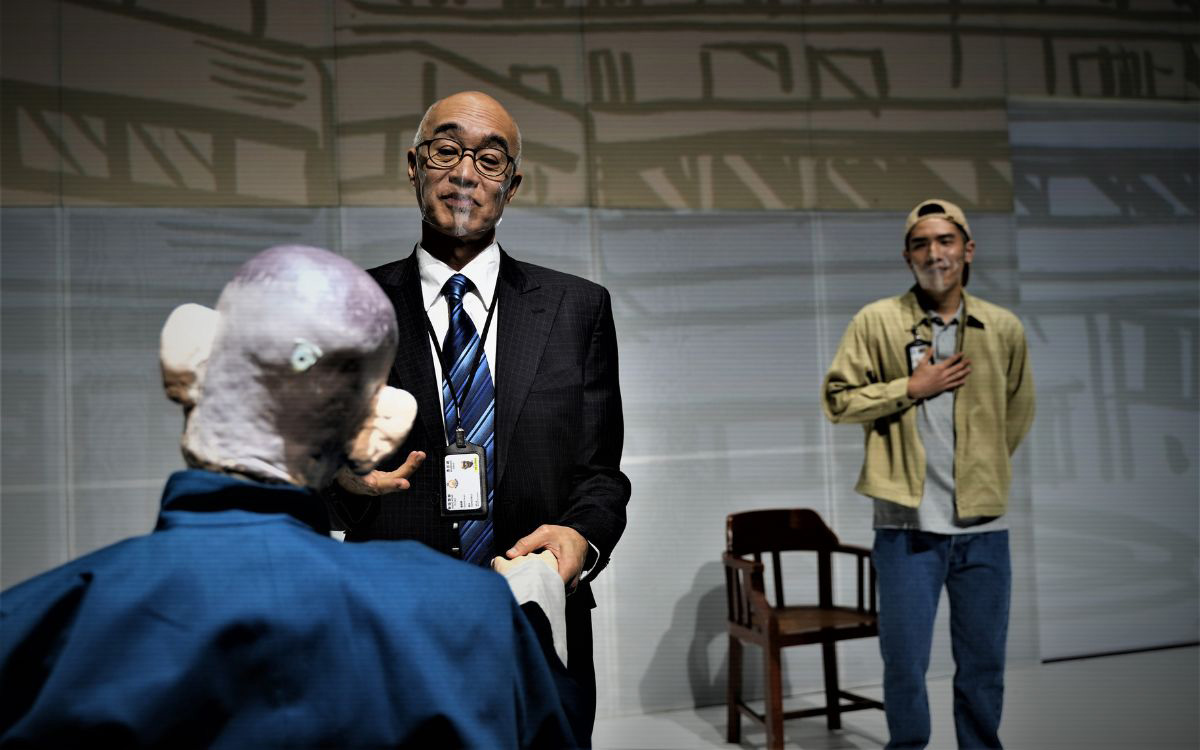
From pop idols to kidnappers, bomb maniacs to a billionaire tycoon, 13·67 promises a host of kaleidoscopic characters that pay tribute to a restless and ever-changing Hong Kong. More than that however, as an experimental theatre company, Mathias has decided to set his sights high, and produce a work that offers a smorgasbord of performance and presentation styles that differs with each era. “I always knew I didn’t want it to just be a conventional drama, because that would be better suited for a 50-episode TV drama,” says Mathias. “Doing a theatre piece means there are time limitations, so we choose to focus on more specific aspects, while also hoping that if they’re interested in more, they can always read the actual novel as well.”
“The company may be known for its experimentation, but we’ve never had a fixed mode as to how we do it. For this show, we do jump about in time and create a more unconventional flow, where the audience does have to think about and work out the logic behind each scene – think of it as giving you a chance to be a detective as well,” he continues. “We’re using forms like illustration, where an entire segment is presented as a comic, while we also have a segment that takes place on a desktop screen, along with immersive audio, some of which features a collage of Cantopop songs that will trigger abstract emotions and push the narrative forward. Theatre remains the most free art form for experimentation, and it still excites me to keep testing and trying what the medium is capable of.”
One of the worries of any production company is alienating the audience, and hearing how Mathias describes the work, we asked if there was any concern about that, and with the audience having to use their brain a little. But Mathias confidently responds and comments on the success of the 2022 premiere in Hong Kong. “We’re not talking about quantum physics here – it just takes a little concentration and mindfulness to work out the flow of the show. It’s much more healthy to exercise the brain instead of simply spoon feeding content, and back in 2022, we had a lot of high school students in the audience who really enjoyed it,” says Mathias. “In the post-show discussions, many of them were very enthusiastic about talking about history and justice, and the role of the police in society and why they’ve become such icons of Hong Kong.”
“Especially considering what’s been happening in Hong Kong for the last five years, so many people have been trying to find a way to better understand the events and logic behind it, rather than jumping to conclusions or stereotypical labels,” he continues. “That is why it’s important to know one’s history, and theatre acts as a space to process all that, along with social issues, and watch things unfolding before us in ‘real time’. We’re also presenting history from a very different perspective – rather than thinking of it as a history of power and who’s in charge, the work instead looks more at tech, and how it’s changed the way people live and process the world around them.”

In the synopsis, one key element that’s been emphasised is the use of pop music across eras and decades in the show, which is set to play an important narrative or atmospheric role. “I think our pop culture isn’t as strong as it used to be, and these days, it’s much more global since everyone’s on TIkTok or YouTube and exposed to a much vaster content pool,” says Mathias. “The new generation has been forced to really think about who they are and their own identity as Hong Kong citizens, especially in terms of culture. Through this show, you really see how much change has happened over the years, from the 60s to to the 90s, each decade having its own specific character.”
“Our role then is to facilitate that thinking of what Hong Kong is, and its uniqueness compared to other cities. When you look at its history, Hong Kong itself is a city of experimentation as we observe how much it changes and constantly reinvents itself,” he adds. “I do compare Hong Kong to Singapore sometimes, where I believe you guys have a very strong conservation and preservation policy, whereas Hong Kong is almost constantly wiping out old areas and shops. Perhaps that is Hong Kong’s unique character – that there is no continuity, and we constantly erase everything before starting anew again.”
On how he feels about the constant change, Mathias expresses nostalgia and some grief, but also acknowledges that it is simply the way things are, and that he has witnessed enough of it to accept it as the norm. “It makes me sad sometimes because I mourn the loss of icons like the beautiful neon signs, or street hawkers. But I also think about how one day, even the great pyramids of Giza will be gone, and I still enjoy how Hong Kong remains an extremely open city, and still very liberal when it comes to ideology and ways of thinking,” says Mathias. “I do hope Hong Kong continues to be an intellectual and creative hub even in an era of technological dominance, and continue to maintain that diversity in thinking we are known for, and continue to create more cultural memory and strengthen ties with other Asian countries.”
“In the new year, I hope that all wars come to a stop as soon as possible, and we should try to enjoy reality more than staring at our phones all the time, and talk to people more in real life too,” he concludes. “I hope we can all breathe better, and enjoy life better, and let go of the stress we’ve been holding onto. I think we need to think more about how we can deprogramme ourselves from ideas of needing to show off superiority or power, but instead to focus on peace, for a more dynamic and constructive future, rather than conflict over wanting to dominate over others.”
13·67 plays from 16th to 17th February 2024 at the Singtel Waterfront Theatre . Tickets available here
Huayi – Chinese Festival of Arts runs from 16th to 25th February 2024 at the Esplanade. Tickets and full programme available here
 Bakchormeeboy