

Love is sometimes about making difficult choices.
Every Singaporean knows about the koel bird – even if you’ve never seen it, you’ve certainly heard it in the wee hours of the morning, crying ‘oo-woo!’ repeatedly at the top of its lungs. But what exactly is it trying to convey in those cries?
From writer Raimi Safari and director Mohd Fared Jainal, the koel is the centre of attention in The Necessary Stage’s new play, aptly titled Oo-Woo. More specifically though, the koel is a pet that remains missing throughout most of the play, and forms a central conflict for its owner. That owner happens to be an elderly Malay woman, Ainah, in the early stages of dementia (Dalifah Shahril), and the missing bird forms a headache for her family – daughter Hanna (Farah Lola), son Haris (Yazid Jalil), and his wife Amellia (Isabella Chiam), each dealing with their own worries as they wrestle between the responsibilities of caring for Mak and their own wants and desires.

Set in their home, Noor Effendy Ibrahim’s set not only reflects the domesticity of the space, but is clearly split into four areas that provide three levels within the house. Each area is given its own flooring and carpet and set of furniture to differentiate them, and demarcate a hierarchy as to who is most important or what issues take precedence within the family conversations. This is clearly seen right from the beginning, as each character goes to their own section of the stage, perhaps representing how torn their family dynamics have become.
As Dalifah takes a seat on the floor, she takes out the quran, and begins praying, while we hear strange gibberish and syncopated noises over the speakers alongside the flapping of birds, a strange alien soundscape created by Safuan Johari. As we see brother and sister with a visiting doctor to check on Mak, she reveals a wry smile at nothing, a tell-tale sign of beginning to lose herself in her own world and child-like speech.
That of course forms a central concern for her family, as brother and sister disagree on how best to care for Mak – to leave her in a home, or to care for her by themselves. Filial piety and personal dreams clash, as it is revealed to us that brother Haris, also Mak’s favourite child, is hiding a secret – that there is now an opportunity for he and his wife to move overseas for work, and should they take it up, will no longer be able to care for Mak. Husband and wife discuss the possibilities, with Haris dead set on leaving.

His wife Amellia however, is rather adamant, and continues to persist in helping Mak, with colourful post-its all over the house to help her recognise the various objects, and one wonders how benign her intentions are, and if she hopes that doing all this nets her some kind of recognition or validation. As we listen to her explain the various colours and markings in Chinatown MRT that help those with dementia navigate, Mak suddenly loses her cool and begins to shout for her missing bird. It’s a terrifying moment where you see how everything seems to be collapsing within her mind, a realisation of all the frustration and fear that comes at her at once.
For Mak, the koel bird then becomes an integral source of comfort, where without it, she becomes completely, totally lost, as she babbles on about how she raised it from a baby, carefully feeding it with a syringe, and watching it grow strong. Such care and concern is reflective of the person she is inside, before the dementia affected her. We realise just how debilitating the loss of a pet can be, and one wonders about how much the bird seems to represent Mak’s inner fears as well of having an empty nest, as her own children grow up and fly away.
Back in reality, the family falls further apart as Mak goes missing, with the sister blaming herself for being distracted while on a Zoom course, oblivious to the world around her. As the siblings begin to panic, we watch as their minds begin to spiral, immediately jumping and escalating to the worst possible conclusions, before Mak is brought back by Amellia.

While Mak rests at home, the siblings finally sit down for that one difficult conversation, on how they can possibly cope with these changes. Haris’ tone softens, his heart opening as he realises the only thing he needs, as he shares his regret about not being home in time on the day dad died. It is a moment where the two siblings are finally in full understanding of each other, as they embrace.
On the other hand, Amellia recalls her own relationship with her family, having been 6 years since she last went to see or even talk to her parents. Isabella Chiam does especially well in this moment to bring out the raw emotions, an unexpected brokenness that emerges as she thinks of all she’s been through, and still recovering from a degree of PTSD as it all comes rushing back to her.

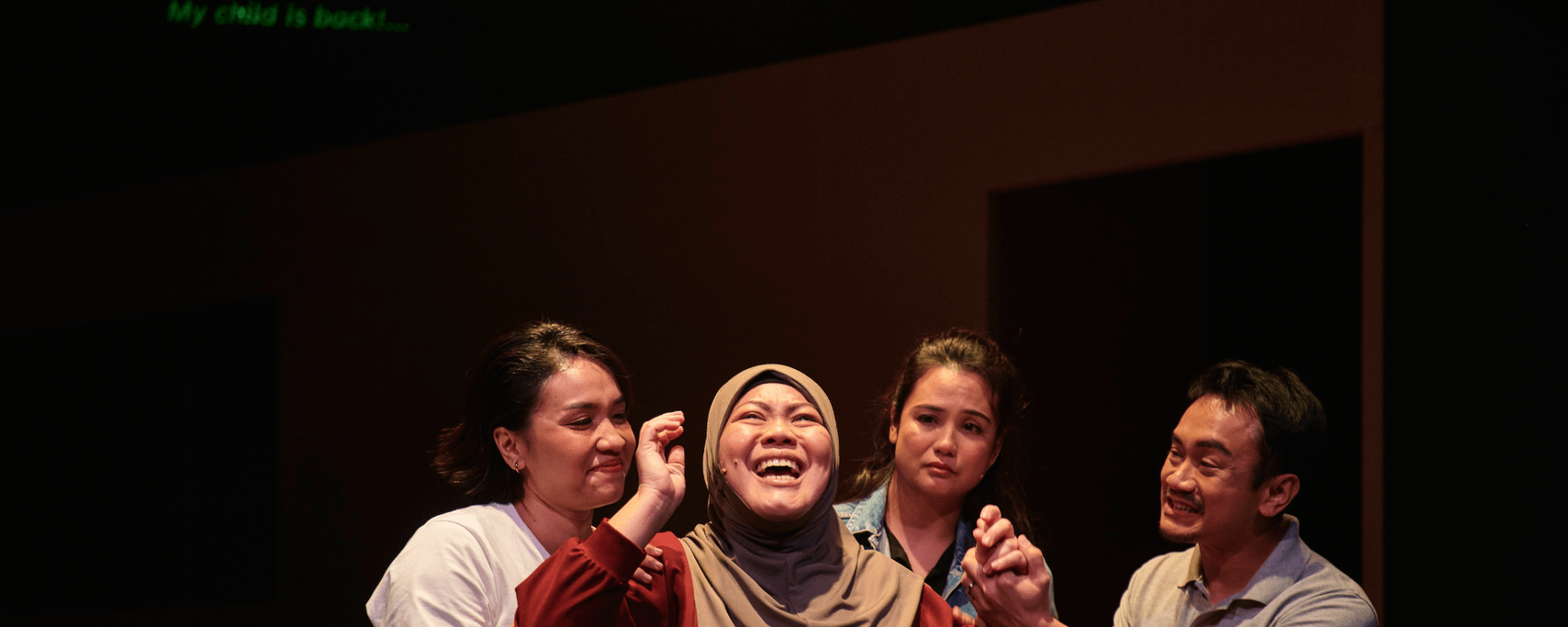
In Oo-Woo, family is everything, and will always find a way amidst the fallouts. In a tearful separation, with Mak telling Haris he is her guardian angel, Haris promises her that he will return one day, while syncopated music begins to play again in the background, a sign that her condition is worsening. One thinks of how to us, it is this noise that alienates her from others, but perhaps, if one tries, we can make sense of it, and still reach out to her before it’s too late. At this point, Mak’s koel suddenly returns, supposedly flying around her, as Dalifah displays a child-like expression, smiling at something so simple as she exclaims ‘my child is back’.
The decision is clearly a hard one, as the family continues to ponder over the consequences of leaving. We hear wings flapping, almost like a reminder of something forgotten. Haris is distraught as Mak begins to speak to herself, and as easy as it seems to forget on the outside, we will always remember on the inside, with the weight of guilt bearing down. Mak addresses her koel directly now, and begins to wonder if any and all of this is her fault, before the final decision over where to send her is made.
That decision is made clearer now as Hanna goes to visit Mak at the home, and she is no longer their number one priority, above all else. At the home, things feel completely different, with the lighting washing out the set and giving the impression of a sanitised space, never lived in. Hanna and Mak begin bonding over old photos, reminiscing over better days, before Mak drifts away and begins to talk to the koel once again. The intention behind such staging is clear, and Dalifah’s delivery is incredibly sincere, her energy and emotion second to none, as she expresses every word in her face and voice. All this showcases director Fared’s understanding of his cast, how well crafted and how well he has led them in bringing out the script’s nuances and subtleties to the audience.

In a final time skip, it’s been six months since that fateful decision, and the siblings have been through hell and back. Raimi does not shy away from bitter reality, Amellia is away in Australia, and Hanna is no longer able to cope, and they must all find a way to mediate, with the help of a very involved case worker. It’s a touchy topic to handle, with everyone high strung and sensitive, especially for a these young adults with their whole life and plenty of opportunities still ahead of them, and impossible to find a compromise to satisfy everyone.
Meanwhile, Mak’s condition is worse than ever before, frustrated with the home’s food and her koel still lost, every family member caged in by obligation and filial piety, and unable to fully move on, each one dealing with their own stresses as the pressure mounts in the room. It feels like an awful thing to have done to prioritise themselves over Mak, yet how can anyone live a full life if they are constantly weighed down as caregivers? A choice has to be made again, but whatever it is, everyone will be deeply and permanently affected.
In the play’s final moments, they enjoy their last moments as a complete family, eating their favourite Jollibee at the table, as we hear the syncopations again. We may not understand exactly what she’s going through, but these issues are very real, as Mak reminisces over her koel, convinced he will somehow come back. With an innocent, child-like look on her face, completely lost in the belief that things will get better, as they all stare blankly, unable to fully process the gravity of it all. Oo-woo isn’t just a wake-up call, it’s a cry for help from caregivers and family members finding themselves paralysed by guilt, affectingly and achingly brought to the stage, as we wonder how many families in Singapore are suffering in silence, as this one has.
Photo Credit: Tuckys Photography
Oo-Woo played from 24th to 28th January 2024 at the Esplanade Theatre Studio. More information available here
M1 Singapore Fringe Festival 2024 ran from 17th to 28th January 2024 across various venues. Full line-up available here.
Production Credits:
| Director: Mohd Fared Jainal Playwright: Raimi Safari Cast: Dalifah Shahril, Farah Lola, Isabella Chiam, Yazid Jalil Dramaturg: Haresh Sharma Set Designer: Noor Effendy Ibrahim Sound Designer: Safuan Johari Hair Stylist: Ashley Lim Make-Up Artist: The Make Up Room Production Manager: Celestine Wong Stage Manager: Ang Cheng Yan Assistant Stage Manager: Geralyn Toh Lighting Coordinator: Huang Xiangbin Captioner: Courtney Mae Lim Costume Coordinator and Props Manager: Jasmine Khaliesah Project Manager: Natasha Fathin |
 Bakchormeeboy
One thought on “★★★★★ Review: Oo-Woo by The Necessary Stage”