

Stunning revival shines spotlight on the difficulty of caregiving.
It is the natural tendency of every parent to shower their own child with unconditional love. But there are times that love is tested and pushed to its limits, when faced with nigh impossible circumstances facing a family. One example might be bringing up a child on the autism spectrum, often requiring additional care, attention and energy, with certain children’s needs so specific that it creates dependency and fuels exhaustion. For any family going through that, it’s an uphill task, and it takes a monumental amount of love to press on and keep trying.
In Deanna Jent’s Falling, audience members get a glimpse into the life of one such family dealing with this on a daily basis. Last staged in 2016 to critical acclaim, Pangdemonium has revived Falling this March to kick off their 2024 season, and brings back actor Andrew Marko in the lead role of Joshua, an autistic 18-year old. Directed by Tracie Pang, Andrew is joined by new cast members Karen Tan playing mother Tami; Dwayne Lau, playing father Bill; Rebecca Ashley Dass, playing older sister Lisa; all of whom have built a life around Josh, placing his needs and happiness above their own. In its opening, we see the family headbanging to Evanescence’s ‘Bring Me To Life’ – beyond the significance of the album’s title (‘Fallen’), the lyrics and performance seem to imply a family that’s close, yet each one nursing their own inner angst over their circumstances.
Right from the beginning of the play, the family’s version of normal is established onstage, where we become privy to the family’s carefully constructed system and routine to ensure Josh’s happiness. We watch as Josh enters the living room with ear protectors, immediately indicating his high sensitivity to loud or sudden noises. He plays with a box of feathers – a favourite daily activity of his, before Tami returns home and asks Josh to pick them up, which he does so reluctantly. Breakfast is served up by Bill, but when Lisa is about to make a smoothie in the blender, Tami quickly goes over to Josh, getting him to cover his ears and patiently going through a simple game to distract him from the whirring blades. Even the simple task of getting Josh to board the school bus, from encouraging him to get ready with the promise of a marble as reward, to helping him put on a ‘safety vest’ for comfort and security, to protect him from the outside world. There is a tiredness that seems to follow Bill and Tami – one notices how both parents are dressed in dour, comfortable and baggy clothing, unlikely to ever leave the house for leisure, with caring for Josh being a full time job.

Eucien Chia’s set is intricate in its attention to detail, recreating an HDB apartment and all its furnishings. It feels like a well-kept but lived in space, with comfy couches, family photos on the wall, a calendar filled with little notes and reminders, a working cabinet that holds alcohol and other paraphernalia, and shoe racks by the front door. Even the kitchen, a separate room only partially shown through a large window, contains shelving, wooden cupboards and other elements that allow us to believe in the realism of the entire set. Yet there are also more interpretive aspects to it as well – for one thing, the edges of the set are irregular, perhaps symbolising the irregularity of the family living there. The entire set feels like a section of a tree trunk, suggesting this is just one of many families like this that exist out there. We even catch a glimpse of the unit above, mostly in darkness, yet also fully furnished with paintings, a couch and doors, hinting at how separately we all live as neighbours, none the wiser to the sheer difference in lifestyles and situations of the people living right beneath us. The paintings in particular showcase jellyfish – soft and gentle, but dangerous when provoked, referencing Josh himself. There is so much effort taken to design the set and suggest the world beyond the family’s home, contributing to powerful worldbuilding and atmosphere.
While it seems that the family has developed a stable form of existence, that calm is disrupted when grandma Sue (Lok Meng Chue) flies in from Australia to see them, herself unused to all these rules and systems developed for Josh’s sake. As the couple prepare for her arrival, there is a moment of levity and lightness, as they prepare to brief Sue on ‘codewords’ to use in case of an emergency, and Bill takes out a massive Jesus calendar to hang up, forewarning of Sue’s Christian devotion – the two even place a bet on when Sue will be proselytising with a Bible verse. As Sue, Lok Meng Chue sweeps into the house with gusto and a DFS Perth plastic shopping bag full of gifts – a bottle of whiskey for Bill, and Tim Tam biscuits for Lisa. Her interaction with Josh however, is more uncomfortable, with her memory of him hazy and not realising how serious his condition is. There is an awkward moment where she coaxes him to come over to give her a hug, to which Josh remains firmly in his own world, never acknowledging her. Even after she initiates the hug and hands him her gift – a train jigsaw puzzle, he nonchalantly slams it on the floor, before opening it up and hurling the pieces into the air, much to Sue’s bewilderment.

Sue is prompted to ready a phrase from the Bible to encourage the family, but is clearly not prepared for Josh at all, accidentally dropping her cane and startling Josh. When he finally calms down, Josh is offered time to watch television instead, and to Sue’s horror, Josh begins to touch himself, with her cries to stop falling on deaf ears. The family explains this quirk – Josh enjoys seeing diaper ads so much, they even call it ‘Josh porn’, leaving Sue aghast and exclaiming how unnatural it all is. All Tami can say is that one has to take things in their stride and laugh, or risk being stuck, while Sue can only counter that the family needs to trust God.
More disturbing still is how Sue discovers Josh’s violent tendencies, when he tells Tami his DVD is broken. Flustered and frustrated, he grabs Tami’s hair and doesn’t let go, as Sue looks on, horrified. Director Tracie Pang has done a very good job of directing this sequence – it takes a lot of care in a fight scene to ensure no one gets hurt, and both Andrew and Karen do a fantastic job of making us feel fear for Josh and Tami. You see both the pain and fear in Karen’s eyes, as she fully embodies the role of Tami, taking on the burden of responsibility herself, always subjecting herself to Josh’s outbursts when triggered, to the point she is visibly shaken and hurt by him, before Bill intervenes. It is a high tension scene, and we see the family taking pause to decompress in their own ways, with Sue clutching the Bible tight, while through the kitchen windows, we see Tami downing a glass of Shiraz to calm her nerves.

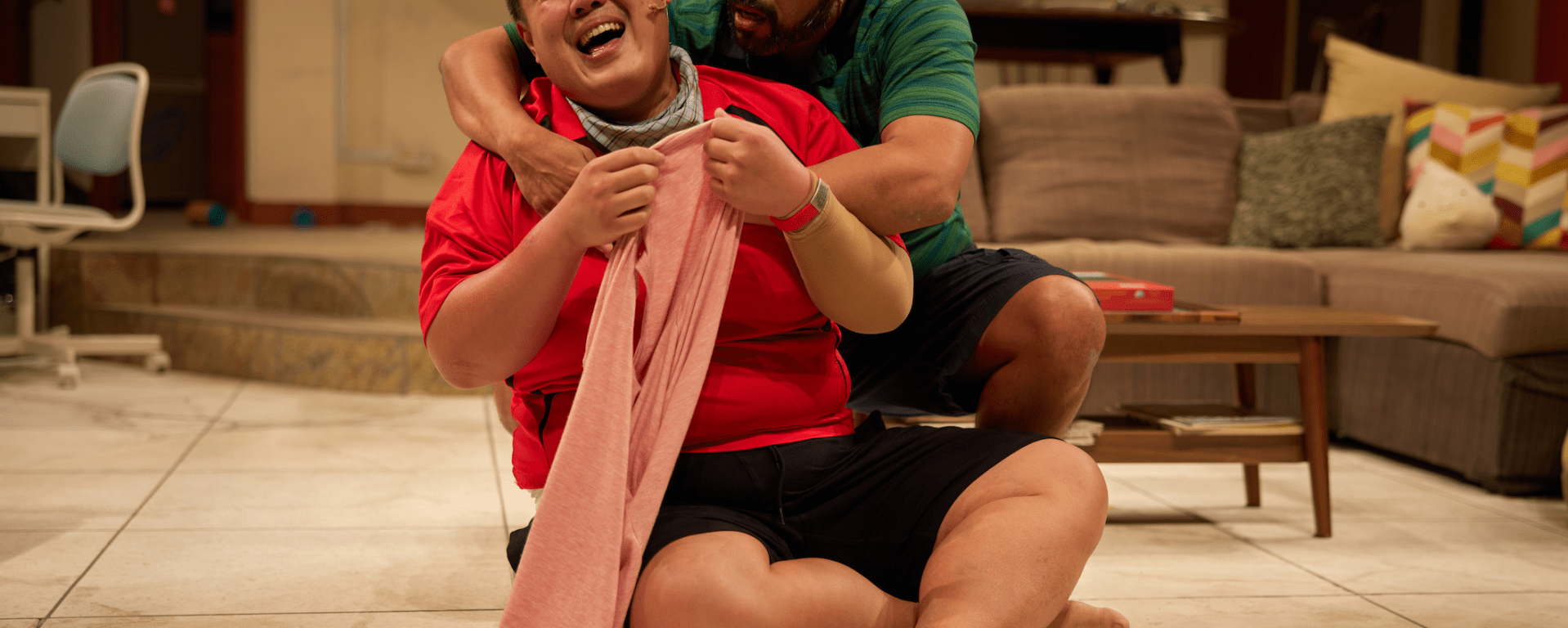
To most of us, this would be an incredibly disturbing scene, but no one seems to be willing to say anything except for Lisa. Josh’s existence ensures that her own wants are placed on the backburner – where she firmly feels the weight of the rule that only when Josh is happy, everyone is happy. As much as you want to chide her for being so negative, Lisa’s feelings of frustration are justified again at dinnertime, as Josh is triggered again by a dog barking outside the house, and begins to act out. Tami activates the emergency codeword, while Sue is ushered into the kitchen for safety. With frustration building, Josh takes it all out on Tami, startling Sue in the process when she wanders back in, before focusing all his attention on Tami again, ripping off her shirt and hurting her, before Bill manages to break it up just in time. As Josh plonks himself onto the floor and begins to cry and Tami reaches for another drink, trying to steady herself. As much as there are pains, this is a family that understands each other, and always willing to forgive, and even after the ordeal, Josh tries to calm himself and asks for popcorn, prompting a smile from Tami.
The cycle of violence prompts Lisa to finally voice out wanting to escape, asking Tami about whether it’s possible to go live with Sue, be it in Perth or even if Sue gets a house in Singapore. Her resentment over how Josh treats Tami growing, Lisa even proposes to lock Josh up, that she wanted to call the police when she saw how much pain Tami was in. There is nothing she can do, as all Tami says is that while Lisa is free to hate him, mothers don’t have a choice, leading to Lisa realising how futile all her words are. Understanding dawns on Sue, as she wonders if there are alternatives for keeping both Josh and the family safe, even suggesting prayer that God will release him from his autism. While Bill gets angry at her proselytising, Tami surprisingly agrees that sometimes, all one can do is pray. As difficult as it gets, the couple are still there for one another to get through this situation, even with them sent into their own spirals of guilt and pain, whether it’s Tami’s penchant for alcohol or Bill’s helplessness – unable to fully connect with each other, and with even intimacy off the table, considering how sex produced Josh to begin with.

Falling is buoyed by its two leads, with Andrew Marko embodying Josh and bringing out a full range of emotions despite his limited lines. Physically, Andrew is incredibly imposing, in both height and size, dwarfing the other actors onstage and feeling like a legitimate threat if angered. At the same time, Andrew is more than capable of bringing out Josh’s innocence and child-like state, where we never blame him for his actions, only pity the family affected. Andrew captures every one of Josh’s facial expressions, wearing them all clearly on his face, and one cannot help but marvel at how much he commits to the role, right down to his movements and voice. As for Karen Tan, stepping into the role of Tami, you see her face able to shift between perplexed and calm, a perseverance and fire within her refusing to give up against all odds. You see her exhaustion when she leans against the kitchen counter with a glass of wine in hand, and panic when Josh grabs her hair – this is a role that demands immense strength and understanding, and to that end, Karen has succeeded at it.
But what if Josh really did go away? How would the family’s life change? In a flurry of activity, from an emergency ambulance to a wake, to a heartbreaking eulogy, that possibility is explored thoroughly in the play’s denouement. For one, the house would feel strangely empty without him. The family is distraught, quiet, and at a loss as to what to say most of the time, a deafening silence filling the stage, freed from their cycles and responsibilities at last. Compared to the beginning of the play, the blender is free to be used without fear of triggering anybody, while the jigsaw puzzle lies unfinished, as they wonder if they should complete it to hang somewhere. Yet for once, there is a sense of calm in the household, and Lisa begins to laugh hysterically at how they’re finally free, jumping up and celebrating, and even Bill and Tami are overcome by this sudden release and joy, dancing along.

It’s a disturbing scene for sure, but after witnessing all that happens in a single day, it’s hard not to understand how desperately the family wants to escape from the burden of care, and how much stress it brings them. Whether dream or nightmare, when Tami awakens, she is overcome by guilt at how she would even imagine Josh gone from their lives, and how a mother could even entertain the thought of enjoying a child’s death. No mother wants to see their own child suffer, and as much as she considers alternate realities, there is only one that she lives in, and she becomes more determined than ever to keep Josh by her side, even if it means more trouble, more hardship, and more pain.
Her decision is clear when Josh comes out of the room, and she holds him tight and refuses to let go as she realises how much she loves him, still choosing Josh forever. With a smile on her face, Tami stands on the couch, slouches down, says ‘catch me’, and falls back, while feathers begin to float down from above. Josh tries to catch them, all while displaying an eternal child-like grin on his face, and in that moment, you understand just how unique and precious a life is, regardless of their mental condition. There is no easy happy ending for Falling, but in watching it, you develop a respect and sympathy for caregivers, striking with its unabashed boldness in displaying the pain that comes with love, and ultimately, moves you with its sincerity and realness, and the bravery it takes to persevere.
Photo Credits: CRISPI
Falling plays from 8th to 24th March 2024 at the Singtel Waterfront Theatre. Tickets available from SISTIC
Production Credits:
| Director Tracie Pang Assistant Director Timothy Koh Playwright Deanna Jent Cast Andrew Marko, Karen Tan, Dwayne Lau, Lok Meng Chue, Rebecca Ashley Dass Set Designer Eucien Chia Associate Set Designer Grace Lin Lighting Designer James Tan Sound Designer & Composer Jing Ng |
 Bakchormeeboy
2 thoughts on “★★★★★ Review: Falling by Pangdemonium!”