
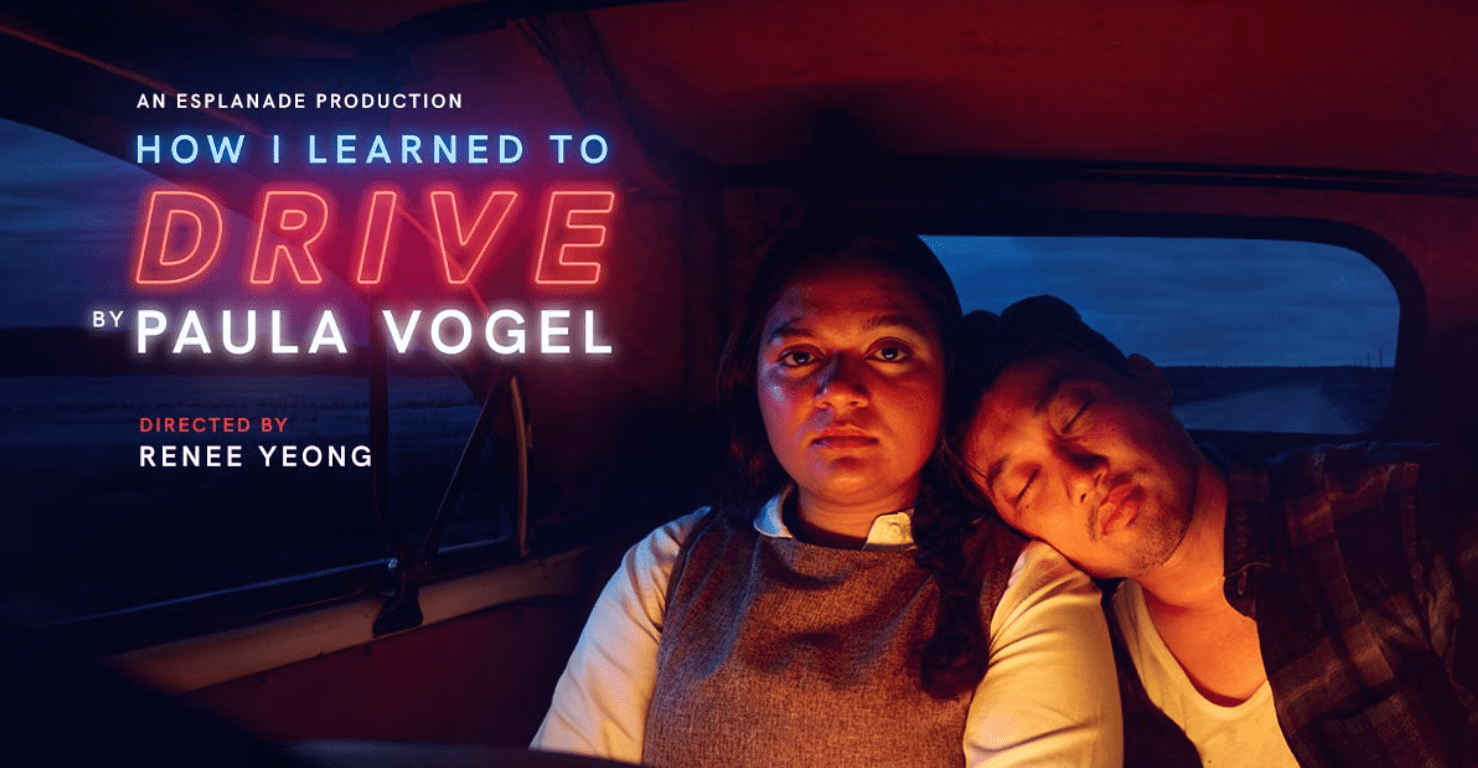
Renee Yeong is a bit of a superwoman. Maintaining a full-time job against her theatrical pursuits, the young theatremaker has just come off directing a successful production of George Brant’s Grounded for Singapore Theatre Company, and is ready to present another production less than a month after closing, with Paula Vogel’s How I Learned To Drive.
Marking her second and ‘graduating’ production for the Esplanade’s TRIP programme to provide early career directors a platform to showcase their work, How I Learned To Drive is a Pulitzer Prize-winning play that deals with the heavy topic of child sexual abuse, where a woman recalls her childhood in rural America with a dysfunctional family, finding solace in her Uncle Peck who encourages her to pursue her dreams. Only, perhaps Uncle Peck himself isn’t as sweet as he seems.

Now, at age 30, Li’l Bit (Masturah Oli) is finally ready to heal—in order to do that, she must revisit some of the key moments in her adolescence that have shaped and changed her, for better and for worse. These moments involve not just Uncle Peck (Andrew Lua), but also the people around her: schoolmates who bullied and sexualised her for her larger-than-average chest, her aunt, who blamed Li’l Bit for stealing her husband, and the waiter who stood by as Uncle Peck manipulated Li’l Bit to drink while underage, all played by a Greek chorus of three (Vester Ng, Tan Rui Shan, and Arielle Jasmine Van Zuijlen). It’s not all doom and gloom, and Renee shares about how she finds balance in this difficult subject, and in her own life as well.
“I’ve always wanted to do this show since I was in school, and while it was quite daunting, both in terms of the touchy subject matter and how I’m used to directing smaller casts, I decided to take the plunge because TRIP is all about trying new things, experimenting with my own style and growing from the experience,” says Renee. “I was drawn to how bold the writing was, already giving you the creeps from the very first scene, and it just filled me with so much disgust and made me so uncomfortable. Beyond the subject, I understood how she could fall into this, and how she could let him do this, and it really doesn’t pull any punches when it comes to the manipulation and grooming, in all its complexity.”

On the relatability of the piece and draw for general audiences, Renee talks about how prevalent the issue actually is in Singapore. “Everyone’s going to come into this show with a different background, and I don’t expect every single person to immediately resonate with it. We’re not going to lean too hard into the ‘Americana’ elements of it, and neither are we forcing any accents, leaving the actors to what was most natural for them, so it wouldn’t be distracting and they wouldn’t be letting the accent determine their performance,” says Renee. “I do think that the survivor-abuser relationship is immediately recognisable to people though, and to the people I’ve spoken to, even in Singapore, grooming can be so pervasive, where you might remember a creepy adult in school or a relative growing up. My goal is to bring Vogel’s portrayal of this complex relationship to life onstage, and to make people realise its presence even in somewhere like Singapore.”
“One thing I’ve learnt is that you really do need a lot of time, whether it’s to start the rehearsal process early, get the blocking down, or even ensure there’s some breathing room for actors in between so they can really take the time to settle into the show, and I was lucky that I had more time to do How I Learned to Drive, especially with five cast members onboard,” she adds. “Most of that comes from just honouring Vogel’s words as they are and the story, which already provides a firm backbone for us to work with.”

On the casting choice of her leads, Renee considered the inherent energy of both Andrew Lua and Masturah Oli, and how they would both embody their respective characters. “I’d always imagined Masturah in the role of Li’l Bit. Survivors of trauma often have an accelerated maturity to them, and Masturah brings that energy of someone who’s all grown up, but still holds an innocent, child-like quality within as well, to show this character as someone who’s been through so much, yet still chooses to revisit these painful memories and face up to them, and begin healing,” says Renee. “But it’s not all horrifying – there’s a lot of comedy and farce and ridiculousness that you wouldn’t expect from a play that’s about trauma, and Li’l Bit is all about finding joy and love despite all that.”
“Meanwhile, I chose Andrew Lua to play Uncle Peck because he looks like a ‘nice neighbour’, which is precisely the kind of person you read about in anecdotes – where you cannot tell if they are abusers or not,” continues Renee. “There was an account I was watching about an American prison guard who was used to managing violent criminals, and when she got reassigned to sex offenders, she was surprised by how nice and polite and respectful they were to her. These are men you see walking down the street, and Andrew is so charming and friendly and sweet, that it makes the message to not take someone for granted just because they look a certain way even more powerful. The thing is, I don’t think Uncle Peck even knows what he’s doing is wrong, considering how this was set in the 60s and 70s, where it was legal for girls to be married at age 14. And that’s why he’s not an ‘evil’ character – he genuinely is grooming because he doesn’t think it’s wrong at all, which makes it all the more terrifying.”

With this production marking a ‘graduation’ of a sorts, Renee reflects on where she is in her career as a theatremaker. “At this stage, it still feels like I’m coming into my own as a theatremaker and director, but also still somewhat emerging. These are all labels, and maybe I’m still somewhere in between,” says Renee. “I do get the chance to connect with more people now, and it’s been more comfortable working here and connect with the scene, be it with the designers or actors, and if it’s one thing I’ve really enjoyed, it’s befriending other directors, because this can be such a solitary role. In this community, I’m glad theres enough space for young people to do all kinds of things now, and while I’m still finding my way, but I’m excited for what lies ahead.”
“While I don’t have anything booked for my next project, I’ve done plenty of one-women shows, and I do think I’d love to try my hands at directing a musical, maybe within the next two years. I’d love to lean more into an opportunity that lets me show off a more fun and imaginative side to myself, and add that to my wheelhouse,” she adds.

Given the general difficulty of being a full-time artist in Singapore, Renee admits that she is not yet ready to take that plunge, and possibly, not anytime soon. “I wouldn’t recommend juggling a full-time job with theatre – not every full-time job can allow for it, but I managed to plan it in a way where I was mostly able to cope, taking leave for tech runs, and clearly demarcating time to direct Grounded and How I Learned To Drive,” says Renee. “You really have to carve our your own space, and be able to separate both your corporate life from your artist life. I’m both grateful to be holding down this job, while wishing I had a way to do more of the arts, but I’ve learnt to make peace with that, especially during the pandemic, where I realised it would be impossible to save in a big way financially while doing this thing I love, as much as I’m fighting to do both.”
“It’s not impossible of course, but you have to know where your own priorities lie and be very clear what you want to do. I know that for myself, I do want to hold on to both having a stable family life, even have a kid at some point, while still pursuing theatre, and to do that, I’ll need to find some kind of balance, instead of giving up one or the other,” she adds. “So I learnt that I have to ultimately advocate for myself, fight tooth and nail for that, and for now at least, I’ve done a relatively good job of it, and I’d say one strength I’ve found in myself is the ability to make room for these things and make it work.”

As for what she hopes audience members will take away, Renee simply hopes that they recognise how she’s willing to push herself out of her comfort zone, and how she continues to grow with each production. “I hope that people walk out of the theatre and say that ‘wow, Renee really went there’, not necessarily in a good or bad way, just to recognise that I took a risk, and wasn’t afraid to tell this story and showcase this subject matter,” Renee concludes. “I want to show the love, the joy and the healing aspects, but to get there, you have to get through all the pain and agony and darkness first, simply because we as humans don’t recognise good things until we go through the bad.”
“I won’t be pulling any punches, but I’ll also take care of the audience, so when we do get to the ‘good’ parts, we learn to move on, and learn from it, and it feels earned. This is the perfect time to take a risk like this, to deal with a serious topic that also allows the funny and joy to come through in parts, and I’m so grateful to have had the chance to do this, and see what I’m going to do.”
Photo Credit: Esplanade – Theatres on the Bay
How I Learned To Drive plays from 19th to 21st April 2024, at the Esplanade Theatre Studio. Tickets available here Find out more about TRIP here
 Bakchormeeboy